

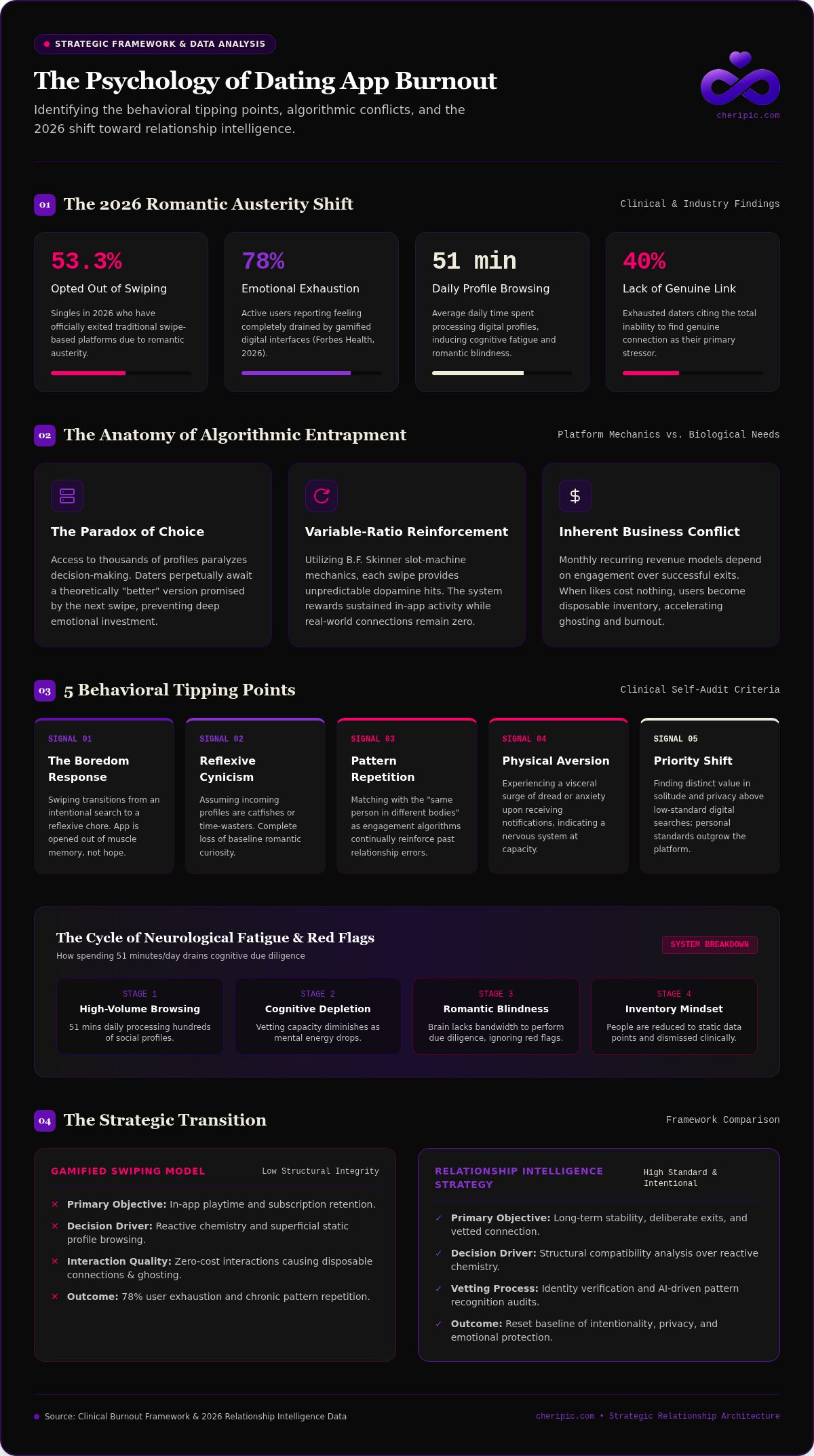
In 2026, a staggering 53.3% of singles have officially opted out of traditional swipe-based platforms, citing a state of romantic austerity that no longer serves their well-being. You likely feel the weight of this shift every time you open an app only to face unverified profiles or matches that lead nowhere. It's exhausting to spend nearly an hour every day on a digital interface that prioritizes algorithmic playtime over real-world connection. If you are questioning when to give up on dating apps, you aren't failing; you're experiencing a rational response to a system designed for engagement rather than exits.
This guide provides a strategic framework to help you identify your psychological tipping point and transition toward a high-standard relationship intelligence strategy. We will analyze the data behind app burnout, examine the inherent conflicts of interest in current platforms, and introduce a methodical approach to verifying compatibility before you invest your emotional energy. You'll learn to move from passive browsing to a deliberate process of assessment, regaining control over your romantic future through logic, vision, and structural integrity.
Key Takeaways
- Identify the psychological markers of dating app burnout to understand why the paradox of choice leads to chronic emotional exhaustion.
- Recognize the five behavioral signals, such as the boredom response and reflexive cynicism, that indicate exactly when to give up on dating apps.
- Learn to distinguish between reactive chemistry and structural compatibility to ensure your romantic investments align with long-term stability.
- Implement a strategic detox protocol using AI-driven pattern recognition to audit past mistakes and reset your baseline for intentional connection.
- Transition from gamified swiping to a verified relationship intelligence strategy that prioritizes identity verification and deep compatibility assessments.
The Psychology of Dating App Burnout: Why Swiping Feels Like a Dead End
Dating app burnout is not merely a temporary mood; it's a clinical state of emotional and mental exhaustion. According to 2026 data from Forbes Health, 78% of active users report feeling drained by the process. This fatigue stems from a misalignment between human biological needs and digital architecture. Determining when to give up on dating apps requires an objective assessment of your internal state. If you find that swiping has become a reflexive chore rather than a hopeful pursuit, your nervous system is likely reaching its capacity for gamified connection.
The "Paradox of Choice" plays a central role in this psychological decline. While having access to thousands of profiles suggests a higher probability of success, the opposite is true. An abundance of options paralyzes decision-making and reduces overall relationship satisfaction. You're no longer choosing a partner; you're perpetually waiting for a "better" version that the algorithm promises is just one more swipe away. This creates a state of chronic indecision that prevents deep emotional investment.
Modern mobile dating applications utilize variable-ratio reinforcement, a mechanic borrowed from B.F. Skinner’s research on slot machines. Every swipe provides a small dopamine hit, creating a loop that rewards engagement rather than results. You feel like you're making progress because you're "active," yet your real-world connection count remains at zero. This digital treadmill replaces intentional intelligence with a low-stakes habit that offers no structural integrity for long-term success.
The Architecture of the Swipe Loop
Traditional platforms prioritize engagement metrics over successful outcomes because their business models rely on monthly recurring revenue. If you find a partner and delete the app, the platform loses a subscriber. This inherent conflict of interest fosters an environment of low-stakes interaction. When the cost of a "like" is nearly zero, human empathy erodes. People begin to treat connections as disposable assets, leading to a culture of ghosting and breadcrumbing that further accelerates burnout.
Neurological Fatigue and Romantic Blindness
The human brain is not designed to process high-volume social data at the speed digital platforms demand. Spending an average of 51 minutes per day browsing profiles leads to a phenomenon known as romantic blindness. When you're fatigued, your ability to vet matches diminishes. This state of exhaustion is often why I ignore red flags, as the brain lacks the cognitive energy to perform due diligence. Instead of seeing complex human beings, you begin to see "profiles"-static data points that you dismiss or accept with clinical detachment. This shift marks the transition from seeking connection to simply managing a digital inventory.
Identifying the Tipping Point: 5 Signs It’s Time to Give Up on Traditional Apps
Deciding when to give up on dating apps requires a clinical assessment of your emotional state. It's not a surrender; it's an act of due diligence for your mental health. According to a recent dating app burnout survey, 40% of exhausted daters cite the inability to find a genuine connection as their primary stressor. When the tool intended to foster connection becomes the primary source of isolation, the strategy is no longer viable. Recognition of these five behavioral signals is essential for protecting your romantic future.
- The Boredom Response: Swiping has moved from an intentional search to a reflexive chore. You open the app out of habit, not hope.
- High Cynicism: You assume every profile is a "catfish" or a "time-waster." You've lost the capacity for curiosity.
- Pattern Repetition: You find yourself matching with the "same person in different bodies." This indicates the algorithm is reinforcing your past mistakes.
- Physical Aversion: You feel a surge of anxiety or dread when a notification appears. Your body is signaling that the environment is no longer safe.
- Priority Shift: You find more value in solitude and privacy than in the "hunt" for a date. Your standards have evolved beyond what the platform provides.
The Audit: Assessing Your Emotional Readiness
A bad week is temporary, but a bad strategy is structural. To evaluate your current situation, calculate your Return on Investment (ROI). If you spend five hours a week swiping and receive zero quality interactions, your strategy is failing. Before attempting a different approach, it's vital to perform an internal assessment. Using a relationship readiness quiz can help you determine if you're operating from a place of clarity or simply reacting to loneliness.
The Cost of Staying Too Long
Remaining in a toxic digital environment devalues your personal brand. Understanding when to give up on dating apps is essential for preserving your capacity for future intimacy. Every unverified interaction and low-quality match erodes your self-esteem, making you more susceptible to "dating jadedness." This cynicism is a form of romantic blindness that can sabotage future healthy connections. Protecting your emotional energy is a prerequisite for success. If you're ready to move beyond these cycles, consider exploring a verified relationship intelligence platform that prioritizes maturity over volume. Staying too long on ineffective platforms only reinforces the belief that quality partners don't exist.
Chemistry vs. Functional Compatibility: The Great Dating App Failure
The fundamental failure of modern apps isn't just about volume; it's about the metrics they use to measure success. Most platforms conflate chemistry with compatibility. Chemistry is biological and reactive. It’s the spark that feels like progress but often lacks structural integrity. Compatibility, however, is intentional and structural. It's the alignment of core values and lifestyle goals. If you're wondering when to give up on dating apps, it's often at the moment you realize the platform is matching you based on hobbies rather than character.
Pew Research Center findings on online dating indicate a growing skepticism regarding algorithmic matchmaking. These systems rely on interest tags, which are superficial data points like a shared love for travel or specific cuisines. These metrics fail to predict relationship success because they don't account for value alignment. A shared interest in hiking doesn't mean a shared vision for financial management or family structures. It's an illusion of compatibility that keeps you in a cycle of low-quality matches.
High-standard dating requires a pivot toward relationship intelligence. Instead of relying on a swipe, a professional relationship compatibility assessment shifts the selection process toward due diligence. This ensures that you're evaluating a partner's long-term viability before you invest emotional capital. It's a strategic investment in your future rather than a gamble on luck.
The Chemistry Trap: Why Your Brain Lies to You
Chemistry often triggers a state of limerence, which is a biological high that typically fades within 90 days. It's a reactive state that can mask anxious attachment or familiar toxic patterns. Many users mistake this spark for a soulmate connection. You must move from the reactive question-"Do they like me?"-to the analytical one: "Are they functional for my life?" If the answer is no, no amount of chemistry can save the connection. Recognizing when to give up on dating apps involves acknowledging that a spark without functionality is a dead end.
The Functional Framework for 2026
In a landscape of unverified profiles and low-quality matches, intentionality is the highest value currency. Relationship intelligence involves vetting for emotional maturity and identity verification. It requires a shared long-term vision that goes beyond a Friday night date. When you prioritize structural compatibility over fleeting excitement, you're not just dating; you're architecting a future. This methodical approach ensures that your time and emotional energy are shared only with those who have passed the necessary verification steps.
The Detox Protocol: A Strategic Transition to Intentional Connection
Determining when to give up on dating apps is a prerequisite for romantic recovery. However, simply deleting an icon from your phone screen is insufficient. A strategic transition requires a structured protocol that moves you from reactive swiping to intentional intelligence. This isn't a period of passive waiting. It's an active phase of structural realignment designed to protect your emotional assets and reset your standards for connection.
- The Hard Reset: Purge your device of unverified platforms that facilitate low-stakes, anonymous interactions. Clear the digital clutter to make room for high-value focus.
- The Pattern Audit: Use AI coaching tools to objectively analyze past relationship cycles. Identify the specific triggers that led to previous failures before attempting new connections.
- Identity Verification: Establish a non-negotiable standard. Commit to only interacting with individuals who have undergone rigorous identity and profile verification.
- The Experience Shift: Reallocate the average 51 minutes spent daily on apps toward curated real-world events. Physical presence is the most efficient filter for chemistry and character.
- Strategic Guidance: Adopt a relationship coach app to act as a clarity coach, ensuring you don't default to old habits during the transition.
Performing Relationship Due Diligence
Once you've decided when to give up on dating apps, you must apply professional standards to your personal life. Implement the "First 90 Days" rule, which prioritizes the assessment of character over fleeting charisma. This period is for observation, not deep emotional investment. Use this time to ask high-value questions that reveal core values early. If a prospect cannot articulate their long-term vision or demonstrate emotional maturity, they do not meet the criteria for further investment. This methodical vetting process eliminates time-wasters and preserves your psychological safety.
Curating Your Social Environment
Move away from "open access" dating where anyone with a smartphone can reach you. High-value partners are rarely found in chaotic, unverified digital spaces. Instead, curate your environment by participating in exclusive, verified circles. Luxury networking events, wellness retreats, and niche social clubs provide a natural layer of verification. These real-world experiences act as the ultimate vetting tool, allowing you to observe body language, social intelligence, and value alignment in real time. To begin your transition toward a more sophisticated standard, apply for the CheriPic Early Access Membership and reclaim control over your romantic future.
Beyond the Delete Button: Graduating to Relationship Intelligence
The act of deleting an app is a powerful gesture, but it's not a complete strategy. Once you've determined when to give up on dating apps, you must replace the chaotic swipe-loop with a more sophisticated architecture. The 2026 landscape demands a transition to a Relationship Intelligence Platform. This shift isn't just about finding a new interface; it's about adopting a new philosophy that prioritizes psychological safety and long-term structural integrity over fleeting digital matches.
Traditional platforms thrive on anonymity and volume. This creates a trust gap that fosters anxiety and burnout. Graduating to a dating app with identity verification is the first step in closing that gap. By ensuring every individual is who they claim to be, you eliminate the cognitive load of constant suspicion. You move from a quantity-based search to a quality-based assessment where every interaction is backed by intelligence rather than just luck. The decision of when to give up on dating apps marks the beginning of a more rigorous selection process that treats your emotional energy as a valuable asset.
The Role of CheriAI in Your Romantic Strategy
CheriAI serves as your personalized Clarity Coach. It provides a stabilizing force in an emotional landscape that is often prone to reactive decision-making. By utilizing advanced pattern recognition, CheriAI helps you identify recurring red flags in your interactions before they evolve into destructive dealbreakers. It offers a reflective perspective that encourages you to pause and evaluate whether a connection aligns with your stated long-term goals. This isn't a passive tool; it's an analytical partner that ensures your romantic investments are based on logic and self-awareness.
Joining the Strategic Standard
High-value singles are increasingly opting out of the mass-market digital conveyor belt. They are moving toward premium experiences designed for the few who prioritize intentionality and growth. This community isn't built on the frantic energy of social platforms. It's built on a shared commitment to maturity and verification. When you join this strategic standard, you're no longer a user in an engagement-driven algorithm; you're a participant in a curated environment of mutual respect and shared vision. Each connection is an opportunity for authentic discovery rather than a gamble on a curated profile.
If you're ready to leave the exhaustion of the swipe-loop behind, it's time to invest in your romantic intelligence. Apply for CheriPic Early Access today and begin architecting a future based on clarity, safety, and uncompromising quality.
Reclaiming Your Romantic Agency
The decision of when to give up on dating apps is the first step in architecting a future based on clarity rather than luck. You've learned that the burnout you feel is a rational response to a system designed for engagement rather than results. By shifting your focus toward functional compatibility and structural integrity, you move from a state of emotional exhaustion to one of strategic power. Success in 2026 requires a transition from the chaotic swipe-loop to a verified relationship intelligence strategy that prioritizes your psychological safety.
This transition is supported by the CheriPic framework, which utilizes CheriAI for sophisticated pattern recognition and mandates identity verification for every member. Instead of managing a digital inventory of unverified profiles, you can invest your energy in curated luxury experiences designed for real-world connection. You don't have to navigate this landscape alone; you simply need the right tools for due diligence. It's time to stop gambling on chemistry and start investing in your long-term success. Transition to Relationship Intelligence and Apply for CheriPic Early Access. Your future connection deserves a higher standard.
Frequently Asked Questions
Is it okay to give up on dating apps entirely in 2026?
It's absolutely acceptable to opt out of traditional systems. By 2026, 53.3% of singles have transitioned away from swipe-based platforms. Choosing when to give up on dating apps is a strategic move toward preserving your emotional energy. Instead of settling for digital exhaustion, you can graduate to a relationship intelligence strategy. This approach prioritizes intentional connection over algorithmic volume, ensuring your time is spent only on high-value interactions.
How do I meet people without using traditional dating apps?
Meeting people offline requires a shift toward curated social environments. High-value singles are increasingly found at wellness retreats, luxury networking events, and niche social clubs. These real-world experiences act as a natural vetting tool. By participating in verified communities like CheriPic, you replace endless messaging with physical presence. Observing body language and social intelligence in person provides a level of verification that a digital profile cannot replicate.
What are the first signs of dating app burnout?
The initial indicators include the boredom response and reflexive cynicism. You might find yourself swiping out of habit rather than hope, or assuming every match is a time-waster. Physical aversion, such as feeling a surge of dread when a notification appears, is a critical signal from your nervous system. These signs indicate it's time to evaluate when to give up on dating apps to protect your psychological well-being and romantic self-esteem.
Can an AI relationship coach really help me find a better partner?
An AI coach provides objective pattern recognition that human intuition often misses. CheriAI acts as a clarity coach by analyzing your interaction history to identify recurring red flags. It helps you move past the "chemistry trap" by focusing on structural compatibility. This analytical partner provides the due diligence necessary to ensure your romantic investments align with your long-term vision, preventing the repetition of past relationship mistakes.
Why do I keep attracting the same type of person on apps?
You likely attract similar profiles because traditional algorithms reinforce existing behavioral cycles. Without a pattern audit, you'll continue matching with the same person in different bodies. This repetition stems from a lack of intentional intelligence in the selection process. Using a relationship intelligence platform allows you to break these destructive patterns by assessing compatibility and emotional readiness before you invest emotional capital in a new connection.
What is the difference between a dating app and a relationship intelligence platform?
Traditional apps are built on engagement metrics and monthly recurring revenue. They prioritize keeping you single and active on the platform. In contrast, a relationship intelligence platform like CheriPic focuses on successful pairing through verification and compatibility assessments. It treats interpersonal connections as serious commitments. The goal is to provide the structural integrity needed for long-term success rather than fostering a compulsive, gamified swiping habit.
Is identity verification necessary for online dating safety?
Identity verification is a non-negotiable standard for modern psychological safety. It eliminates the trust gap and reduces the risk of interacting with unverified or deceptive profiles. When you know a member's identity is confirmed, you can focus on assessing compatibility rather than performing basic security checks. This layer of due diligence is essential for creating an exclusive environment where members feel protected and valued during their search.
How long should I take a break from dating apps?
A strategic reset typically requires 30 to 90 days. This duration is necessary to reset your dopamine baselines and recover from neurological fatigue. During this sabbatical, you should perform a pattern audit and clear digital clutter. Deleting unverified platforms allows you to regain a sense of control. Once you've rehabilitated your romantic self-esteem, you can re-enter the market using a more methodical, intelligence-based approach to connection.


