

You don't attract who you want; you attract what you tolerate, rationalize, and leave unvetted. If you find yourself asking how to stop attracting the wrong person after yet another draining dynamic, the issue isn't bad luck. It's an architectural blind spot in how you screen for character and long-term alignment.
You already know how exhausting this cycle is. You invest months into a partner who appears exceptional on paper, only to watch severe emotional mismatches surface once the initial dopamine fades. In a dating culture engineered to reward superficial charm over verified integrity, it's easy to mistake high-intensity chemistry for genuine compatibility.
This guide provides a structured blueprint to diagnose the subconscious patterns driving these missteps and implement an objective evaluation system. Ahead, we will examine your recurring attraction triggers, establish clear criteria to disqualify incompatible prospects within weeks rather than months, and transition your romantic life from passive hope to intentional, verified connection.
Key Takeaways
- Uncover the mechanics of repetition compulsion to recognize why your nervous system often mistakes familiar emotional chaos for genuine romantic safety.
- Conduct an objective attraction audit across past relationships to isolate recurring blind spots, identify boundary leaks, and clarify your baseline compatibility metrics.
- Learn how to stop attracting the wrong person by implementing a four-stage vetting protocol designed to disqualify emotionally unavailable prospects within weeks.
- Understand why uncurated dating platforms monetize perpetual searching, and discover how relationship intelligence systems provide objective feedback to safeguard your time.
- Transition from defensive dating to proactive romantic architecture by replacing dopamine-driven chemistry with verified values and emotional maturity.
The Psychology of Misalignment: Why You Keep Attracting the Wrong Person
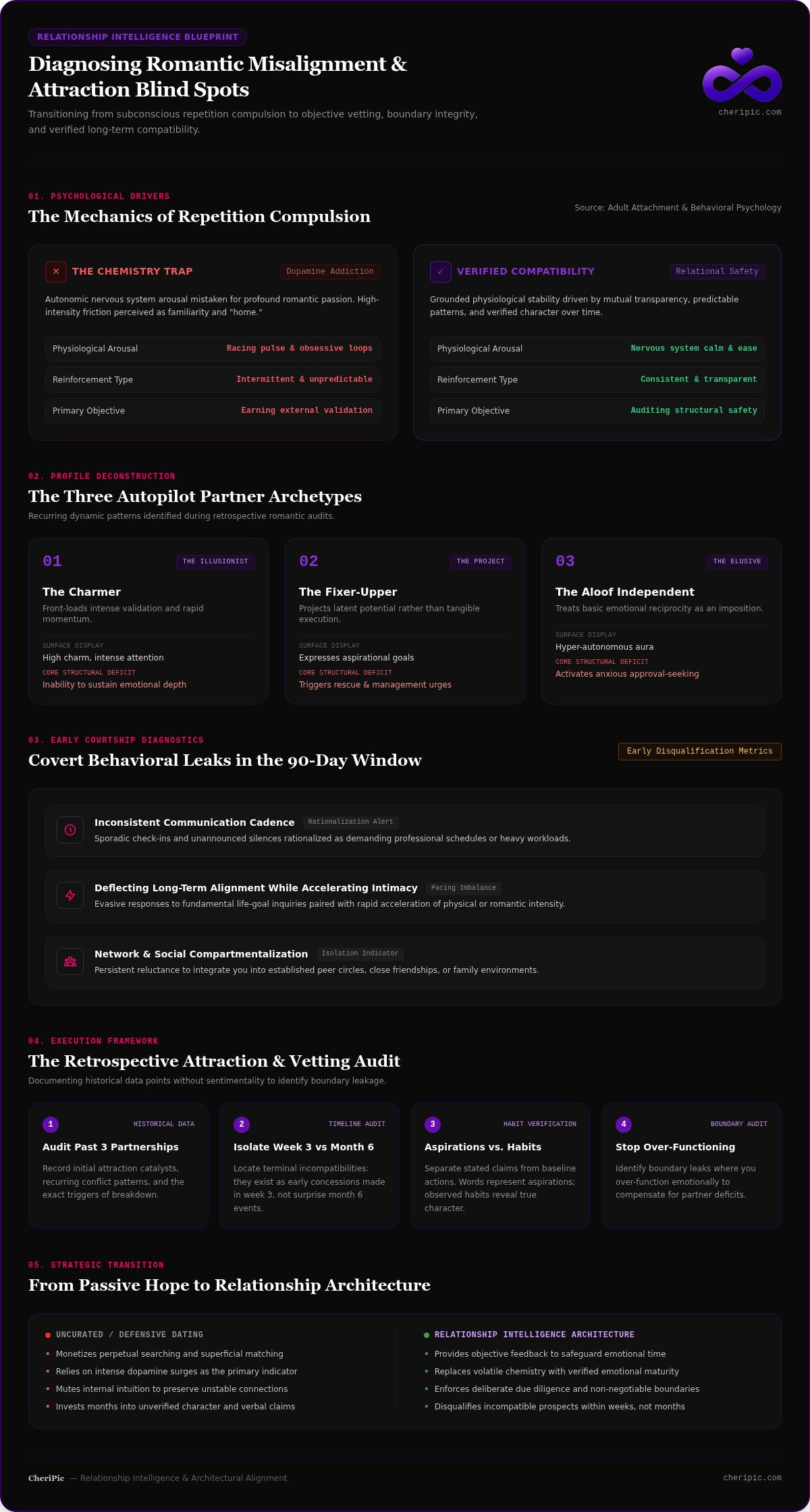
Repeated relationship failures rarely stem from bad luck. In clinical terms, they reflect repetition compulsion: the subconscious drive to recreate unresolved emotional dynamics because familiarity feels like safety. When your early conditioning involves emotional turbulence, your nervous system mistakenly perceives friction as home. Unaddressed boundaries invite manipulative or unavailable partners straight into your life, while polished surface charm masks structural deficits in character. If you want to understand how to stop attracting the wrong person, you have to diagnose why your subconscious equates anxiety with connection.
The Chemistry Trap vs. Core Compatibility
Intense initial chemistry is often a physiological warning signal, not a soulmate indicator. Autonomic nervous system arousal; characterized by racing pulses, obsessive mental loops, and persistent uncertainty; is frequently mistaken for profound romantic passion. In reality, it signals intermittent reinforcement. When affection and communication are delivered unpredictably, the brain experiences dopamine surges identical to behavioral addiction. You become consumed with earning validation rather than auditing relational safety. To understand why instincts often override logic in these moments, examine the psychological drivers behind why I ignore red flags during early courtship.
Attachment Styles and the Magnetism of the Familiar
Subconscious relational wounds operate like emotional magnets. Grounded in the principles of adult attachment theory, the classic anxious-avoidant dynamic thrives because each partner validates the other's worst fears: the anxious partner expects abandonment, while the avoidant partner anticipates suffocation. During the critical ninety-day evaluation window, emotional unavailability rarely announces itself loudly. Instead, it surfaces covertly through specific behavioral leaks:
- Inconsistent communication cadences rationalized as demanding professional schedules
- Deflecting inquiries about long-term goals while accelerating physical intimacy
- Reluctance to integrate you into established peer circles or family networks
Tolerating these micro-behaviors constitutes self-abandonment. When you mute your intuition to preserve an unstable connection, you establish the baseline for what mistreatment you will absorb. Learning how to stop attracting the wrong person requires replacing instinctive reactivity with deliberate, objective due diligence.
Diagnosing Your Dating Patterns: How to Conduct an Attraction Audit
Breaking a repetitive cycle requires clinical objectivity. Rather than treating partner selection as an unpredictable gamble, conduct a retrospective audit of your last three significant romantic partnerships. When you document historical data points without sentimentality, patterns emerge immediately. You begin to see that terminal incompatibilities don't appear out of nowhere at month six. They exist as subtle concessions made during the first three weeks. Understanding how to stop attracting the wrong person demands that you identify your personal boundary leaks before meeting anyone new.
Deconstructing Historical Partner Archetypes
Most individuals cycle through three primary archetypes when operating on autopilot:
- The Charmer: Front-loads intense validation and romantic momentum, disguising an inability to sustain genuine emotional depth.
- The Fixer-Upper: Projects potential rather than execution, triggering your desire to rescue or manage them.
- The Aloof Independent: Treats basic communication as an imposition, activating an anxious urge to earn their approval.
Document the initial traits that attracted you to these partners, their specific conflict styles, and the exact catalyst that triggered the breakup. Separate stated claims from observed baseline behavior. When someone claims they prioritize emotional honesty but shuts down during minor friction, prioritize their actions. Words represent aspirations; habits reveal character.
Auditing Your Boundary Integrity
Boundary leakage occurs when you over-function emotionally to compensate for a partner's deficits. According to Pew Research Center's study on online dating, millions of users experience profound fatigue and frustration from superficial interactions. Much of this exhaustion stems from auditioning for approval instead of screening for mutual compatibility.
Map the moments where you suppressed intuition to keep the peace. Did you laugh off passive-aggressive humor? Did you restructure your evening when they canceled plans last-minute? High-functioning adults often compromise core standards for flexible preferences like shared musical taste or mutual career ambition.
To master how to stop attracting the wrong person, benchmark your personal patterns against clear behavioral standards. Utilizing a systematic relationship compatibility assessment allows you to evaluate relational readiness objectively. For those ready to replace emotional guesswork with structured vetting, securing early access to CheriPic provides the architectural tools needed to filter candidates by verified compatibility and baseline integrity.
How to Stop Attracting the Wrong Person: The 4-Stage Vetting Protocol
Vague advice like "love yourself first" fails because self-worth without an operational screening system offers zero defense against skilled manipulators. You need an objective, repeatable protocol. Knowing how to stop attracting the wrong person requires transitioning from intuitive guessing to systematic behavioral due diligence. This four-stage vetting protocol filters out incompatible prospects before emotional attachment distorts your judgment:
- Stage 1: Upfront Criteria Codification. Define your non-negotiables regarding financial transparency, emotional regulation, and relational trajectory before engaging a prospect.
- Stage 2: Low-Stakes Conversational Stress-Testing. Evaluate baseline emotional availability through real-time dialogue and minor boundary friction.
- Stage 3: Environmental and Identity Verification. Confirm that real-world lifestyle and baseline circumstances align with digital representations before investing emotional energy.
- Stage 4: Zero-Tolerance Disqualification. Exit the dynamic at the very first breach of core integrity rather than negotiating with poor behavior.
Conversational Stress-Testing and Inquiry
Do not wait for a crisis to uncover a prospect's emotional maturity. Integrate strategic, low-friction stress-tests within the first three interactions. Ask open-ended questions about past relationship endings: "What was your contribution to your last breakup?" Candidates lacking emotional accountability will immediately cast their former partners as entirely unstable, revealing a systemic externalization of blame.
Next, enforce a minor logistical boundary. Decline an inconvenient date time or suggest an alternative venue. An emotionally regulated adult responds with flexibility and respect. An entitled prospect displays passive-aggressive withdrawal, impatience, or guilt-tripping. Applying a research-backed framework for mindful dating allows you to step back from the emotional rush, observe behavioral data dispassionately, and evaluate consistency between digital claims and real-world actions.
The Principle of Swift Disqualification
Dating potential is an expensive cognitive trap. When you date someone for who they could become, you subsidize their personal development at the expense of your emotional safety. High-value dating relies entirely on elimination, not rehabilitation.
If a candidate demonstrates chronic tardiness, evasiveness regarding their relationship status, or dismissive reactions to your expressed needs, disqualify them immediately. Terminating misaligned connections within the first month eliminates the sunk cost fallacy. You preserve your emotional bandwidth for partners who meet your baseline standards from day one. That discipline is precisely how to stop attracting the wrong person and protect your long-term peace.
Evaluating Solutions: Uncurated Apps vs. Therapy vs. Relationship Intelligence
Breaking repetitive romantic errors requires an effective operational mechanism. Daters usually rotate between two extremes: endless swiping on mass-market platforms or retrospective analysis in therapy. Psychotherapy remains essential for resolving early attachment conditioning; standard sessions nationwide average $100 to $250 out of pocket. However, therapy analyzes past decisions rather than screening real-time prospects. Uncurated dating apps, meanwhile, operate on business models engineered for platform retention. Solving how to stop attracting the wrong person requires an intentional infrastructure that prioritizes behavioral due diligence over endless browsing.
The Structural Flaws of Mainstream Dating Apps
Mainstream swipe platforms monetize emotional exhaustion. Their algorithms optimize for daily active usage, rewarding superficial charm, polished staging, and instant physical attraction over demonstrated reliability. This unchecked environment enables bad actors, misstated intentions, and unverified biographies to proliferate without consequence.
Daters spend weeks messaging only to discover fundamental lifestyle misalignments or fabricated personas. Protecting your emotional capital requires transitioning to a modern dating app with identity verification that enforces strict standards before prospects can initiate contact.
The Rise of Strategic Relationship Intelligence
Relationship intelligence platforms introduce architectural precision to partner selection. By assessing psychometric compatibility and core values before any conversation takes place, these systems screen out unviable prospects before your emotions become entangled.
Unlike human intuition, which is susceptible to dopamine highs and repetition compulsion, an objective AI relationship coach detects subtle behavioral anomalies and attachment traps in real time. This technological screening provides continuous pattern recognition, helping you hold firm to your non-negotiables. You save months of unviable dating through pre-interaction compatibility scoring.
Mastering how to stop attracting the wrong person requires replacing unvetted swiping with structural precision. To safeguard your time and vet prospective partners with absolute clarity, request your CheriPic Early Access Membership today.
Engineering Intentional Romance: Transforming Your Dating Architecture
Defensive dating is inherently exhausting. When your strategy centers solely on dodging red flags, you remain trapped in a reactive posture. Sustainable partnership requires shifting from defensive avoidance to proactive curation. You don't just need to filter out dysfunction; you need to place yourself in environments where self-awareness and emotional maturity are structural prerequisites. Learning how to stop attracting the wrong person ultimately means transforming the entire architecture of how, and where, you connect.
Curating Environments of Intentionality
High-caliber, emotionally regulated peers rarely linger in uncurated digital spaces that reward performative charm. Instead, they invest their time in spaces dedicated to personal evolution, physical wellness, and intellectual enrichment. Designing a proactive romantic strategy means stepping away from endless, transactional messaging and shifting toward context-first environments.
Transitioning initial digital introductions into curated real-world cultural or wellness experiences grounds courtship in shared values immediately. By adopting an advanced relationship intelligence platform, you ensure that interactions bypass digital posturing entirely, anchoring connection in mutual accountability from the very first encounter.
Leveraging CheriPic for Permanent Relational Clarity
Retiring self-sabotaging patterns permanently requires objective data, not wishful thinking. CheriPic provides the structural scaffolding modern dating lacks through rigorous profile authentication and behavioral pattern tracking:
- Identity and Profile Verification: Mandatory verification protocols screen out bad actors and biographical fabrication before any interaction begins.
- CheriAI Relationship Coaching: Proprietary AI provides real-time behavioral pattern recognition, identifying your subconscious attachment blind spots before you form emotional attachments.
- Core Value Alignment: In-depth compatibility assessments ensure both partners share matching baseline values, life trajectories, and emotional readiness metrics.
When you replace algorithmic manipulation with psychological verification, you stop auditioning for approval and start selecting with precision. Knowing how to stop attracting the wrong person is no longer a theoretical exercise; it becomes an automated standard. Step out of the cycle of romantic exhaustion and reclaim your standards by joining CheriPic's intentional community.
Executing Your Strategic Shift in Romantic Selection
Ending the cycle of chronic misalignment is never about wishing for better luck; it's about upgrading your vetting infrastructure. When you replace dopamine-fueled chemistry with structured behavioral benchmarks and enforce swift disqualification, your trajectory shifts permanently. Knowing how to stop attracting the wrong person means treating your emotional bandwidth as a finite, non-negotiable asset.
You don't have to navigate this transition in isolation. CheriPic provides the structural scaffolding necessary to safeguard your standards. Through rigorous identity and profile verification standards, comprehensive values and emotional readiness assessments, and CheriAI-driven behavioral pattern recognition, you can finally eliminate attachment blind spots before they cost you months of misdirected energy. Take the decisive step toward intentional partnership and break the cycle of toxic attraction with CheriPic. Lasting emotional peace isn't an accident; it's engineered.
Frequently Asked Questions
Why do I feel instant intense chemistry only with people who are bad for me?
Immediate, magnetic chemistry usually signals autonomic nervous system activation rather than authentic safety. When someone mirrors unhealed childhood dynamics or displays unpredictable attention, your brain misinterprets adrenaline and intermittent validation as profound passion. A healthy partner feels calm and predictable, which an addiction-primed nervous system initially mistakes for boredom. True compatibility develops steadily over time rather than erupting in an anxious rush.
Can you genuinely change who you are attracted to, or is it hardwired?
Attraction patterns are conditioned rather than unchangeable. While basic physical preferences have biological roots, your emotional attraction is dictated by internal scripts and tolerated behaviors. By auditing boundary leaks and actively resetting your nervous system to value emotional consistency, your preferences recalibrate. This deliberate conditioning is central to understanding how to stop attracting the wrong person and beginning to favor genuine emotional equilibrium.
How quickly can I determine if someone is emotionally unavailable?
You can assess baseline availability within two to three weeks by observing behavioral follow-through. Look for how they handle subtle boundaries, whether their communication remains steady between dates, and how openly they discuss past relationship dynamics. Avoidant candidates often accelerate early physical or verbal intimacy to create an illusion of closeness while deflecting questions regarding future trajectory or personal emotional accountability.
What are the first questions to ask to screen out incompatible partners?
Skip generic small talk and introduce low-friction diagnostic questions early in conversation. Ask: "What did your last relationship teach you about what you need to improve?" and "What does emotional consistency look like in your daily routine?" Their answers reveal whether they possess genuine self-awareness or routinely externalize blame. How a candidate reflects on past shortcomings is the most accurate predictor of future behavior.
Does having high standards cause you to end up completely alone?
High standards do not isolate you; they filter out low-investment prospects who would drain your resources. Intentional solitude is far safer and more productive than subsidizing an incompatible partner's emotional growth. Clarifying your non-negotiables shrinks your dating pool numerically but exponentially raises its quality. Knowing how to stop attracting the wrong person ensures that the time you invest is reserved exclusively for partners capable of equal commitment.
How does a relationship intelligence platform differ from a typical dating app?
Mainstream apps optimize for screen time and volume through unvetted swiping, monetizing continuous searching. In contrast, a verified relationship intelligence platform like CheriPic prioritizes pre-interaction screening. It evaluates core values, emotional readiness, and lifestyle compatibility before interaction begins. By incorporating objective CheriAI relationship coaching and mandatory identity verification, it eliminates bad-actor entry and provides actionable pattern recognition instead of endless digital browsing.
What role does identity verification play in preventing romantic exploitation?
Identity and profile verification establishes psychological safety by eliminating catfishing, bad actors, and biographical deception upfront. Unverified environments allow manipulative individuals to craft disposable, idealized personas without accountability. By requiring authenticated profiles before any connection occurs, you remove bad actors from the pipeline entirely. This due diligence ensures you only invest emotional energy into real individuals whose stated circumstances match their actual lives.


