

Chemistry is not a reliable barometer for compatibility; it is frequently a biological distraction that masks structural flaws in a potential partner. You've likely found yourself asking "why I ignore red flags" after realizing you've spent months investing in a connection that was fundamentally broken from the start. It's a recurring cycle where the brain prioritizes immediate emotional rewards over long-term psychological safety. You aren't failing at love. You're simply operating with an unverified map in an increasingly chaotic emotional landscape.
We recognize the exhaustion of dating the same person in a different body and the toll of gaslighting yourself into believing that intense sparks justify poor behavior. This exploration provides a grounded, analytical look at the neurological triggers that cause romantic blindness. You'll discover the systemic reasons your judgment falters and learn a strategic framework to restore your romantic clarity. We'll examine the biological "why" behind your choices before providing a concrete method to vet partners early. This process allows you to treat your emotional energy as the high-value asset it is, ensuring your next commitment is built on intelligence and verification rather than just hope.
Key Takeaways
- Understand how dopamine-driven chemistry can effectively silence your amygdala, creating a neurological blind spot for early warning signs.
- Distinguish between the biological "spark" of familiar dysfunction and the sustainable, slow-burn compatibility required for long-term psychological safety.
- Recognize how modern dating environments prioritize superficial speed over depth, leading to systemic choice overload that compromises your vetting process.
- Implement a "Romantic Due Diligence" framework to finally address why I ignore red flags and restore your clarity during the critical first 90 days of a connection.
- Learn how leveraging Relationship Intelligence and objective pattern recognition can stabilize your decision-making when emotional intensity is at its peak.
Beyond the Broken Picker: The Neurological Basis for Ignoring Red Flags
If you find yourself repeatedly questioning why I ignore red flags, it's essential to understand that your brain is likely bypassing its own security protocols. This isn't a matter of poor luck or a lack of character. It is a sophisticated neurological event where the brain's reward system actively prioritizes dopamine over safety signals. Instead of viewing these choices as failures, we must analyze them as instances of unconscious pattern repetition. Your brain seeks the familiar, even if the familiar is structurally unsound. It treats known chaos as safer than unknown stability.
Cognitive dissonance plays a central role in this process. When a potential partner displays behavior that contradicts your idealized version of them, your mind performs exhausting mental gymnastics to resolve the conflict. You rationalize the neglect or the inconsistency to maintain the internal narrative of a "perfect" match. This is not just optimism; it's a structural failure of your internal vetting system. You're effectively editing the person's character in real-time to fit a pre-written script.
The Amygdala Hijack: Why Logic Fails in the First 90 Days
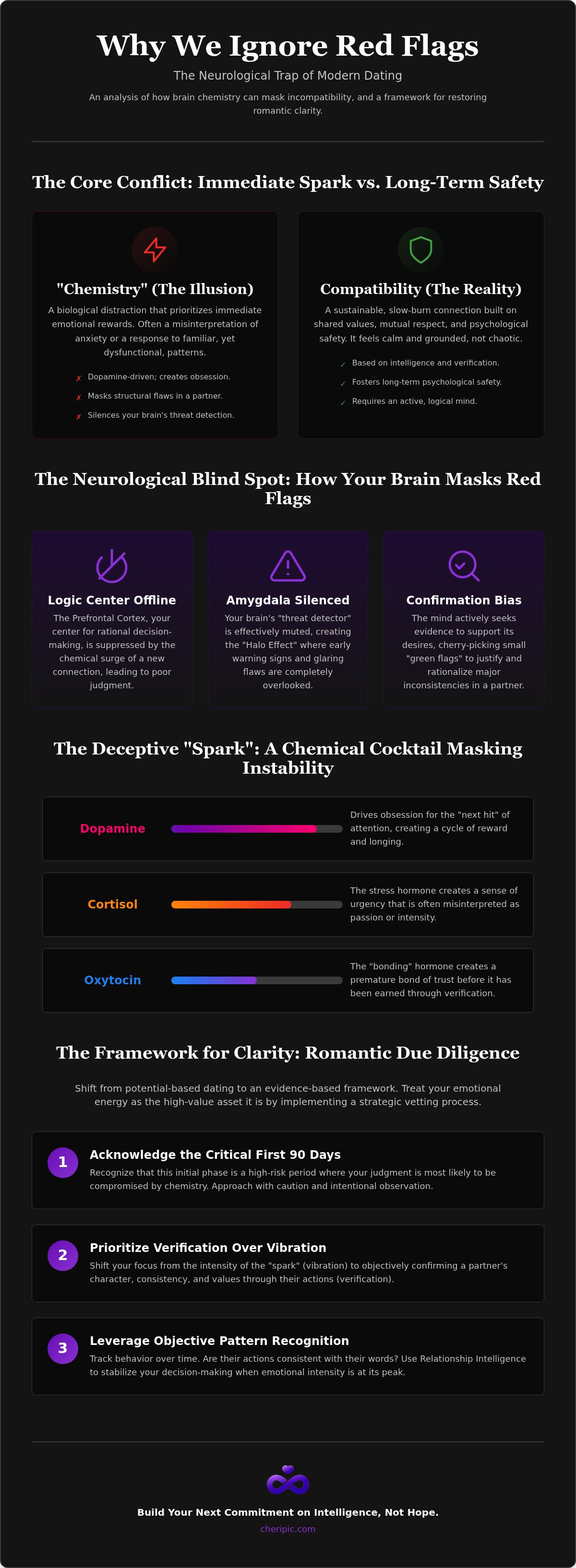
During the initial phase of a connection, the prefrontal cortex, which serves as your executive logic center, effectively goes offline. The amygdala, responsible for detecting threats, is silenced by the chemical surge of a new connection. This creates the "Halo Effect," where a single positive attribute, such as physical attraction or shared interests, creates a blinding glow that obscures glaring character flaws. Limerence is a state of cognitive obsession that masks red flags through intense, involuntary longing. Without an active logic center, you are essentially navigating a high-stakes investment without a radar.
Confirmation Bias in Love: Seeing What We Want to See
Our brains are wired to seek evidence that supports our existing desires. The Neurological Basis for Ignoring Red Flags is often rooted in this tendency to cherry-pick "green flags" while dismissing warnings as anomalies. You might focus on their occasional thoughtfulness to justify months of inconsistency. This leads to potential-based dating, where you fall in love with a hypothetical future version of a person rather than the individual standing before you. Breaking this cycle of why I ignore red flags requires the objective perspective of a Relationship Architect to verify reality before you invest your emotional capital. You must learn to value verification over vibration.
The Chemistry Trap: Why Your Brain Prioritizes Spark Over Stability
The "spark" is often a misinterpretation of physiological arousal. In many cases, what we perceive as an undeniable connection is actually our nervous system responding to familiar patterns of instability. This biological reaction is a primary reason why I ignore red flags during the early stages of a connection. We prioritize high-intensity chemistry because it feels significant, yet it often signals a lack of safety rather than the presence of health. True intimacy requires a slow-burn foundation, but the brain is easily hijacked by the immediate rewards of attraction.
Hormonal Blindness: The Chemical Cocktail of Early Attraction
When we meet someone who triggers our attachment wounds, our bodies release a chemical cocktail that mimics intimacy. Dopamine drives our obsession with the "next hit" of their attention, while cortisol creates a sense of urgency that we mistake for passion. Oxytocin and vasopressin then create a "bond of trust" before that trust has been earned through rigorous verification. This hormonal surge effectively masks the psychological reasons we ignore red flags, such as inconsistent communication or a lack of accountability. To determine if your connection is healthy or just a stress response, evaluate these signals:
- Physical Arousal: Is your heart racing with anxiety or do you feel a sense of grounded calm?
- Need for Validation: Are you obsessed with their approval or do you feel secure in your own worth?
- Dependency: Does their absence feel like a physical withdrawal or a manageable pause?
Compatibility vs. Chemistry: The Strategic Difference
Stability is rarely as exciting as dysfunction in the short term. However, long-term success requires a shift from seeking "chemistry" to evaluating "compatibility." Compatibility is the alignment of core values and emotional readiness; it's the structural integrity of the partnership. The "Anxious-Avoidant Trap" is a classic example of chemistry gone wrong. The avoidant partner's distance triggers the anxious partner's nervous system, creating a "high" when they finally reconnect. This roller coaster is often mistaken for deep connection, but it's simply a cycle of triggered wounds. To move beyond the cycle of why I ignore red flags, you must utilize a Relationship Compatibility Assessment to conduct romantic due diligence.
By prioritizing Relational Intelligence over fleeting excitement, you can identify long-term viability before you've fully committed your emotional assets. If you're ready to move from emotional chaos to strategic clarity, incorporating Relationship Intelligence coaching can help you identify these biological traps before they become long-term investments. Choosing peace over intensity is not a compromise; it's a strategic investment in your future psychological safety.
Systemic Sabotage: How Modern Dating Apps Train You to Overlook Warnings
Modern dating environments are not designed for psychological safety. They are designed for retention. While our neurobiology provides the internal mechanism for romantic blindness, the platforms we use provide the external catalyst. Traditional swipe culture rewards superficiality and speed, intentionally bypassing the reflective pauses required for sound judgment. This systemic design is a primary driver of why I ignore red flags; the environment itself treats human connection as a high-volume, low-stakes game rather than a strategic investment.
Choice overload further compromises our ability to conduct due diligence. When presented with an endless stream of profiles, the brain's executive function begins to fatigue. Research from 2026 indicates that 78% of Gen Z dating app users report experiencing dating app fatigue, a state that significantly impairs pattern recognition. When you are cognitively exhausted, you are less likely to vet any single individual properly. You stop looking for structural integrity and start looking for reasons to keep moving, which often means dismissing subtle warnings as mere "noise" in a crowded market.
The Gamification of Connection: Why We Stop Vetting
The mechanics of traditional apps mirror those of a slot machine. Variable reward schedules keep users focused on the next potential match rather than the current person's behavior. This gamification fosters a "Disposable Dating" mindset where emotional safety is sacrificed for the dopamine hit of a new notification. This environment is another reason why I ignore red flags, as it encourages you to overlook deception in favor of the "win." Free, unverified messaging further complicates this landscape, creating a breeding ground for those who wish to remain anonymous while they bypass your boundaries. Without a trust baseline, your defensive instincts are constantly overwhelmed by the sheer volume of unvetted data.
Verification as a Filter for Intentionality
In a marketplace of unvetted profiles, the refusal to verify identity is a significant, yet often ignored, warning sign. High-value dating requires a transition toward "Relationship Due Diligence," where verification is the minimum standard for entry. Someone who resists proving they are who they claim to be is demonstrating a lack of accountability from the outset. Restoring your romantic clarity requires moving toward The Strategic Standard: Choosing a Dating App with Identity Verification in 2026. By demanding identity verification, you effectively filter for intentionality, ensuring that your emotional energy is only shared with those who meet a baseline of transparency and respect. This shift from volume to verification is the stabilizing force needed in a chaotic digital landscape.
Relationship Due Diligence: Building a Strategic Vetting Framework
To break the cycle of romantic blindness, you must adopt a framework that prioritizes structural integrity over emotional impulse. We call this Relationship Due Diligence. It is the application of professional standards to your personal connections, ensuring that your emotional capital is only invested in verified assets. This approach requires you to implement the First 90 Days rule. During this period, you are not in a commitment; you are in an observation phase. This intentional delay allows the chemical fog discussed earlier to dissipate, revealing the actual character of the individual before you.
Effective vetting focuses on pattern recognition rather than isolated incidents. You must look for the precise alignment between words and actions over time. Most people eventually ask why I ignore red flags because they accepted a partner's verbal promises as a substitute for their behavioral history. High-value dating requires you to distinguish between your non-negotiable values, which are the pillars of your psychological safety, and your flexible preferences, which are merely aesthetic or lifestyle choices.
The Vetting Protocol: 5 Steps to Clarity
Establishing a repeatable process removes the guesswork from your decision-making. By following a structured protocol, you ensure that no critical area of compatibility is overlooked during the early stages of attraction.
- Step 1: Identity Verification. This is your baseline of safety. Never move toward intimacy with an unverified profile.
- Step 2: Value Alignment Assessment. Conduct a structural check of their core beliefs, financial habits, and long-term goals.
- Step 3: Conflict Style Observation. This is a stress test. Observe how they handle minor disagreements or service errors in public.
- Step 4: Third-Party Perspective. Utilize an objective mentor check, such as CheriAI, to identify patterns you may be too close to see.
- Step 5: The "Slow Down" Mandate. Intentionally limit the frequency of contact to prevent emotional hijacking and maintain your autonomy.
Identifying "Yellow Flags" Before They Turn Red
Not every warning sign requires an immediate exit, but every warning sign requires an inquiry. We define yellow flags as behaviors that suggest a potential lack of alignment or maturity. Instead of performing the mental gymnastics associated with why I ignore red flags, use these moments to initiate difficult conversations. A partner’s reaction to a calm, direct question about their behavior is the ultimate test of their emotional readiness. If they respond with defensiveness or gaslighting, the yellow flag has turned red. If they respond with accountability and a desire for resolution, you have found a foundation for growth.
Utilizing due diligence tools allows you to quantify compatibility rather than relying on a vague "feeling." If you are ready to apply professional-grade standards to your personal life, you can access our Relationship Compatibility Assessments to begin your vetting process with surgical precision. True confidence in your judgment comes from having a system that works even when your emotions are high.
CheriPic: Leveraging Relationship Intelligence to Break Destructive Patterns
CheriPic serves as the stabilizing force in an often chaotic emotional landscape. It is the world’s first Relationship Intelligence Platform, engineered specifically to disrupt the cycle of repeated mistakes. While your neurobiology may be hardwired for attraction, our platform is designed for verification. We provide the structural tools necessary to conduct rigorous romantic due diligence, ensuring that your emotional energy is shared only with those who meet the highest standards of transparency and accountability. This is a strategic shift from hope to intelligence.
If you have spent years questioning why I ignore red flags, the answer often lies in the lack of an objective mirror. When you are in the midst of a chemical surge, your internal threat detection is naturally compromised. CheriPic restores your romantic clarity by replacing the frantic energy of traditional dating with a methodical, instructional rhythm. We treat interpersonal connections as serious commitments that require a high level of verification rather than just luck or chemistry.
CheriAI: Your Objective Relationship Architect
When your logic center goes offline during the initial stages of attraction, you need an external anchor. CheriAI acts as an objective AI Relationship Coach that stays analytical while you are emotional. By processing behavioral data and identifying subtle inconsistencies, the engine flags patterns that your "honeymoon phase" brain might intentionally overlook. This moves you from a volatile gut feeling to data-backed clarity. The benefit of these personalized relationship insights is a significant increase in your long-term success rate, as you learn to identify structural flaws before you become deeply entangled.
The Future of Connection: Intentionality Over Excitement
High-value dating requires a community of individuals who prioritize psychological safety over fleeting excitement. CheriPic’s membership model acts as an intentional filter for those ready for genuine commitment. By requiring identity and profile verification, we eliminate the anonymity that allows deception and "catfishing" to thrive. This creates a psychologically safe environment where every user has already passed a baseline of accountability. This is the core of our philosophy: slowing down the decision-making process to ensure quality over quantity.
Our premium experiences transition connection from digital interactions to real-world intentionality. When you operate within a system built on verification and pattern recognition, you restore confidence in your own judgment. You no longer have to fear the cycle of why I ignore red flags because you have a strategic framework protecting your emotional assets. The era of unverified connection is over. Join the CheriPic Early Access Membership to restore your romantic clarity.
Reclaiming Your Strategic Romantic Clarity
Assessment of your neurobiology is the first step toward breaking destructive cycles. You've explored how dopamine can silence your amygdala and how systemic app design intentionally exploits your cognitive fatigue. The persistent question of why I ignore red flags is finally answered by a lack of objective verification and a structural failure of romantic due diligence. You now possess the framework to transition from fleeting excitement to long-term psychological safety.
Restoring your judgment requires a stabilizing force that remains analytical when you feel emotional. CheriPic provides this through CheriAI objective pattern recognition and an identity-verified community of intentional singles. Our safety-first architecture ensures that your emotional energy is only shared with those who meet your high standards for transparency. It's time to treat your heart as a strategic investment rather than a gamble. Master Your Relationship Intelligence with CheriPic Early Access and begin your journey toward a connection built on intelligence and verification. You deserve a connection that honors your maturity and self-awareness.
Frequently Asked Questions
Why do I ignore red flags even when I see them?
You ignore warnings because your brain’s reward system effectively shushes your threat detection. When you experience high-intensity attraction, dopamine floods your system, prioritizing immediate emotional gratification over long-term safety. This cognitive bypass is a primary reason why I ignore red flags during the early stages of a connection. Your mind performs mental gymnastics to align a partner's bad behavior with your idealized version of them, effectively editing reality to maintain the spark.
What are the most common red flags people ignore in the first month?
Common warnings overlooked in the first month include:
- Inconsistent communication patterns.
- Subtle testing of your personal boundaries.
- A lack of accountability for minor mistakes.
- Disparaging remarks about all previous partners.
You might rationalize these signals as passion or privacy, but they indicate a lack of structural integrity. These behaviors often manifest as significant dysfunction once the initial chemical fog dissipates.
Is it possible to "fix" a broken picker?
Yes, you can recalibrate your selection process by shifting from emotional impulse to Relationship Intelligence. Fixing your picker is a process of neurological reprogramming where you learn to value stability over intensity. By implementing a strategic vetting framework and prioritizing identity verification, you move from unconscious pattern repetition to intentional selection. This requires a commitment to slowing down and conducting rigorous due diligence before sharing your emotional energy with a potential partner.
How does chemistry make us blind to red flags?
Chemistry creates a state of hormonal blindness where oxytocin and vasopressin establish a bond of trust before it has been earned through verification. This chemical surge effectively takes your prefrontal cortex offline, impairing your ability to process logical data. You become focused on the hit of attraction, which masks the psychological reasons why I ignore red flags. This physiological hijacking ensures that you prioritize the feeling of connection over the reality of the person’s character.
Can an AI really help me identify relationship patterns?
AI provides an objective, data-driven perspective that remains unaffected by the chemical surges of attraction. While your judgment may be clouded by limerence, a tool like CheriAI analyzes behavioral data to identify inconsistencies you might miss. It acts as a pattern recognition engine, flagging deviations between a partner's words and actions. This moves your decision-making from a volatile gut feeling to a foundation of data-backed clarity, ensuring you remain the architect of your own connection.
What is the difference between a red flag and a yellow flag?
A red flag is a non-negotiable indicator of danger that requires an immediate exit. A yellow flag is a behavior that requires further inquiry. The distinction is tested through a direct conversation:
- Red Flag: Defensiveness, gaslighting, or shifting blame.
- Yellow Flag: Accountability, curiosity, and a desire for resolution.
If a partner cannot handle a calm inquiry about their behavior, the yellow flag has officially turned red.
How do I stop dating the same type of person over and over?
Breaking this cycle requires interrupting your attraction to familiar dysfunction. You can achieve this by:
- Adhering to the First 90 Days rule of observation.
- Refusing to compromise on identity verification.
- Prioritizing value alignment over chemical intensity.
By treating your time as a high-value asset, you conduct romantic due diligence on every connection. This ensures they meet your structural standards before you invest emotional capital.
Why is identity verification important in modern dating?
Identity verification is the essential baseline for psychological safety in a digital landscape. It eliminates the trust gap created by anonymous, unvetted profiles and filters for individuals who are serious about intentional connection. When a person refuses to verify their profile, they are demonstrating a lack of transparency from the outset. Requiring verification ensures that you are only investing your emotional capital in real, accountable individuals, effectively restoring the trust baseline required for healthy connection.


