

What if the most revealing part of a dating profile isn’t the profile at all? If you’re wondering how to spot a narcissist on a dating app, polished photos and confident answers offer little clarity on their own. Intense attention may feel exciting yet leave you uneasy, while a single awkward message can be easy to overread.
That uncertainty makes sense. A profile can’t establish someone’s character, and no checklist can diagnose a stranger. Self-centeredness or an imperfect moment isn’t proof of a personality disorder. What matters more is whether behavior repeats, especially when you express a need, set a limit, or ask to slow down.
This article will help you assess concerning patterns without turning ordinary flaws into clinical labels. You’ll learn what to notice in early messages, how to respond when someone pushes past your boundaries, and when stepping back may be the clearest choice. The aim isn’t to reach a diagnosis. It’s to protect your judgment, make room for careful verification and reflection, and decide what feels right before investing further.
Key Takeaways
- Learn how to spot a narcissist on a dating app by noticing repeated interactions, not judging someone by charm or profile polish.
- Track whether conversations make room for your preferences and feelings, rather than treating one awkward exchange as a verdict.
- Understand the difference between an isolated lapse, a recurring interpersonal pattern, and a clinical diagnosis you can’t make from app messages.
- Use a measured response: pause, name the behavior, state your boundary, then consider how the person responds.
- Use verification and compatibility tools as separate inputs to thoughtful dating. Neither can establish someone’s character or guarantee relationship safety.
Spotting Narcissists on Dating Apps Without Profile Clues
A dating profile can raise questions, but it can’t establish someone’s personality. A list of achievements, luxury travel photos, or confident claims may reflect what a person wants to present, not how they treat a partner. More useful evidence emerges through interaction: whether their words and behavior remain consistent, and whether they show respect when your preferences differ from theirs.
What can a dating profile tell you, and what can’t it?
Think of profile details as conversation prompts, not proof. If someone describes themselves as unusually successful or posts idealized photos, you can ask what matters to them and notice how they respond. Do they answer with openness and curiosity, or use the exchange to demand admiration and dismiss your perspective?
Profiles are curated by design. They offer a selective presentation, not a complete psychological picture. Someone may be proud, self-promotional, or awkward at first without showing a persistent disregard for others. Look for alignment over time between stated intentions and conduct. Someone who says they value respect should also respect your pace, attention, and preferences.
Why “narcissist” is not a diagnosis to make from an app
In everyday conversation, “narcissistic” is often used to describe self-centered or attention-seeking behavior. That informal label isn’t the same as Narcissistic Personality Disorder, a clinical diagnosis. The overview of Narcissistic personality disorder describes a mental health condition that requires professional assessment. Only a qualified professional can evaluate and diagnose it.
One boastful message, disagreement, or uncomfortable exchange isn’t enough to determine what explains someone’s behavior. Similar conduct can have different causes, and an app conversation can’t establish those causes. For your own decisions, focus on what you can observe instead of trying to assign a label.
- Notice the behavior: What happened, and how did it affect you?
- Look for repetition: Does the same disregard show up across conversations or situations?
- Use “red flag” practically: It means a behavior deserves attention, not that you’ve identified a disorder.
This is a more grounded way to approach how to spot a narcissist on a dating app: assess repeated conduct and its effect on your boundaries, without treating a profile or a single interaction as a diagnosis.
Which Dating-App Behaviors Matter More Than Charm or Chemistry?
Charm can create a strong first impression. Chemistry can make rapid attention feel especially compelling. Neither tells you whether someone will respect your preferences consistently. To understand how to spot a narcissist on a dating app, focus on repeated interactions rather than treating any single behavior as a diagnostic checklist. The question isn’t whether someone is always charming or never self-focused. It’s whether the connection leaves room for two people.
Notice whether attention and conversation are consistently one-sided
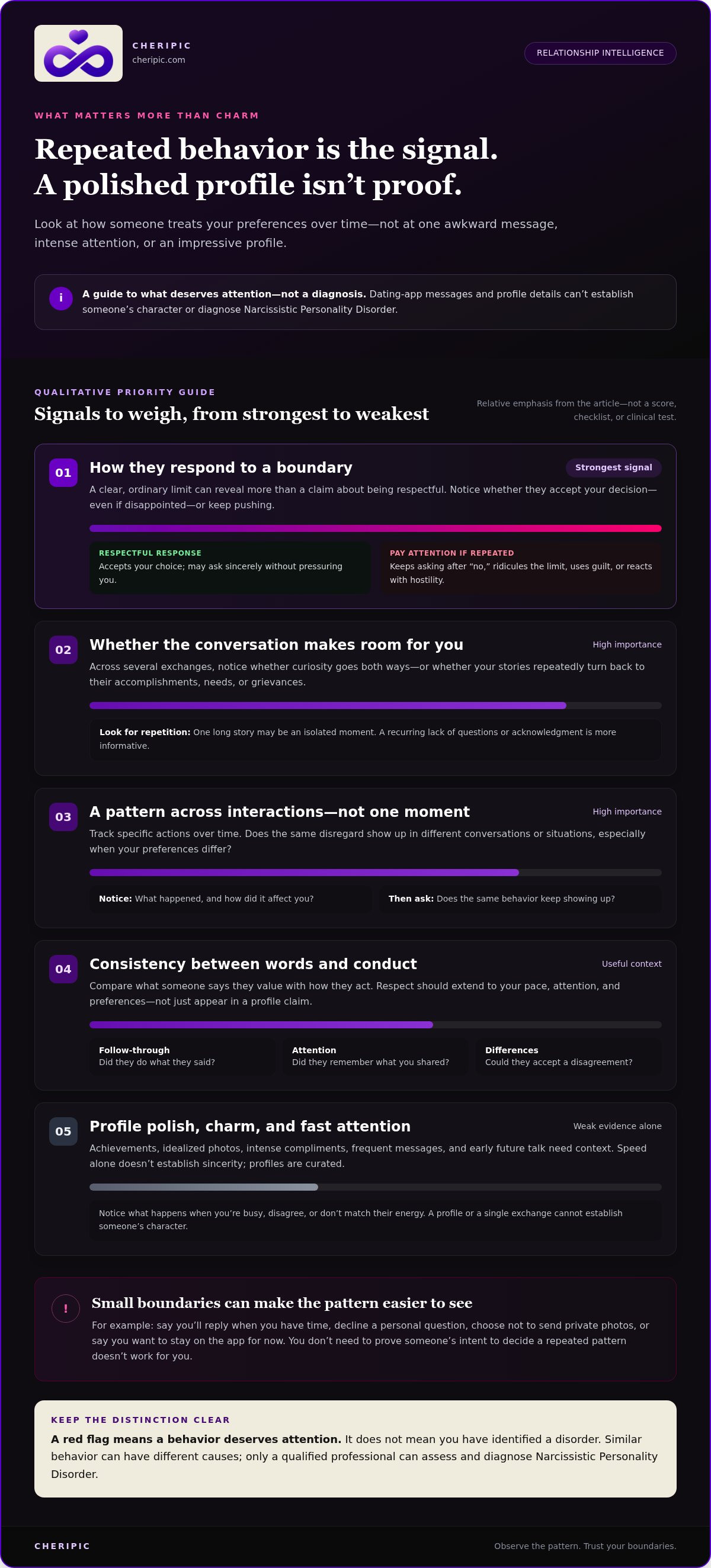
Across several exchanges, notice who gets to speak, what receives attention, and whether curiosity goes both ways. Someone may occasionally talk at length about work, achievements, or a difficult experience. A more concerning pattern is repeatedly turning your stories back to their accomplishments, needs, or grievances without asking questions or acknowledging what you shared.
Intense compliments, frequent messages, and early talk about a shared future need context. They may be sincere, but speed alone doesn’t establish sincerity. Notice whether the attention stays respectful when you’re busy, disagree, or don’t match their energy. A PsyPost report on research on manipulative tactics discusses online dating behaviors including love-bombing and inauthentic self-presentation. Treat this as a reason to observe carefully, not a basis for labeling an individual.
Keep track of specific actions across interactions: Did they follow through on what they said? Did they remember something you shared? Could they accept a difference without turning it into a contest? These observations help distinguish a single self-focused moment from a recurring lack of reciprocity.
Watch how they respond when you set a small boundary
A clear, ordinary limit can show you more than a polished claim about being respectful. You might say you prefer to reply when you have time, aren’t ready to answer a personal question, won’t send private photos, or want to stay on the app for now. Then notice the response.
Respect doesn’t require enthusiastic agreement. Someone can express disappointment or ask a sincere question while still accepting your decision. Pressure is different. Repeatedly asking after you’ve said no, ridiculing your limit, using guilt to change your mind, or retaliating with hostility are reasons to take the interaction seriously.
Repeated boundary dismissal matters more than a single polished profile claim. You don’t need to prove intent to decide that a pattern doesn’t work for you. For structured support reflecting on interaction patterns, CheriAI Relationship Coaching can be one input alongside your own judgment.
Narcissistic Traits, Bad Dating Behavior, and NPD: What’s the Difference?
Self-centered behavior can be unpleasant without revealing why it happened. A person may show narcissistic traits in some situations, behave harmfully in a relationship, or meet the criteria for Narcissistic Personality Disorder (NPD). These categories aren’t interchangeable. Narcissistic traits don’t automatically make someone abusive, and harmful behavior doesn’t prove that a person has NPD.
For someone asking how to spot a narcissist on a dating app, the useful distinction is between what you can observe and what you can’t conclude. A match’s messages may show a pattern that affects you. They can’t establish its cause.
| What you observe | What it may mean | What you can conclude |
|---|---|---|
| Isolated behavior | A boastful comment, a thoughtless reply, or one disagreement. | Notice it, but don’t treat one instance as a defining pattern. |
| Recurring interpersonal pattern | Repeated disregard for your preferences, feelings, or limits. | Consider its impact and whether the person takes responsibility when you raise it. |
| Clinical diagnosis | A mental health condition assessed in a clinical context. | Only a qualified professional can determine whether someone meets diagnostic criteria. |
When does self-centered behavior become a pattern worth taking seriously?
Look at repetition, context, impact, and what happens after feedback. If someone interrupts once, then listens and adjusts when you mention it, that differs from repeatedly dismissing you and insisting you’re overreacting. An apology matters less than whether conduct changes. Assess the experience you’re having, not a theory about someone’s hidden motives.
You can act on harmful behavior without naming its diagnosis. If an interaction consistently leaves you feeling pressured, belittled, or unable to express a preference, you can slow down or disengage without deciding why the other person acts that way.
Why online checklists cannot diagnose Narcissistic Personality Disorder
Online checklists can flatten complex clinical concepts into labels applied to a handful of messages. NPD is diagnosed through qualified clinical assessment, not profile analysis or a stranger’s interpretation of a dating conversation. The DSM-5-TR provides the professional diagnostic framework; an app exchange cannot establish whether someone meets it.
It’s also possible to overlook behavior when attraction, hope, or uncertainty shapes your interpretation. Reflecting on why people ignore relationship red flags can help you examine your own decision-making without turning that reflection into a diagnosis of someone else. Keep the standard practical: notice what happened, whether it repeats, and whether the relationship feels respectful.
How to Respond to Concerning Behavior on a Dating App
You don’t need to settle on a label before deciding how to respond. A practical approach is to pause, identify the specific behavior, state a boundary if you choose, observe the response, and decide what you want to do next. This keeps your attention on what’s happening rather than guessing the other person’s motives.
Set a clear boundary and assess the response
Keep your boundary brief. You don’t have to justify it, soften it, or debate it.
- “I’m not ready to share that.”
- “I prefer to stay on-app for now.”
- “I reply when I’m available, not on a set schedule.”
Then notice what follows. A respectful response may be as simple as accepting your answer and moving on. Pressure, insults, guilt, or repeated attempts to change your mind are reasons to step back. That response tells you how the person handles a limit; it doesn’t prove a diagnosis. If the behavior continues, you can stop replying, unmatch, or block without further explanation.
Protect personal information and choose when to disengage
Keep sensitive details private while trust is still developing. Don’t share financial information, your home address, account credentials, or images you wouldn’t want exposed. Be cautious if someone pushes you to move off-app before you’re comfortable. Identity checks may provide information about whether a profile matches an identity, but they can’t confirm honesty, character, compatibility, or emotional safety. For more context, read about dating app identity verification.
Blocking or reporting is a reasonable choice if someone harasses you, coerces you, or continues unwanted contact. You don’t have to wait for behavior to escalate or collect proof of a clinical pattern before using the platform’s safety tools. If you feel threatened, prioritize immediate safety and reach out to someone you trust. If there’s an immediate danger, contact local emergency services.
Learning how to spot a narcissist on a dating app shouldn’t require diagnosing a match. It’s about making deliberate decisions based on behavior and your own limits. For structured reflection on interaction patterns, explore CheriAI relationship coaching as one source of support alongside your judgment.
Use Relationship Intelligence for Clarity, Not Diagnosis
The goal of thoughtful dating isn’t to identify a disorder from a profile or a handful of messages. It’s to make a considered decision using separate kinds of information: whether a person’s identity is supported, whether your values and relationship readiness align, and whether their behavior over time matches what they say. These inputs can inform your judgment. None can replace it.
What verification and compatibility tools can, and can’t, tell you
Identity and profile verification can add information about whether a profile corresponds to a person’s identity. It can’t certify honesty, compatibility, emotional safety, or character. Treat verification as one layer of context, not a guarantee about how someone will behave in a relationship.
Compatibility reflection helps you clarify what you’re looking for and consider whether your values, expectations, and readiness appear aligned. A relationship compatibility assessment can support that deliberate evaluation. It isn’t a verdict on a person or a substitute for observing how they treat you.
CheriPic brings together identity and profile verification, relationship compatibility assessments, and CheriAI relationship coaching. These tools serve different purposes: verification offers identity-related information, compatibility assessments help clarify alignment, and CheriAI can support reflection and pattern recognition. None diagnoses narcissism or guarantees safety.
Make the next decision from evidence, boundaries, and your own judgment
Compare stated intentions with consistent conduct. Someone may describe themselves as attentive or ready for commitment; consider whether their actions reflect those claims, including how they respond to your needs and boundaries. Give yourself time to gather a clearer picture. You don’t have to keep investing simply because an early interaction felt promising, and you don’t need a diagnosis to decide a connection isn’t right for you.
CheriAI is a reflection tool, not a clinical evaluator. It can help you consider interaction patterns, but it can’t determine someone’s mental health or decide what you should do. As you consider how to spot a narcissist on a dating app, keep the focus on observable behavior, your boundaries, and the quality of the connection rather than a label.
For a measured next step, explore CheriPic’s relationship intelligence platform as a resource for more deliberate assessment before deeper emotional investment.
Date with Clarity, Not a Label
Knowing how to spot a narcissist on a dating app isn’t about diagnosing someone from a profile or a few messages. It’s about noticing whether behavior forms a repeated pattern, especially when you express a preference or set a boundary. A polished presentation or an isolated awkward exchange can’t tell the whole story.
Keep your assessment grounded in what you can observe: whether conversations allow for mutual curiosity, whether stated intentions align with conduct, and whether the person responds respectfully to your limits. You can step back from behavior that feels harmful without deciding what diagnosis, if any, explains it.
CheriPic offers identity and profile verification tools, compatibility assessments focused on values and relationship readiness, and CheriAI relationship coaching for personalized reflection. These tools can support a more deliberate process, but they don’t certify someone’s character or guarantee relationship safety.
Explore CheriPic’s relationship intelligence platform as one resource for thoughtful assessment before deeper emotional investment. You’re allowed to take your time, trust what repeated behavior shows you, and choose connections that respect your boundaries.
Frequently Asked Questions
Can you tell if someone is a narcissist from their dating profile?
No, a dating profile can’t establish that someone is a narcissist or has Narcissistic Personality Disorder. It shows a curated selection of photos and claims, not a complete picture of personality or behavior. Confidence, polished images, or attention-grabbing achievements may prompt questions, but they aren’t proof. Focus on how the person interacts over time, including whether their actions align with their stated intentions and respect your preferences.
What are common red flags of narcissistic behavior on dating apps?
Potentially concerning patterns include repeatedly redirecting conversations to their needs or achievements, dismissing your feelings, or pushing past stated limits. Intense compliments or frequent messages may warrant attention if they come with pressure to move faster than you want. These behaviors don’t diagnose anyone. If you’re considering how to spot a narcissist on a dating app, watch for repetition and impact, not a single message or trait.
Is love bombing proof that someone is a narcissist?
No. Intense flattery, constant contact, or premature talk of a special future isn’t proof of narcissism or a personality disorder. Consider the context and whether the attention stays respectful when you’re busy, set a boundary, or don’t match the same pace. If someone uses affection to pressure you or reacts badly when you slow things down, assess that conduct directly. You can take space without deciding what caused it.
How can I respond if a dating-app match ignores my boundaries?
State the limit clearly and briefly, such as, “I’m not ready to share that,” or, “I prefer to stay on-app.” You don’t need to defend your decision. Notice whether the person accepts it or continues pushing, insulting, or using guilt. If pressure persists, you can stop replying, unmatch, block, or report the behavior. If you feel threatened, prioritize immediate safety and seek support from someone you trust.
Can identity verification tell me whether a dating match is trustworthy?
No. Identity and profile verification can provide information about whether a profile corresponds to an identity, but it can’t confirm honesty, character, compatibility, or emotional safety. Treat it as one source of information, not a guarantee. Make decisions using several separate factors: identity information, alignment in values and relationship readiness, and the person’s observed conduct over time. Keep your own boundaries and judgment central.
Should I block someone I think might be a narcissist?
You can block someone if you no longer want contact, whether or not you think they’re a narcissist. You don’t need a diagnosis or proof of intent to end an interaction that feels uncomfortable, coercive, or disrespectful. Blocking and reporting are reasonable options for harassment or repeated unwanted contact. Base your choice on the behavior and its effect on you, rather than trying to establish a clinical label first.


