

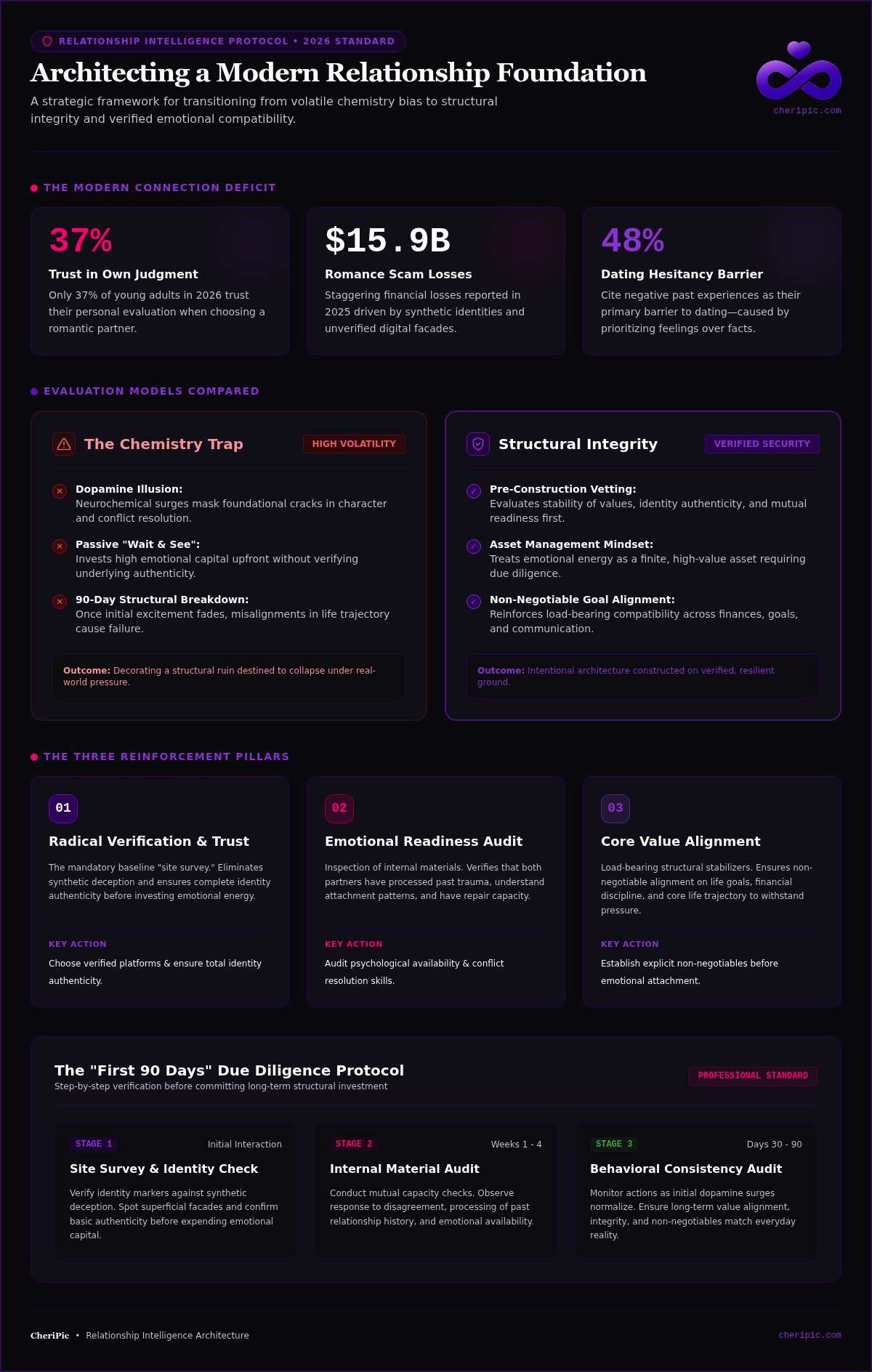
Only 37 percent of young adults in 2026 trust their own judgment when selecting a romantic partner. This deficit in confidence is a natural response to a dating culture that often rewards superficiality over substance. You've likely felt the sting of wasting months on an incompatible match or the persistent anxiety of online deception. These failures occur because most people focus on the facade of a partner rather than building a relationship foundation that is structurally sound from the start.
Chemistry is a poor substitute for due diligence. To create something lasting, you must shift your perspective from that of a passive observer to a relationship architect. This guide teaches you how to apply relationship intelligence and strategic vetting to construct a partnership that withstands the tests of time. We will outline a clear framework for evaluation, including how to spot red flags and verify core values before you're deeply invested. You'll learn to treat your emotional energy as a valuable asset that requires professional-grade management and careful verification.
Key Takeaways
- Transition from the volatility of "Chemistry Bias" to the stability of "Structural Integrity" by prioritizing long-term value alignment over fleeting excitement.
- Learn the essential pillars of building a relationship foundation, including radical identity verification and a comprehensive audit of emotional readiness.
- Adopt a professional standard of due diligence by utilizing a "First 90 Days" audit to verify behavioral consistency and integrity in a potential partner.
- Establish your own structural requirements through a rigorous self-audit that identifies your non-negotiables and emotional capacity for a serious commitment.
- Integrate advanced relationship intelligence tools to move beyond traditional dating patterns and secure a partnership based on verified compatibility.
What is a Relationship Foundation in the Age of Intelligence?
Building a relationship foundation is an engineering task, not an emotional accident. In 2026, the traditional methods of meeting and connecting have been compromised by digital fragmentation and synthetic identities. A true foundation is the structural alignment of verified values, mutual trust, and psychological readiness. It's the "site survey" you conduct before any emotional capital is spent. Without this initial assessment, you aren't building a home; you're merely decorating a ruin that's destined to collapse under the weight of reality.
Modern connection requires a shift toward "Pre-Construction Vetting." This process involves looking past the surface to ensure the "soil" of the partnership is stable. In a landscape where romance scams reached a staggering $15.9 billion in reported losses during 2025, the cost of being wrong has never been higher. Intelligence-driven dating means treating your time as a finite resource and your heart as a high-value asset that requires professional-grade due diligence.
The Chemistry Trap vs. Structural Integrity
Dopamine is a powerful liar. It creates a temporary sense of safety while obscuring the fundamental cracks in a partner's character or lifestyle trajectory. Many people fall into the "Chemistry Trap," where high-intensity beginnings are mistaken for long-term compatibility. These sparks often mask deep-seated misalignments in financial discipline, family goals, or conflict resolution styles. When the neurochemical surge eventually fades, usually within the first 90 days, the lack of a solid base causes a total structural failure. Research indicates that 48 percent of young adults cite negative past experiences as their primary barrier to dating. Most of these failures occur because they prioritized the "feeling" over the facts. Structural integrity in a romantic context is the alignment of non-negotiable life goals.
The Shift to Relationship Intelligence
The landscape of interpersonal relationships has evolved beyond the era of passive dating. You can no longer afford to "wait and see" if a partner is who they claim to be. Relationship intelligence is the proactive use of data, pattern recognition, and verification to ensure that your emotional investment is secure. It involves moving from a reactive mindset to one of intentional architecture. By adopting a Relationship Intelligence Platform: The Strategic Standard, you can verify the authenticity of your materials before the first stone is laid. This methodical approach prioritizes psychological safety and long-term success over fleeting thrills, allowing you to build with confidence rather than hope.
The Three Pillars of a Strong Relationship Foundation
Constructing a lasting partnership requires more than good intentions. It demands a triple-reinforced support system. When building a relationship foundation, you must ensure that every weight-bearing element is tested for quality before you commit your emotional capital. These three pillars-Radical Verification, Emotional Readiness, and Value Alignment-act as the stabilizers that prevent a partnership from buckling when external pressures like financial shifts or health crises arise. Without all three, the structure remains inherently unstable.
Radical Verification and Trust
Verification is the non-negotiable baseline of psychological safety. In an era where generative AI can fabricate entire personas, knowing exactly who you're speaking with is the ultimate "site inspection." Without this, trust is built on a hollow promise. By Choosing a Dating App with Identity Verification, you eliminate the risk of synthetic deception. This allows you to focus on the characteristics of healthy relationships, such as honesty and mutual respect, from the very first interaction. Authenticity is the only material strong enough to support a lifetime of connection. It provides the calm authority needed to move forward without the constant friction of doubt.
Emotional readiness is the audit of your internal materials. It isn't enough for a partner to be "available" on paper; they must be structurally sound. This means they've processed past traumas, understand their attachment patterns, and possess the capacity for conflict repair. You should evaluate your own readiness with the same rigor you apply to others. If you're ready to begin your own audit, you might consider verifying your own readiness through professional intelligence tools that prioritize long-term success over fleeting excitement.
Auditing Value Alignment
Value alignment is the blueprint that determines the final shape of the relationship. While surface interests like hobbies or shared tastes are pleasant, they don't hold weight during a crisis. You must identify the "Core 5" values: family vision, career trajectory, wellness habits, financial discipline, and spiritual outlook. Differentiating between these foundational principles and temporary interests is vital for anyone serious about building a relationship foundation. Utilizing a Relationship Compatibility Assessment provides the data needed to confirm that your long-term visions are compatible. When these pillars are secure, the relationship transitions from a fragile hope to a resilient, engineered reality.
Relationship Due Diligence: Vetting Before Building
Vetting is frequently mischaracterized as a lack of trust. In reality, it's a professional standard for anyone serious about building a relationship foundation. In any high-stakes environment, due diligence is the prerequisite for investment. You wouldn't sign a mortgage without a structural inspection; you shouldn't commit your emotional future without a similar audit. This process isn't about looking for reasons to leave. It's about gathering the data necessary to stay with confidence. It's a form of radical respect for both your time and your partner's integrity.
The "First 90 Days" audit serves as your primary diagnostic period. This timeframe is essential because it allows the initial "representative" to fade, revealing the consistent behavioral patterns underneath. You aren't looking for perfection. You're looking for consistency between stated values and actual choices. Ignoring red flags during this phase isn't an act of kindness; it's a failure of due diligence. When you overlook a structural flaw early on, you're essentially choosing to build on a site you already know is unstable. Bad luck is rare in relationships. Poor vetting is common.
Actual "site visits" are required to move beyond the digital simulation. Messaging apps provide a controlled environment where personas can be curated. Real-world experiences, however, provide the friction necessary to see a partner's true materials. Observe how they handle a delayed flight, a difficult server, or a professional setback. These moments reveal the psychological infrastructure that will eventually support your shared life.
Recognizing Behavioral Patterns
You must distinguish between a one-off mistake and a structural flaw. A mistake is an isolated incident followed by genuine repair. A flaw is a recurring trait that signals a deeper misalignment. If you find yourself dating the same personality type in different bodies, your vetting process is likely focusing on the wrong metrics. Understanding Why I Ignore Red Flags can help you break the cycle of romantic blindness and identify these recurring patterns before they become permanent fixtures in your life.
The Architecture of Intentional Communication
Move beyond small talk and toward "structural talk" within the first few dates. You need to ask questions that reveal character rather than just preferences. Inquire about how they handle stress, how they've navigated past conflicts, and what success looks like to them. This isn't an interrogation; it's an intelligent exchange designed to uncover the blueprint of their personality. Using relationship intelligence allows you to navigate these early disagreements productively, ensuring that the process of building a relationship foundation is grounded in reality rather than projection.
Step-by-Step: Constructing Your Foundation
Constructing a resilient partnership is a methodical process that requires precision at every stage. Building a relationship foundation is not achieved through hope or luck; it's the result of a disciplined sequence of evaluation and action. By following a structured blueprint, you ensure that your emotional investment is placed on a site that has been thoroughly surveyed and cleared for development. This approach protects your most valuable assets: your time and your emotional well-being.
- Step 1: Self-Audit. Determine your own structural requirements and emotional capacity before engaging with potential partners.
- Step 2: Verification. Utilize identity and profile verification tools to confirm the authenticity of the individuals you connect with.
- Step 3: Compatibility Assessment. Quantify value alignment using intelligent tools that move beyond surface interests.
- Step 4: Pattern Recognition. Employ AI relationship coaching to identify and avoid the romantic errors of your past.
- Step 5: The Experience Test. Evaluate the connection through curated, real-world events that reveal character under pressure.
Phase 1: Internal Blueprints
The integrity of your partnership depends heavily on the quality of your own psychological infrastructure. Before entering the market, you must define your non-negotiables with absolute clarity. This internal blueprint serves as your guide, preventing you from compromising on foundational requirements during the initial rush of chemistry. Healing the cracks in your own foundation through self-reflection or targeted coaching is essential for long-term success. Emotional readiness is the ability to invest without seeking to be 'completed'. When you approach a connection from a place of wholeness, you're better equipped to identify a partner who offers genuine alignment rather than a temporary distraction from internal work.
Phase 2: Real-World Stress Testing
Digital interactions are merely the prologue to a relationship. To truly understand the materials you're working with, you must observe how a partner interacts with the world. Real-world stress tests, such as travel or singles wellness retreats, reveal more in 48 hours than months of dinner dates. These environments provide the friction necessary to witness a partner's responsiveness, patience, and character. Observe how they treat service staff, how they respond to travel delays, and how they navigate interactions with strangers. These behaviors are the indicators of their long-term reliability. Transitioning from dating to a committed partnership requires this level of verification. To begin your own process of intelligent construction, you can apply for an early access membership and start building with verified intent.
CheriPic: The Architecture Firm for Your Relationship
CheriPic functions as the architecture firm for your romantic future, providing the specialized intelligence required to move beyond the chaos of modern dating. Building a relationship foundation in 2026 requires more than a simple profile; it requires a verified standard of authenticity and compatibility that legacy apps cannot provide. Most platforms rely on the dopamine-driven slot machine mechanics of endless swiping, which prioritizes volume over value. CheriPic disrupts this cycle by mandating a 100 percent Identity and Profile Verification standard. Every connection is built on a site that is both real and safe. This is not a social network. It's a strategic investment in your psychological safety.
The "Verified Relationship Intelligence" standard is designed for high-value singles who recognize that their emotional energy is a finite resource. By shifting from reactive dating to intentional investment, you ensure that every interaction has a purpose. You aren't just looking for a partner; you're vetting a co-founder for your future. This platform provides the tools for that due diligence, acting as a stabilizing force in an often chaotic emotional landscape. It prioritizes long-term success over fleeting excitement, offering a grounded perspective that encourages you to pause and evaluate the structural integrity of your connections.
Leveraging CheriAI for Pattern Recognition
The core of this platform is CheriAI, a specialized engine designed for romantic pattern recognition and red-flag detection. An AI Relationship Coach acts as an analytical mirror, identifying the attachment traps and behavioral blind spots that often lead to structural collapse. While chemistry might blind you to a partner's inconsistencies, CheriAI provides data-driven clarity to ensure your foundation is sound. This coaching doesn't end once a match is made. It provides ongoing insights to help you maintain the integrity of the partnership as it grows. By quantifying value alignment, you move from unreliable gut feelings to verifiable compatibility. These personalized insights go far beyond simple matchmaking, offering a sophisticated roadmap for interpersonal growth.
Joining a Community of Intentionality
High-value connections require a high-intent environment. The CheriPic Early Access Membership is designed specifically for individuals who treat their time and emotional energy as valuable assets. By moving away from ad-supported, open-access models, the platform ensures that every member is committed to a slower, more methodical approach to connection. This membership-based model ensures that everyone in the community shares your high standards for quality and intent. It's a protective space for those who are serious about building a relationship foundation that lasts.
This ecosystem extends beyond the digital interface into curated real-world experiences. From rooftop mixers to luxury singles wellness retreats, these events provide the grounded physical site where foundations are tested and strengthened. Every attendee has already passed the rigorous vetting process, allowing you to focus on building rather than investigating. Your romantic life deserves the same level of due diligence you apply to your career. It's time to Join CheriPic and build your foundation on intelligence.
Constructing a Future Based on Clarity
The transition from passive dating to intentional architecture is the only viable path for navigating the romantic complexities of 2026. By prioritizing radical verification and value alignment, you transform the process of building a relationship foundation from a high-stakes gamble into a strategic investment. You now understand that chemistry is a poor substitute for due diligence. Structural integrity requires more than just a gut feeling; it requires precise tools to identify patterns and verify the authenticity of your connections before you invest your emotional capital.
CheriPic provides this essential infrastructure. As a Verified Relationship Intelligence Platform, it offers Identity and Profile Verification along with CheriAI personalized coaching to ensure you never have to build on sand again. You don't have to settle for the uncertainty of traditional platforms when a more methodical path exists. Your time and emotional energy are your most valuable assets. Protect them by choosing a connection based on verified data rather than fleeting sparks. Apply for CheriPic Early Access and start building with intelligence. It's time to create a partnership that's engineered for success.
Frequently Asked Questions
How long does it take to build a solid relationship foundation?
Generally, the first 90 days are critical for initial assessment, but a truly resilient foundation requires consistent behavioral observation over six to twelve months. This timeframe allows the "representative" phase to fade, revealing true character. It's about the quality of interaction rather than just time elapsed. You should look for consistency across various environments and stressors before considering the structure stable enough for a long-term commitment.
Can you fix a relationship foundation if it was built on a lie?
Repairing a structure built on deception is rarely successful because the fundamental material, trust, is compromised. While some attempt renovation through radical transparency, most find that the psychological safety required for a healthy bond cannot be retrofitted. It's often more efficient to deconstruct the connection and start over with someone who values verification and honesty from the beginning. Protecting your emotional assets means knowing when a site is beyond repair.
What is the difference between chemistry and foundational compatibility?
Chemistry is a neurochemical response that creates temporary excitement, while foundational compatibility is the structural alignment of life goals and values. Chemistry often masks red flags that would otherwise be obvious. Compatibility, however, ensures the relationship can withstand external pressures like financial shifts or health crises. When building a relationship foundation, you must prioritize long-term value alignment over the dopamine-driven sparks that typically fade within months.
How do I know if I am emotionally ready to build a foundation?
Emotional readiness is defined by your ability to invest in another person without seeking to be "completed" or saved. You're ready when you've audited your own attachment patterns and possess the capacity for healthy conflict repair. If you're still reacting to past traumas or seeking a partner to fill an internal void, your own foundation has cracks. Self-awareness and personal due diligence are the prerequisites for any successful partnership.
Is it possible to vet someone too much in the beginning?
Intelligent vetting is a professional standard, not an act of suspicion. You cannot over-verify the identity or integrity of a person you plan to share your life with. While an interrogation feels intrusive, a methodical assessment of values and behavioral consistency is essential. High-value individuals respect due diligence because they understand that their own time and safety are equally precious. It's about ensuring the materials are sound before construction begins.
What are the most common red flags that signal a weak foundation?
Inconsistency between words and actions is the primary indicator of structural instability. Other red flags include a history of unresolved conflicts, a lack of transparency regarding their past, and significant misalignments in core values like finance or family vision. If a partner avoids verification or reacts defensively to honest questions, they're likely hiding flaws that will eventually cause the relationship to collapse. Recognizing these patterns early prevents wasted emotional investment.
How does AI help in building a relationship foundation?
AI provides data-driven clarity by identifying behavioral patterns and blind spots that humans often overlook due to emotional bias. Tools like CheriAI act as an analytical mirror, helping you quantify compatibility and recognize recurring attachment traps. By leveraging relationship intelligence, you can navigate early disagreements productively and ensure your decisions are based on logic rather than fleeting neurochemistry. This proactive approach is vital when building a relationship foundation.
Why is identity verification important for a healthy relationship?
Identity verification establishes the baseline of psychological safety required for vulnerability. In a landscape where romance scams and synthetic profiles are prevalent, knowing exactly who you're connecting with is a non-negotiable requirement. It eliminates the friction of doubt and allows you to focus on deep connection with a real person. Without this initial site inspection, any trust you develop is built on an unverified and potentially dangerous premise.


