

What if the clearest sign of a shared future isn’t a powerful first spark, but what happens after it? Chemistry can make possibility feel certain, yet building a future with a new partner takes more than imagining what could be. It means finding out whether your values, expectations, and everyday choices can work together over time.
If you’re unsure when to discuss long-term plans, or how to raise sensitive subjects without making the relationship feel like a negotiation, that hesitation is understandable. You don’t need to settle every question at once. You do need to notice whether honest conversations are met with curiosity, respect, and consistent follow-through. This guide covers the discussions that matter before major commitments, how to assess alignment through words and actions, and how to agree on thoughtful next steps while respecting each person’s autonomy. Start by clarifying what matters to you, then open difficult conversations and look for patterns that show whether your plans can grow together. A future is built gradually, one candid conversation and one reliable action at a time.
Key Takeaways
- Building a future with a new partner starts with clarifying what matters to you, not securing an early promise.
- Use open-ended questions to explore values, family, work, finances, location, and everyday expectations.
- Assess alignment over time by comparing stated intentions with repeated behavior, not a single interaction.
- Choose small, reversible shared steps to learn how you communicate and coordinate while preserving personal boundaries.
- For a practical next move, reflect on your priorities, choose one conversation, and agree when to revisit it.
Building a Future with a New Partner Starts with Clarity, Not Promises
Wanting to know where a relationship may be heading is reasonable. But an early demand for certainty can turn a genuine question into pressure: one person is asked to promise an outcome before both have enough experience to understand what they’re choosing. Building a future with a new partner is better treated as a process of learning, deciding, and following through together.
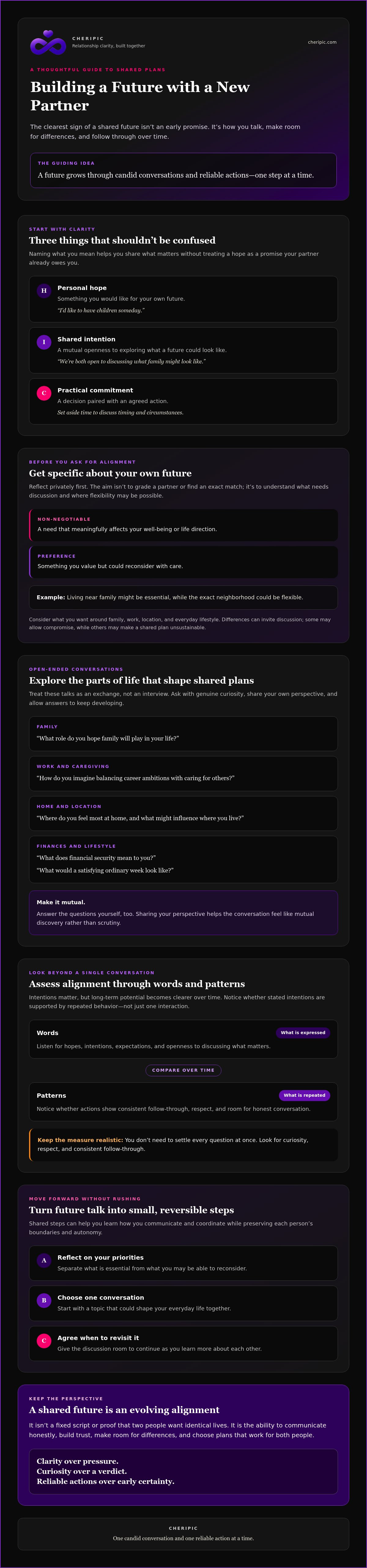
Separate three ideas that can easily blur. A personal hope might be, “I’d like to have children someday.” A shared intention could be, “We’re both open to discussing what family might look like.” A practical commitment is a decision paired with an agreed action, such as setting aside time to discuss timing and circumstances. Each has value, but they aren’t interchangeable. Naming the difference helps you explain what matters without treating a hope as a promise your partner already owes you.
A shared future is built from plans supported by mutual choices and consistent behavior.
What does building a future together mean in a new relationship?
A future together isn’t a fixed script or proof that two people want identical lives. It is an evolving alignment: the ability to communicate honestly, build trust, make room for differences, and choose plans that work for both people. An interpersonal relationship can take different forms and develop over time. A lasting bond doesn’t require one universal pace or sequence.
Curiosity invites understanding: “What does a fulfilling life look like to you?” Pressure demands a verdict: “Can you guarantee we’ll move in together?” The first helps each person explain their perspective. The second asks for certainty the relationship may not yet be equipped to provide.
What should you clarify about your own future first?
Before asking someone else to define a shared direction, get specific about your own. Consider what you want around family, work, location, and everyday lifestyle. Then separate core needs from preferences. For example, living near family might be essential, while the exact neighborhood could be flexible. This distinction helps you communicate clearly without presenting every preference as a condition.
- Non-negotiable: a need that meaningfully affects your well-being or life direction.
- Preference: something you value but could reconsider with care.
Use a private list to reflect, not to grade a partner. The aim isn’t to find someone who matches every item. It’s to understand which differences call for discussion, where compromise may be possible, and which differences could make a shared plan unsustainable.
Discuss Values, Life Goals, and Timelines Before Making Shared Plans
Once you’ve clarified what matters to you, find out how your priorities meet your partner’s. These conversations don’t need to feel like an interview or a test. Treat them as an exchange: ask with genuine curiosity, share your own perspective, and make room for answers that are still developing. That’s more useful than expecting instant agreement on every detail.
Which future-focused questions should new partners ask?
Choose a few areas that could shape daily life together, then invite each other to describe what feels important. For example:
- Family: “What role do you hope family will play in your life?”
- Work and caregiving: “How do you imagine balancing career ambitions with caring for others?”
- Home and location: “Where do you feel most at home, and what might influence where you live?”
- Finances and lifestyle: “What does financial security mean to you?” or “What would a satisfying ordinary week look like?”
Answer the questions yourself, too. If you ask about career priorities but don’t explain your own, the conversation can feel like scrutiny rather than mutual discovery. The Gottman Institute’s guidance on discussing the future offers another perspective on approaching these talks with care. For a more structured look at values alignment, explore this relationship compatibility assessment guide. An assessment can suggest useful questions, but it can’t replace honest conversation or your own judgment.
How can you discuss different timelines without creating pressure?
A timeline often has a reason behind it. One person may want to move soon for work; another may need more time because of family responsibilities or a previous experience. Ask what the preference means to each of you before treating it as a demand or a promise. “I’d like to live together within a year” expresses a current preference. It doesn’t, by itself, establish a mutual decision.
If you don’t have a shared answer yet, name what remains uncertain and agree when to return to it. You might say, “We see this differently right now. Can we talk again after we’ve each had time to think?” A review point keeps the question active without forcing premature agreement. As circumstances and trust develop, your understanding may change. Building a future with a new partner depends on being able to revisit plans honestly, not just having one decisive conversation.
If prompts would help you reflect on values and readiness, CheriPic’s relationship compatibility assessments may help you identify topics to discuss. Use them as a starting point, then let your conversations and choices guide what comes next.
Assess Long-Term Potential by Comparing Words with Patterns
Someone may say that honesty, reliability, or respect matters to them. Those statements are useful, but long-term potential becomes clearer when you notice whether their choices align with those values in different situations. Look for consistency without expecting perfection. A missed plan, a tense conversation, or a poorly chosen remark deserves context, not an immediate verdict about the relationship.
A recurring pattern is behavior repeated across situations. One isolated behavior is a single data point, not a conclusion.
What patterns can help you understand readiness for a shared future?
Notice whether communication and follow-through remain reasonably consistent, including when plans change or conversations become uncomfortable. After a disagreement, consider whether each person can acknowledge their part, listen to the impact, and make a sincere effort to repair. These observations can inform trust, but they can’t guarantee how a relationship will develop. Avoid diagnosing your partner or reducing them to their hardest moment.
Keep your assessment grounded by noting specific actions and open questions instead of labels such as “selfish” or “uncommitted.” Give observations a time frame: behavior repeated across several plans may tell you more than one difficult evening.
| Expressed value | Observed behavior | Open question | Time period |
|---|---|---|---|
| “I value reliability.” | Follows through on plans, or communicates when something changes. | How do we handle commitments when circumstances shift? | Across several plans |
| “I want respectful communication.” | Listens during disagreement and returns to unresolved issues. | Can we both raise concerns without dismissing each other? | Across different conversations |
How can you recognize when chemistry is obscuring important concerns?
Strong attraction can make it tempting to explain away recurring discomfort. Pause if you repeatedly feel unheard, find yourself lowering a core need to preserve the connection, or notice a mismatch between assurances and actions. One incident may have a reasonable explanation. Repeated incidents deserve a direct conversation and thoughtful attention.
Keep notes that separate what happened from what you inferred: “They cancelled twice without suggesting another plan” is an observation; “They don’t care about me” is a conclusion. Ask what context you may be missing, whether the behavior has changed, and how your partner responds when you raise it. For more guidance on noticing these patterns, read about the psychology of ignoring red flags.
As you consider building a future with a new partner, treat repeated choices as evidence to discuss, not as a substitute for discussion. The goal isn’t to reach certainty from observation alone. It’s to make better-informed decisions together.
Turn Future Conversations into Small, Reversible Shared Steps
A promising conversation doesn’t require an immediate, high-stakes decision. The practical test is whether you can turn a shared hope into a manageable next step, learn from the experience, and adjust together. This keeps building a future with a new partner grounded in real interaction rather than assumptions about what either person should be ready for.
Use this sequence:
- Name the hope: “We’d like to spend more time together in a way that fits both our schedules.”
- Choose a small step: Plan a day trip, cook together, or talk through one practical topic.
- Agree on boundaries: Clarify time, cost, responsibilities, and what each person is comfortable with.
- Review afterward: Discuss what worked, what felt difficult, and whether you’d choose a similar step again.
What are realistic first steps toward a shared future?
Start with a plan that matches the relationship’s current stage and what you know about each other. A shared activity can reveal preferences and coordination styles without requiring a major commitment. If you’re discussing a practical issue, focus on one subject, such as how you each approach saving or dividing household tasks, rather than trying to resolve every future question at once.
Before deciding, ask, “What would feel comfortable for you?” Then share your own answer. Either person should be able to suggest a change or decline without being treated as though they’ve rejected the relationship. Bigger decisions, such as combining finances, relocating, or buying property, call for direct discussion of risks and responsibilities. Where needed, seek advice from a qualified professional who understands the specific financial or legal circumstances.
How should couples revisit plans when circumstances change?
Set aside a calm time to check in instead of waiting until frustration turns into conflict. Discuss what’s working, what has changed, and whether the plan still suits both of you. A new job, family responsibility, or shift in comfort can change someone’s preferences. Sharing that change clearly is more respectful than silently expecting a partner to infer it.
Try: “I was comfortable with our original plan, but my circumstances have changed. Could we review it together?” This states a need without framing adjustment as rejection. A regular check-in also makes it easier for either partner to raise uncertainty before it becomes resentment. Revisit the agreement, listen to each other, and decide whether to continue, modify, or pause the step.
If reflection prompts would help you prepare for these conversations, explore CheriAI relationship coaching as one source of support. Use any insights to clarify your questions, then make decisions through mutual discussion and informed judgment.
Build Relationship Clarity with Reflection, Honest Dialogue, and Support
Clarity doesn’t come from finding a tool or conversation that removes all uncertainty. It comes from using what you learn to make a considered choice together. As a practical next step, reflect individually, choose one question you want to discuss, then agree on when to revisit it. That keeps building a future with a new partner rooted in honest dialogue and shared judgment, rather than pressure to reach a final answer immediately.
Before the conversation, write down what you want to understand and what you’re prepared to share. During it, listen for the other person’s perspective as well as their answer. Afterward, consider whether the discussion helped you understand each other. If anything remains unresolved, agree on a point to revisit it. A review date isn’t a deadline for commitment. It helps ensure important questions don’t disappear into silence.
When can a relationship coach or assessment help?
Structured prompts can help you identify values, prepare questions, and notice patterns you may want to discuss. They’re most useful as a starting point for reflection, not as a verdict. CheriAI offers personalized relationship insights and pattern recognition, while CheriPic offers relationship compatibility assessments. Neither can guarantee compatibility, determine whether someone is trustworthy, or replace direct communication. For a deeper look at the role of these tools, read this AI relationship coach guide.
How can you take a thoughtful next step with CheriPic?
CheriPic is a relationship intelligence platform with coaching, compatibility assessment, and identity and profile verification tools. These can support a more intentional approach by giving you additional material for reflection. They can’t establish whether a relationship is right for you; that judgment still depends on what you learn through conversation and observe over time. Before relying on a particular feature, check its current availability and precise scope.
Keep the next step simple: identify one question, discuss it openly, and decide together whether a follow-up conversation would help. If a structured tool offers useful prompts, bring those questions into the relationship rather than treating a result as a decision. Your pace and boundaries still matter.
If you’d like structured support for intentional connection, explore CheriPic’s relationship tools and consider whether they fit what you’re looking for.
Take the Next Step with Clarity and Care
Building a future with a new partner doesn’t require certainty about every milestone. It asks for something more grounded: clarity about your priorities, honest conversations about what matters, and attention to whether your choices consistently support the intentions you share.
Let the process stay gradual. Reflect on what you need, choose one meaningful conversation, and agree on a point to revisit anything unresolved. Small, thoughtful steps can help you learn about your connection while respecting both people’s boundaries and pace.
If structured support would help you reflect, CheriPic offers relationship compatibility assessments, CheriAI insights for pattern recognition, and identity and profile verification tools. These resources can prompt useful questions, but they can’t decide whether a relationship is right for you or replace direct communication.
Explore CheriPic for a more intentional approach to relationship clarity. A strong shared future isn’t promised all at once. It takes shape through mutual choices, honest dialogue, and a willingness to keep learning about each other.
Frequently Asked Questions
How soon should you talk about the future with a new partner?
There’s no universal timetable. Start discussing future topics when they become relevant, and keep early conversations exploratory rather than demanding certainty. You might share that having a family matters to you someday, then ask how your partner thinks about family. As you gain experience together, revisit the topic with more context. The aim is to understand each other’s direction, not to secure a promise before either person is ready.
What should you discuss before building a future together?
Discuss the areas that could shape everyday life: values, family, children or caregiving, work, finances, location, lifestyle, and expectations about commitment. You don’t have to cover everything in one conversation. Choose one topic, ask open questions, and share your own perspective too. For example, explain what financial security means to you rather than asking only how your partner handles money. Specific answers reveal where further discussion may help.
Can a new relationship become serious without moving too quickly?
Yes. A relationship can be intentional and serious while decisions unfold gradually. Seriousness is shown through honesty, respect, follow-through, and willingness to discuss what matters, not only through major commitments made early. Choose steps that fit what you currently know about each other, and agree on boundaries before making plans. This allows closeness to develop while preserving each person’s ability to pause, reconsider, or express a different need.
How do you know if you and your partner want the same things?
You learn by discussing priorities and comparing what each person says with their choices over time. You don’t need identical preferences, but it helps to know whether important goals can coexist. Talk about family, work, home, and lifestyle, then notice how you navigate differences and follow through on agreements. Treat a mismatch as a reason to ask questions, not as an instant verdict. Shared direction becomes clearer through both dialogue and repeated behavior.
What happens if you have different timelines for commitment?
First, ask what each timeline represents. A preferred pace may reflect personal readiness, practical circumstances, or a need for more information. Explain your own reasons without presenting them as demands, and ask your partner to do the same. If you can’t resolve the difference now, agree on when to revisit it. Then consider whether both people’s needs can be respected. Avoid treating a present preference as a binding promise.
Can chemistry predict whether a relationship will last?
No. Chemistry can create attraction and excitement, but it can’t establish whether you share important values or can navigate everyday decisions together. As building a future with a new partner develops, pay attention to communication, respect, reliability, and how you handle disagreements. Notice recurring discomfort instead of explaining it away because the connection feels intense. Attraction can be part of a relationship, but consistent choices provide additional information about how it works over time.
How do you make future plans without pressuring your partner?
Name a hope, invite your partner’s perspective, and suggest a manageable next step rather than asking for a sweeping commitment. For example, say, “I’d like to talk about where we see ourselves living. Would you be open to discussing that?” Ask what feels comfortable to both of you, agree on boundaries, and set a time to revisit unresolved questions. Make room for a changed preference. Clear plans are collaborative, not assumed.


