

What if the behavior that leaves you uncertain matters less than whether it keeps happening? A delayed reply, a hard week, or one uncomfortable conversation can have many explanations. But if you’re repeatedly left feeling alone, dismissed, or responsible for starting every meaningful discussion, it’s reasonable to look more closely at the pattern. The signs of emotional unavailability aren’t a checklist or a diagnosis. They’re recurring behaviors that limit mutual emotional engagement.
It can be especially confusing when intense chemistry or occasional affection sits alongside distance. You may wonder whether your partner needs time, is under temporary strain, or can’t consistently participate in emotional intimacy. This article will help you distinguish a difficult season from a persistent pattern, recognize common signs without jumping to conclusions, and decide what to do next. You’ll learn how to name your needs, set clear boundaries, and assess the response over time. The aim isn’t to label someone. It’s to make a grounded decision based on what they consistently do, not only what they promise or how connected you feel in the best moments.
Key Takeaways
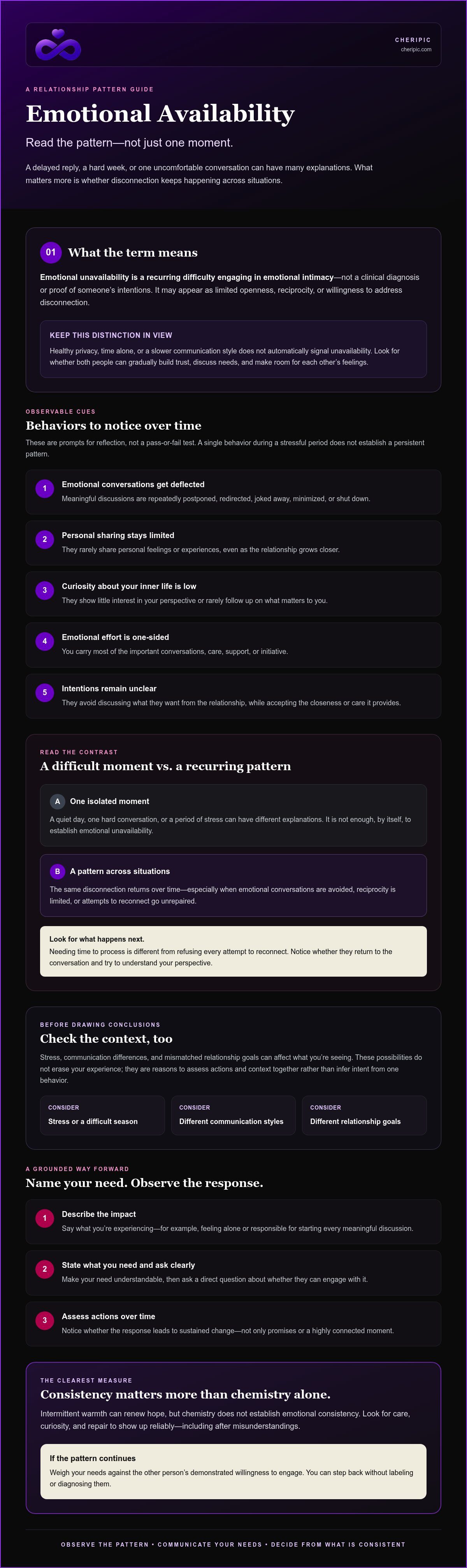
- Assess the signs of emotional unavailability as recurring behaviors across different situations, not as proof of someone’s intentions or a diagnosis.
- Notice whether emotional conversations are repeatedly deflected, reciprocity is limited, or attempts to reconnect go unrepaired.
- Consider stress, communication differences, and mismatched relationship goals before drawing conclusions from one behavior.
- Describe the impact you’re experiencing, state what you need, and ask a clear question. Then observe whether their response leads to sustained change.
- If the pattern continues, weigh your needs against the other person’s demonstrated willingness to engage. You can step back without labeling or diagnosing them.
What Are the Signs of Emotional Unavailability in a Relationship?
Emotional unavailability is a recurring difficulty engaging in emotional intimacy, not a clinical diagnosis or proof of someone’s intentions. It may show up as limited openness, reciprocity, or willingness to address disconnection. The signs of emotional unavailability matter when they form a pattern across time and situations, not when someone has one quiet day or struggles with a single conversation.
People differ in how much they share and how quickly they feel comfortable doing so. Healthy privacy, time alone, or a slower communication style doesn’t automatically signal unavailability. Look instead at whether both people can gradually build trust, discuss needs, and make room for each other’s feelings.
How does emotional unavailability show up in everyday dating?
Notice what happens as the connection deepens. A person may repeatedly change the subject when conversations turn vulnerable, give minimal answers to meaningful questions, or keep dates focused on light topics even as closeness grows. They might enjoy spending time together but rarely ask about your inner experience or share their own. These are observable behaviors, not a diagnosis or an explanation for why they happen.
Why can the pattern be difficult to recognize?
Intermittent warmth can blur the picture. A thoughtful message or affectionate weekend may renew hope, even if important conversations are still avoided and effort remains one-sided. Chemistry can be real, but it doesn’t establish emotional consistency. Assess whether care, curiosity, and repair show up reliably, including after misunderstandings, rather than judging the relationship by its most connected moments.
Attachment theory offers one lens for understanding how people approach closeness. An overview of attachment styles in adults can provide background, but it can’t tell you what a specific person feels or will choose. It’s also easy to explain away concerning behavior when attraction is strong. If that feels familiar, the psychology of ignoring red flags can help you examine how hope and attention shape your interpretation. Return to what you can observe: whether emotional effort is mutual and sustained.
Seven Signs of Emotional Unavailability to Notice Over Time
Use these signs as prompts for reflection, not a pass-or-fail test. A person may show one behavior during a stressful period without having a persistent difficulty with emotional intimacy. The more useful question is whether the same pattern returns in different situations, especially after you’ve communicated what you need.
Repeated behavior offers more information than isolated incidents. Consider actions, context, and consistency together. These signs don’t prove intent or explain someone’s reasons. They can help you assess whether emotional engagement is mutual.
Do they avoid vulnerability and emotional conversations?
Notice whether meaningful discussions are repeatedly postponed, deflected, or shut down. Someone might minimize a concern with “It’s not a big deal,” change the subject when you ask how they feel, or become unavailable whenever the relationship needs attention. Needing time to process is different from refusing every attempt to reconnect. Look for whether they return to the conversation and make a genuine effort to understand your perspective.
Are closeness, commitment, and reciprocity consistently limited?
Look beyond affectionate moments. Does one person mostly initiate plans, offer support, and raise important questions? Does the relationship remain undefined while one person accepts the closeness or care it provides? A person may also pull back after increased intimacy, such as after a vulnerable conversation or a discussion about commitment. That change is worth noticing, but it doesn’t establish why it happened.
- Emotional deflection: Difficult topics repeatedly get redirected, joked away, or left unresolved.
- Limited self-disclosure: They rarely share personal feelings or experiences, even as the relationship grows closer.
- Low curiosity: They show little interest in your inner life or follow up on what matters to you.
- One-sided effort: You carry most of the emotional conversations, care, and initiative.
- Unclear intentions: They avoid discussing what kind of relationship they want while continuing to accept its benefits.
- Withdrawal after closeness: Their engagement drops repeatedly after moments of greater intimacy or vulnerability.
- Difficulty repairing disconnection: After conflict or hurt, they don’t acknowledge the impact or work with you to reconnect.
One missed conversation or uneven week isn’t enough to establish a pattern. Ask yourself what tends to happen, whether you’ve raised the concern clearly, and whether their response leads to sustained change. Notes about recurring interactions can help you distinguish a memorable moment from the relationship’s usual dynamic.
If reflecting on relationship patterns would be useful, CheriAI relationship coaching offers personalized insights as a complement to direct communication, not a diagnosis or verdict about another person.
Emotional Unavailability, Stress, or Incompatibility: How to Tell the Difference
A change in emotional engagement can have more than one explanation. Pressure at work, grief, health concerns, or a major life transition may temporarily reduce someone’s capacity for conversation. Different communication styles can also affect how quickly people disclose personal feelings. One behavior alone can’t establish a person’s emotional capacity, intentions, or future choices. Look at the context, whether they communicate their limits, and what happens afterward.
Could stress or communication differences explain the behavior?
Consider whether the distance began alongside a specific strain and whether the person acknowledges its effect on the relationship. Someone who needs time to process may say so, then make a genuine effort to return to the conversation. Introversion, privacy, or slower disclosure isn’t evidence of emotional unavailability by itself. Follow-through, rather than assumptions about what quietness means, helps clarify the difference.
| Pattern | Alternative explanation to consider | What to observe next |
|---|---|---|
| They’re less communicative during a demanding period. | Stress, grief, health concerns, or a life change may be affecting their capacity. | Do they explain what they can manage and reconnect when circumstances allow? |
| They share feelings slowly or prefer private reflection. | A different communication style or pace of trust may be at play. | Can they still listen, respond to your needs, and share more over time? |
| They avoid defining the relationship or discussing the future. | You may want different levels of commitment or have mismatched goals. | Can you discuss what each person wants and reach an honest understanding? |
| They repeatedly withdraw after difficult conversations. | They may need time to regulate, or the pattern may reflect ongoing avoidance. | Do they return to the topic and take part in repair, or does it remain unresolved? |
When does a mismatch become a meaningful relationship concern?
A mismatch matters when stated intentions, needs, or preferred pace remain incompatible and neither person can negotiate without dismissing the other. One partner may want commitment while the other prefers to keep things undefined. Neither preference is automatically wrong. What matters is whether both people can discuss the difference and decide what they’re willing to build, or whether one person’s needs repeatedly go unaddressed.
Give more weight to sustained follow-through than to explanations, promises, or a brief return to closeness. If you’re clarifying shared priorities, a relationship compatibility assessment can offer a structure for reflecting on values and expectations. It can support discussion, but it can’t guarantee compatibility or determine someone’s emotional readiness.
Use the signs of emotional unavailability as prompts to examine a repeated pattern, not as a verdict. Ask what changed, what the person communicated, and whether their actions over time make room for both people’s needs.
How to Talk About Emotional Needs and Set Boundaries
A productive conversation doesn’t require you to diagnose the other person or prove why they act as they do. Focus on what you’ve observed, how it affects you, and what you need in order to continue. Then ask a direct question and listen to the answer. The goal is clarity, not persuasion.
What can you say without turning the conversation into an accusation?
Choose a calm moment and describe a specific recurring interaction rather than making a broad claim about their character. For example: “When I bring up something difficult, we often change the subject, and I’m left unsure whether we can work through it together. I need us to be able to talk about concerns. Are you interested in building more emotional closeness, and do you feel able to work on that with me?”
This names the behavior, its impact, and your need while leaving room for an honest response. Give them time to think, but don’t erase your own needs while waiting. A thoughtful answer matters, and so does what follows it.
How can you assess whether behavior is changing?
Make the request observable and mutual. You might agree to return to a difficult topic after taking time to process, check in with each other about unresolved concerns, or share responsibility for initiating meaningful conversations. These aren’t tests. They’re practical ways to see whether both people are willing to create more reliable communication.
A stated need becomes meaningful evidence when it’s met with consistent, observable follow-through. After the conversation, look for repeated effort, accountability, and repair, not only reassurance in the moment. Do they return to the topic as agreed? Do they acknowledge the impact of their actions? Does emotional effort become more mutual over time?
A boundary is a decision about your own participation, not a rule that controls someone else. You might say, “I’m looking for a relationship where we can discuss difficult things. If we can’t make space for those conversations, I’ll need to reconsider whether this relationship works for me.” Then follow through on the choice you’ve named. Boundaries protect your needs; they don’t compel another person to change.
If you’re unsure whether a shift is lasting, write down what happened, what you asked for, and what the person did afterward. This can help you distinguish a sustained pattern from one reassuring interaction. Support from a qualified professional may also help you clarify your needs and options.
For additional support reflecting on relationship patterns, explore CheriAI relationship coaching. It can complement direct communication, but it doesn’t diagnose another person or decide what you should choose.
What to Do If Emotional Unavailability Remains a Pattern
If you’ve communicated your needs and the same distance continues, shift from trying to explain the pattern to evaluating what it means for you. The signs of emotional unavailability don’t need to add up to a label before you can make a decision. You can step back because the relationship isn’t meeting your needs, without proving the other person’s intentions or predicting whether they might change.
How do you decide whether to continue, pause, or leave?
Consider three things: whether you can raise concerns safely and be treated with respect, whether the relationship as it consistently operates meets your needs, and whether the other person shows sustained willingness to participate in change. Compare the relationship you’re experiencing with the one you need, not only with its most hopeful moments.
Continuing, pausing, or leaving are personal decisions. You might take time to reflect, ask where the relationship is heading, or choose to end it if the pattern is no longer acceptable to you. If the decision feels difficult or high-stakes, a trusted person or qualified professional can help you think through your options without deciding for you.
How can relationship intelligence support more intentional choices?
Independent reflection can help you clarify what you value, what you’ve observed, and what questions remain. CheriAI offers personalized relationship insights and pattern reflection as an optional aid. It can help organize your thinking, but it can’t determine another person’s emotional capacity, replace direct conversation, or provide professional care. Check the platform for current features and access details.
Before taking a next step, write down what you need from a relationship, what the other person has consistently demonstrated, and what you’re willing to do if the pattern continues. This can help you make a decision grounded in reality rather than potential.
If you’d like an additional tool for intentional reflection, explore CheriPic’s relationship intelligence platform. Use it to complement your judgment and conversations, not as a verdict about someone else.
Choose Your Next Step With Clarity
Recognizing signs of emotional unavailability isn’t about assigning a label. It’s about noticing whether emotional effort is mutual, communicating what you need, and assessing whether actions change consistently over time. Stress or different communication styles may explain a difficult moment, but your decision can rest on how the relationship works in practice and whether it meets your needs.
You don’t have to prove someone’s intentions before choosing to continue, pause, or step away. Give weight to your experience, the pattern you’ve observed, and the other person’s demonstrated willingness to engage. Your needs matter even when the explanation for someone else’s behavior remains uncertain.
CheriPic offers relationship compatibility assessments and identity and profile verification. CheriAI provides personalized relationship insights and pattern recognition. Check the platform for current feature details. These tools can support intentional decision-making, but they don’t diagnose emotional unavailability or replace direct conversation.
Explore CheriPic’s relationship intelligence platform as one option for reflecting on your relationship priorities. Move forward thoughtfully, with greater trust in what consistent behavior shows you.
Frequently Asked Questions
What are the most common signs of emotional unavailability?
Common signs include repeatedly avoiding vulnerable conversations, offering little emotional reciprocity, keeping the relationship undefined, withdrawing after moments of closeness, and struggling to repair disconnection. These behaviors matter most when they recur across situations and continue after you’ve expressed what you need. A single quiet day, delayed reply, or difficult conversation isn’t enough to establish a pattern. Consider the broader context and whether mutual emotional effort is present over time.
Can someone be emotionally unavailable and still care about you?
Yes. Someone can care about you and still have difficulty sharing feelings, responding to emotional needs, or participating in the kind of closeness you want. Care and capacity are not the same thing. Rather than trying to infer what they feel, consider what they consistently offer and whether they’re willing to discuss the gap. Your decision can be based on how the relationship affects you, even if their feelings are genuine.
How can you tell emotional unavailability from stress?
Look at timing, communication, and follow-through. If distance began during a demanding period, the person acknowledges the strain, and they make an effort to reconnect when they can, stress may be contributing. If emotional conversations are avoided repeatedly across circumstances, that suggests a broader pattern worth discussing. Neither explanation is certain from one interaction. Ask what’s affecting their availability, express what you need, and observe whether the relationship becomes more mutual.
Is emotional unavailability a mental health diagnosis?
No. Emotional unavailability is a descriptive term for a pattern of difficulty engaging in emotional intimacy, not a formal mental health diagnosis in the DSM-5-TR. A partner’s behavior alone cannot establish a clinical condition or explain its cause. Avoid diagnosing them yourself. If their behavior raises concerns about their well-being, they can consider speaking with a qualified mental health professional. You can still set boundaries based on your own experience of the relationship.
Can an emotionally unavailable person change?
Change is possible, but it can’t be assumed or produced by a partner’s patience alone. Meaningful progress requires the person to recognize the pattern and show willingness through repeated actions, such as returning to difficult conversations and taking responsibility for disconnection. Promises or a short period of increased affection don’t establish lasting change. You can remain open to growth while making decisions based on what is happening now.
What should I say to someone who avoids emotional conversations?
Describe a specific behavior, its impact, and one clear need. For example: “When our conversations about concerns stop without a plan to return to them, I feel alone with the issue. I need us to make space to talk. Are you willing to work on that with me?” Give them room to respond, then notice whether they engage and follow through. You don’t need to use a psychological label to ask for clarity.
Should I end a relationship with someone who seems emotionally unavailable?
That decision depends on whether the relationship, as it consistently operates, meets your needs and whether both people are willing to address the gap. Consider whether you can raise concerns respectfully, whether effort is mutual, and whether promised changes become sustained behavior. You don’t have to prove the other person’s intentions or apply a label before stepping away. If the choice feels especially difficult, seek perspective from someone you trust or a qualified professional.


