

A profile that says “looking for a relationship” isn’t proof that someone is ready to build one. That’s the central challenge with dating apps for serious relationships only: stated intentions, polished profiles, and engaging conversations don’t always reveal whether your goals align.
If you’re wondering which app can help you meet people who genuinely want commitment, the answer depends on more than a platform’s label. Endless messaging or unclear identity details can make it difficult to judge whether a connection deserves your attention. This guide will help you compare platforms using practical criteria for relationship intent, trust, and compatibility.
You’ll learn what verification and compatibility tools can indicate, where their limits are, and how to assess a person through conversation and consistent behavior. We’ll also cover how to move from thoughtful evaluation toward a real-world connection without treating more swipes or longer chats as progress. The goal isn’t to find a platform that makes decisions for you. It’s to choose an approach that helps you make better ones.
Key Takeaways
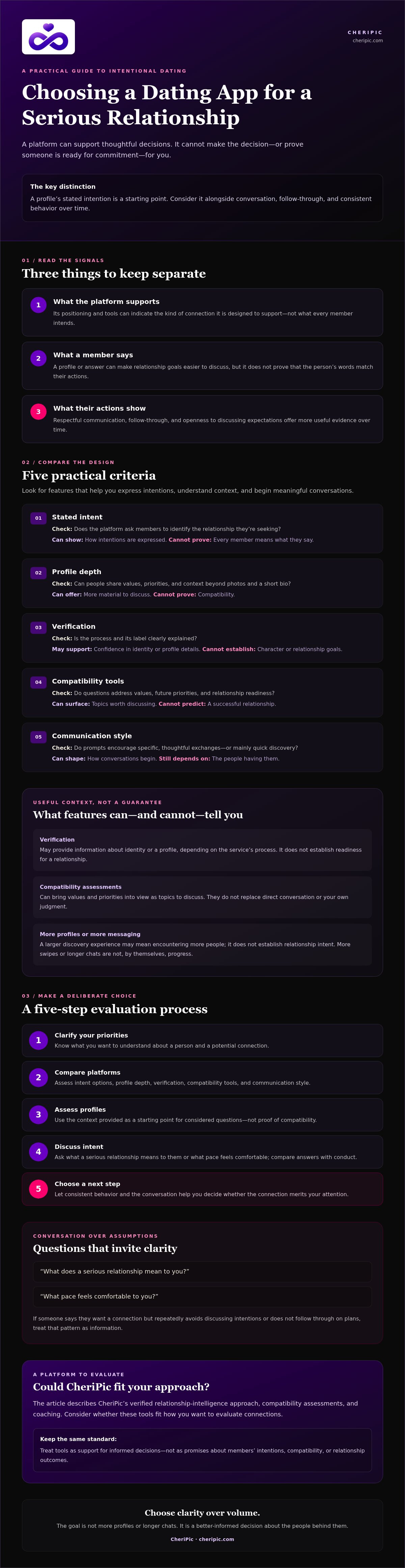
- Evaluate dating apps for serious relationships only by their stated intent, profile depth, verification, compatibility tools, and communication style.
- Distinguish features that support informed decisions from promises no platform can make about members’ intentions or relationship outcomes.
- Use a deliberate five-step process: clarify your priorities, compare platforms, assess profiles, discuss intent, and choose a next step.
- Look for prompts that help you begin meaningful conversations, not just tools that increase the number of profiles you see.
- Consider whether CheriPic’s verified relationship-intelligence approach, compatibility assessments, and coaching fit how you want to evaluate connections.
What Dating Apps for Serious Relationships Only Can and Cannot Promise
The label “serious relationships only” can sound like a filter that removes uncertainty. It isn’t. A platform can be designed to support deliberate connections, but its positioning alone can’t verify that every member is ready for commitment or will act consistently.
A serious-relationship platform signals the kind of connection it is built to support. It cannot guarantee the intentions, compatibility, or behavior of the people using it. That distinction matters when assessing dating apps for serious relationships only. Look beyond the tagline to the tools and prompts that help members express what they want, share relevant context, and consider compatibility.
What does “serious relationships only” mean on a dating platform?
The phrase describes an intended use, not a promise about every profile. Check how a platform asks members to state their goals. Does it offer clear relationship-intention options, ask questions that reveal priorities, or provide space for more than a brief bio? These features can make intentions easier to discuss, but they don’t prove that someone’s answers match their behavior.
Keep three signals separate: what the platform says it supports, what a member says they’re seeking, and what their actions demonstrate over time. A profile may state a desire for commitment. Respectful communication, follow-through, and openness to discussing expectations offer more useful evidence of how that person approaches a connection.
Why an app cannot guarantee someone’s intentions
Profiles are self-presentations. Prompts, compatibility tools, and verification may add useful context, but none can replace your own judgment or a direct conversation. Verification, for example, may provide information about identity or a profile, depending on how a specific service defines its process. It doesn’t establish someone’s readiness for a relationship.
Ask clear, respectful questions early. You might ask what a serious relationship means to them or what pace feels comfortable. Then compare their answers with their conduct. If someone says they want to build a connection but repeatedly avoids discussing intentions or doesn’t follow through on plans, treat that pattern as information instead of interpreting the profile more generously.
A large member count or broad discovery experience may increase the number of people you encounter. It doesn’t establish relationship intent. Focus instead on whether the platform’s design helps you assess goals and start substantive conversations. For a broader view of platforms and their stated features, consult this comparison of online dating services, then verify details directly with each service. The useful question isn’t simply how many profiles are available. It’s whether the platform helps you make a clearer decision about the people behind them.
How to Compare Dating Apps for Serious Relationships
Compare a platform’s actual design, not just its promise. Useful criteria show whether an app helps you communicate intentions, assess context, and make considered decisions. No single feature establishes that a member is ready for commitment, but a clear comparison can help you decide where to invest your attention.
| Criterion | What to check | What it can and can’t tell you |
|---|---|---|
| Stated intent | Does the platform ask members to identify the relationship they’re seeking? | Shows how intentions are expressed, not whether every member means what they say. |
| Profile depth | Can people share values, priorities, and context beyond photos and a short bio? | Offers more material to discuss, but doesn’t prove compatibility. |
| Verification | Are the verification process and label clearly explained? | May support confidence in identity or profile details. It doesn’t establish character or relationship goals. |
| Compatibility tools | Do questions address values, future priorities, and relationship readiness? | Can surface topics worth discussing, not predict a successful relationship. |
| Communication style | Do prompts support specific, thoughtful exchanges, or mainly quick discovery? | Can shape how conversations begin, but members still determine their quality. |
Use the table to separate confirmed features from hoped-for outcomes. A platform may offer identity and profile verification or relationship compatibility assessments. Those are features to evaluate. A lasting relationship is an outcome no feature can promise. For broader context on online dating experiences, Pew Research Center data can help frame what users report, while platform-specific claims should be checked directly with the service.
Which trust and verification signals should you assess?
Look for a plain-language explanation of what a verification label confirms and what it leaves unknown. An identity check is not proof of someone’s intentions, values, or conduct. For a closer look at the distinctions, consult a dating app identity-verification guide. Treat verification as one useful signal, then assess a person through respectful questions and consistent behavior.
Do compatibility tools help identify long-term alignment?
Useful questions invite reflection on values, future priorities, and readiness for a relationship. A relationship compatibility assessment can help people identify topics to explore, but it can’t settle whether two people will work well together. A relationship intelligence platform guide offers broader context on this approach. Use results to ask better questions, not to outsource your judgment.
If you’re comparing a relationship-intelligence approach with profile-first discovery, explore CheriPic’s relationship-focused approach as one option to assess. Check its current offering details directly and weigh them against the criteria above.
Dating Apps for Serious Relationships Only vs. General Dating Apps
The difference is usually one of emphasis, not a guarantee of better outcomes. General dating apps often center on browsing and discovery, while relationship-focused platforms may put more weight on stated intentions, profile detail, compatibility reflection, or guidance on what to consider next.
General dating apps tend to offer more open-ended discovery. Relationship-intelligence approaches add structure for reflecting on intent and compatibility. Neither model is universally superior. A larger pool or a longer list of filters doesn’t automatically create stronger alignment. What matters is whether the experience helps you identify relevant questions and make decisions that reflect your priorities.
| Experience | Potential value | Trade-off to consider |
|---|---|---|
| Open-ended browsing | Lets you explore a range of profiles and decide who to contact. | You may need to clarify relationship goals and values yourself. |
| Detailed profiles and intent prompts | Can give you more context for starting a focused conversation. | Answers are self-reported and still need to be discussed. |
| Structured reflection or compatibility tools | May bring values and priorities into view before you invest further. | Prompts and assessments support reflection. They can’t predict how a connection will develop. |
| Next-step guidance | May help shift attention from prolonged chat toward a considered decision. | You still need to assess readiness, communication, and follow-through together. |
When does a general dating app make sense?
Broad discovery may suit you if variety matters and you’re comfortable asking about intentions directly. Before choosing, check each app’s current features rather than assuming all general platforms offer the same profile prompts, filters, or communication options. Use your own criteria to narrow conversations, and don’t treat a high volume of profiles as evidence of relationship alignment.
When might a relationship-intelligence approach fit better?
If you want more structure for considering values, compatibility, and your own decision patterns, a relationship-intelligence approach may be worth evaluating. CheriPic is one example. Its listed offerings include identity and profile verification, Relationship Compatibility Assessments, and CheriAI Relationship Coaching. These tools can support reflection and discernment, but they don’t guarantee compatibility, commitment, or a particular outcome.
Consider what you need before choosing: open access to discovery, prompts that make intentions easier to discuss, or structured support for evaluating relationship priorities. Then review each platform’s current explanations of its features. The better fit is the one whose process matches how deliberately you want to connect, not necessarily the one with the most profiles or the strongest promise.
How to Choose and Use a Serious-Relationship Dating App
A platform can shape your options, but your process determines how thoughtfully you use them. Apply these five steps before investing heavily in a new connection:
- Define your priorities. Identify the values and relationship goals that matter most, along with areas where you’re open to discussion.
- Compare features. Check whether profiles, prompts, and tools help you assess the priorities you’ve identified. Test a few prompts: could they help you begin a meaningful conversation, or do they invite only a quick reaction?
- Assess profiles. Look for specific details that give you something substantial to ask about. Treat profile statements as conversation starters, not proof.
- Discuss intent. Ask clear, respectful questions about relationship goals and expectations at a pace that feels appropriate to both of you.
- Decide next steps. Consider whether communication and actions appear consistent, then choose whether to continue messaging, meet, or step back.
What should you clarify before creating a profile?
Separate non-negotiable values from preferences you’re willing to discuss. Then write a profile that reflects what you want without claiming certainty or readiness you don’t feel. Compare apps by asking whether their questions help you express those priorities and recognize people who may share them. A profile should be honest, not optimized to attract everyone.
How do you move from messaging to meaningful evaluation?
Move beyond small talk with questions such as, “What does a serious relationship look like to you?” Listen for whether the answer is clear and whether later actions align with it. No single exchange settles the question. Patterns matter. If a behavior raises concern, review a guide to identifying relationship red flags and consider whether the pattern fits your boundaries.
Protect your privacy as you get to know someone. Avoid sharing sensitive personal or financial details, and check the platform’s privacy and reporting options. Before meeting, choose a public place, arrange your own transportation, and let someone you trust know your plans. Meet only when both people feel ready, and agree on a next step that feels comfortable rather than pressured.
Use dating apps for serious relationships only as a setting for careful evaluation, not as a substitute for it. If you’re considering a platform that includes identity and profile verification, relationship compatibility assessments, or coaching, explore CheriPic’s relationship-focused approach and review its current offering details.
Is CheriPic a Fit for People Seeking Serious Relationships?
CheriPic may appeal to people who want more than profile browsing as they assess a potential connection. It describes itself as a verified relationship-intelligence platform, with listed offerings intended to support reflection and more deliberate decisions. That makes it a different approach from a traditional swipe-based dating app or a human matchmaking service.
What CheriPic offers for more intentional connection
CheriPic lists identity and profile verification, Relationship Compatibility Assessments, and CheriAI Relationship Coaching. The assessments may give users topics to reflect on, while CheriAI provides relationship insights and pattern recognition. These offerings can support a more considered evaluation process. They don’t establish that two people are compatible or ready for commitment.
The platform also states an emphasis on intentional connections and real-world experiences rather than endless messaging. That approach may be relevant if you prefer reflection before deciding whether to take a next step. Before relying on any verification label, review the platform’s explanation of what it checks and what it does not. Don’t assume the exact verification process.
How to decide whether its approach matches your priorities
Ask yourself whether structured reflection and relationship insights suit the way you make decisions. Would compatibility questions help you identify subjects to discuss? Would coaching help you notice patterns in your own relationship choices? If you prefer to assess people through direct conversation without added reflection tools, another format may fit your process better.
As with other dating apps for serious relationships only, features can support discernment but cannot guarantee serious intentions, compatibility, or relationship outcomes. Treat assessments as prompts for conversation, verification as limited information about identity or a profile, and coaching as a source of insight rather than a decision-maker. A person’s communication and follow-through still matter.
Before joining, confirm whether the CheriPic Early Access Membership is currently available and review its included features. Don’t assume availability, terms, or specific capabilities without checking the current platform information.
Explore CheriPic and its relationship-intelligence approach to review its current information and decide whether the stated offerings align with your priorities.
Choose a Platform That Supports Your Intentions
The strongest choice isn’t necessarily the app with the most profiles or filters. It’s the one whose prompts and tools help you clarify priorities, assess trust, and begin conversations that reveal whether your goals align. Dating apps for serious relationships only can create a more intentional starting point, but no platform can confirm someone’s readiness or guarantee a relationship outcome. Your judgment still matters.
CheriPic offers identity and profile verification, relationship compatibility assessments, and CheriAI Relationship Coaching, which provides relationship insights and pattern recognition. Its stated approach encourages intentional connections and real-world experiences. Consider whether that kind of structured reflection fits how you want to make relationship decisions, and review current platform information before deciding.
Explore CheriPic’s relationship-intelligence approach to review its current offerings. Choose thoughtfully, stay grounded in your priorities, and give your time to connections that show consistency as well as stated intent.
Frequently Asked Questions
Are there dating apps for serious relationships only?
Some platforms are positioned for people seeking committed relationships, but “serious relationships only” describes an intended purpose, not a guarantee about every member. Look for clear ways to state relationship goals, detailed profiles, compatibility questions, or tools that encourage thoughtful decisions. These features can help you assess whether an app suits your priorities. You’ll still need to clarify intentions with each person and consider whether their actions match what they say.
How can I tell whether someone on a dating app wants a serious relationship?
Ask directly and respectfully what a serious relationship means to them, then observe whether their behavior aligns with their answer. A profile or conversation can offer clues, but neither proves readiness for commitment. Notice whether the person communicates clearly, respects your pace, and follows through on plans. One interaction may not reveal a pattern, so give yourself time to assess consistency without dismissing concerns that conflict with your boundaries.
Do verified dating profiles mean someone is ready for a relationship?
No. A verification label may indicate that a platform has checked certain identity or profile details, but its meaning depends on the service’s process. It doesn’t establish someone’s character, relationship intentions, or readiness for commitment. Before relying on a badge, check what the platform says it verifies and what it doesn’t. Treat verification as one limited trust signal, then assess intentions through conversation and consistent behavior.
What should I compare when choosing a dating app for a serious relationship?
Compare how each app presents relationship intent, the depth of its profiles, the clarity of its verification information, its compatibility tools, and the way it supports communication. Ask whether prompts help you express priorities and begin substantive conversations. Also check which features are currently available and how they work. More profiles or filters don’t necessarily mean better alignment. Choose a platform whose design supports the kind of evaluation you value.
Can a compatibility assessment predict whether a relationship will last?
No assessment can reliably guarantee whether a relationship will last. A compatibility assessment can help surface values, priorities, or questions that deserve discussion, but it can’t replace communication or show how two people will behave over time. Treat results as a starting point for reflection, not a verdict. Ask each other about areas of alignment and difference, then consider how you communicate, handle disagreement, and follow through on shared expectations.
How do I avoid endless messaging when dating online?
Give conversations a purpose. After establishing basic comfort, ask a meaningful question about relationship goals or expectations rather than extending small talk indefinitely. If there’s mutual interest, discuss a next step that feels safe and comfortable to both of you, such as meeting in a public place. You don’t need to rush, but repeated messaging without greater clarity may not serve your priorities. Pay attention to whether both people show reciprocal effort.
Is CheriPic a traditional swipe-based dating app?
No. CheriPic describes itself as a verified relationship-intelligence platform, not a traditional swipe-based dating app or a human matchmaking service. Its listed offerings include identity and profile verification, Relationship Compatibility Assessments, and CheriAI Relationship Coaching. The platform states that it encourages intentional connections and real-world experiences. These tools may support reflection and decision-making, but they don’t guarantee another person’s intentions, compatibility, or a particular relationship outcome.


