

A relationship check-in is an exercise in intentional architecture, not an emotional interrogation. Still, knowing how to have a relationship check-in without triggering defensiveness is one of the hardest hurdles couples face. It's exhausting to watch a well-intentioned conversation deteriorate into reactive scorekeeping, leaving both partners guarded and misunderstood. When unaddressed logistics and micro-frustrations compound, the emotional distance grows; yet the fear of sparking conflict often forces you into silence.
Sustainable intimacy doesn't require emotional endurance; it requires a structured process. In this strategic guide, you'll master a repeatable framework designed to preserve psychological safety, align mutual expectations, and dissolve underlying friction before it calcifies into resentment. Ahead, you'll discover the optimal cadence to maintain, the exact questions to evaluate your partnership, and a calm, reliable agenda that turns volatile confrontations into routine maintenance.
Key Takeaways
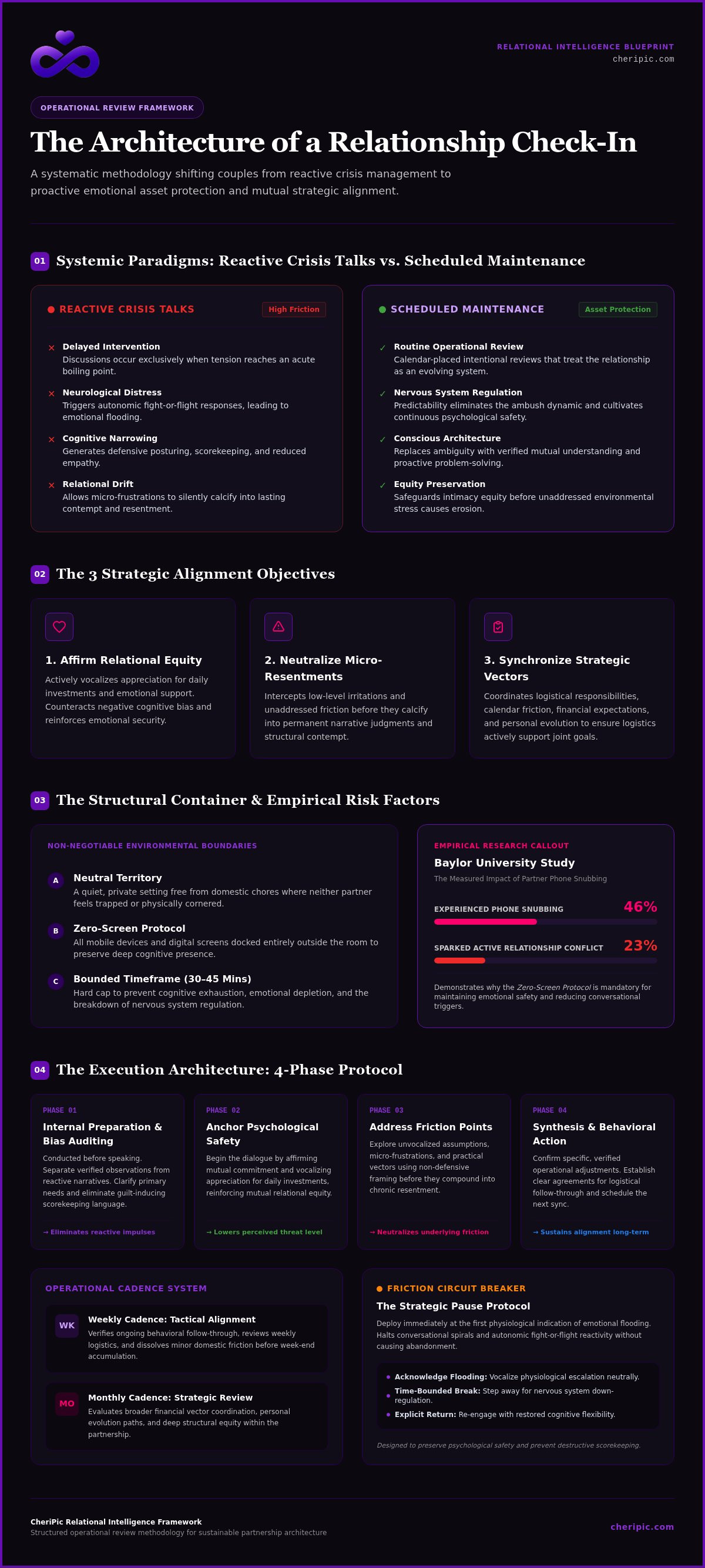
- Shift from reactive crisis talks to calm, scheduled maintenance by treating connection as an evolving system requiring routine operational reviews.
- Discover how to have a relationship check-in using a structured 4-phase protocol designed to anchor psychological safety before addressing points of friction.
- Establish essential container rules and environmental boundaries that eliminate digital distractions and prevent defensive reactivity.
- Deploy a strategic pause protocol at the first physiological sign of emotional flooding to halt conversational spirals without abandonment.
- Implement a balanced weekly and monthly cadence to verify behavioral follow-through and sustain mutual alignment over the long term.
What Is a Relationship Check-In and Why Does It Matter?
A relationship check-in is not an emergency summit or an emotional reckoning. It is a recurring, intentional operational review designed to evaluate the structural integrity and emotional climate of your partnership. Without deliberate alignment protocols, relational drift happens silently. Daily pressures, unvocalized assumptions, and micro-stresses accumulate, creating distance long before overt conflict erupts. Knowing how to have a relationship check-in transforms your connection from passive coexistence into conscious architecture. It replaces chronic ambiguity with verified mutual understanding.
The Distinction Between Maintenance and Crisis Talks
Most couples discuss their relationship only when tension reaches a boiling point. This reactive pattern carries severe neurological costs. Waiting for acute distress triggers emotional flooding, an autonomic nervous system response that activates fight-or-flight reactivity. In this state, cognitive flexibility narrows and defensive posturing takes over. Scheduled maintenance removes this ambush dynamic entirely. When conversations are placed deliberately on the calendar, the nervous system remains regulated. Predictability generates psychological safety; partners no longer need to brace for sudden emotional confrontations. Regular check-ins function as asset protection for intimacy, safeguarding your joint investment before unaddressed stress drains your emotional equity.
The Core Objectives of Regular Alignment
A structured operational review translates internal perceptions into shared clarity by applying foundational principles of interpersonal communication. Master how to have a relationship check-in by orienting your dialogue around three distinct objectives:
- Affirming Relational Equity: Actively vocalizing appreciation for daily investments and emotional support. This practice counteracts negative cognitive bias and reinforces emotional security.
- Neutralizing Micro-Resentments: Intercepting low-level frustrations before they metastasize into structural contempt. Left unspoken, tiny irritations become permanent narrative judgments.
- Synchronizing Strategic Vectors: Coordinating logistical responsibilities, calendar friction, financial expectations, and personal evolution. Alignment ensures that practical logistics support your shared relational goals rather than undermining them.
The Essential Prerequisites for a Constructive Check-In
Initiating a dialogue without establishing the container first invites defensiveness. Emotional safety is not an accidental byproduct of goodwill; it requires deliberate structural preparation. Research from the Gottman Institute underscores that regular relationship check-ins succeed only when couples create a reliable architecture that lowers perceived threats. Learning how to have a relationship check-in demands that you manage the physical environment and your internal state before uttering a single sentence.
Establishing the Emotional Container
Conversations about relational health should never compete with background stimuli. A casual chat over coffee or in passing leaves dialogue vulnerable to sudden domestic disruptions. Protect your time by instituting three non-negotiable container boundaries:
- Neutral Territory: Choose a quiet, private area where neither person feels cornered or distracted by unfinished household tasks.
- Zero-Screen Protocol: Dock all phones outside the room. A Baylor University study revealed that 46% of individuals have experienced partner phone snubbing, with 23% reporting it caused active conflict. Total presence requires eliminating digital interruptions.
- Bounded Timeframes: Cap the initial dialogue between 30 and 45 minutes. Open-ended discussions breed cognitive exhaustion, which erodes emotional regulation.
Internal Preparation and Bias Auditing
The most critical work happens before the conversation begins. Entering an operational review while dysregulated ensures you react to immediate emotional impulses rather than addressing systemic needs. Conduct an internal audit to separate verifiable behavioral observations from reactive narratives. Clarify your primary emotional need, verify your underlying motives, and discard scorekeeping language designed to induce guilt.
When chronic misunderstandings resurface, evaluate whether the root friction stems from miscommunication or fundamental incompatibility. Reviewing a comprehensive relationship compatibility assessment provides an objective baseline of shared values and behavioral expectations. If you need external structure to analyze these underlying patterns, utilizing tools from CheriPic helps identify relational blind spots before small grievances calcify into structural disconnects.
How to Have a Relationship Check-In: The 4-Phase Protocol
Random prompt cards and chaotic emotional venting do not produce relational stability. Sustainable alignment requires a linear, repeatable architecture that regulates your nervous systems from start to finish. Drawing structural inspiration from research such as the Gottman Institute's 5-step check-in, this 4-phase protocol establishes psychological safety before addressing operational demands or underlying friction. Master how to have a relationship check-in by following these sequential phases without skipping ahead.
Phase 1: Appreciation and Relational Deposits
Open every review by affirming relational equity. Do not offer generic flattery; deliver precise, behavioral acknowledgments of efforts made over the previous week. Detail specific actions, such as handling a difficult domestic errand or offering patience during an exhausting workday. Gottman Institute research demonstrates that stable, thriving partnerships maintain an optimal 5:1 ratio of positive to negative interactions during conflict discussions. Front-loading sincere gratitude funds your emotional bank account, ensuring that constructive critiques are received within a context of demonstrated goodwill rather than existential threat.
Phase 2 & 3: Logistics and Emotional Alignment
Once emotional safety is established, transition into practical coordination followed by emotional calibration. Keep these two arenas distinct so practical planning does not derail deeper intimacy:
- Phase 2: Operational and Logistical Review: Spend 10 minutes resolving upcoming domestic schedules, social commitments, and budgetary expectations. Clear the mental clutter first. Treating operational burdens as joint logistics prevents unaddressed daily chores from masquerading as emotional neglect.
- Phase 3: Emotional and Physical Alignment: Pivot into subjective relational health. Inquire directly: "Where did you feel most connected to me this week?" and "Where did you experience friction or emotional distance?" Frame vulnerabilities through objective observations of specific events rather than sweeping character indictments.
Phase 4: Collaborative Action and Closing
Conclude the meeting by translating insights into verified commitments. Vague resolutions like "we need to communicate better" fail because they lack measurable behavioral accountability. Outline one or two explicit adjustments, record them in a shared note, and confirm the exact date and time for the next session. Close the container with deliberate physical contact; a twenty-second hug or steady handhold signals neurological safety, verifying to both bodies that the partnership remains secure.
Navigating Friction, Defensiveness, and Emotional Flooding
Even within a structured framework, discussions can veer into unexpected tension. When a partner perceives an observation as an attack, the autonomic nervous system triggers emotional flooding. Heart rates surge, cognitive bandwidth narrows, and active listening evaporates. True mastery of how to have a relationship check-in lies not in evading tension entirely, but in managing the physiological and defensive reflexes that follow.
The Strategic Time-Out Architecture
Walking away abruptly isn't communication; it's an ambush that triggers abandonment anxiety. A strategic pause, by contrast, is a negotiated, procedural reset designed to protect the container. Implement an explicit protocol: either partner can call a pause when physiological flooding occurs, paired with a mandatory twenty-minute timer.
Neurological regulation requires at least twenty minutes for elevated cortisol and adrenaline levels to recede. During this window, avoid rehearsing retaliatory arguments or nursing grievances. Focus entirely on somatic down-regulation through slow diaphragmatic breathing, a brief walk, or sensory grounding. The non-negotiable rule of this architecture is the guaranteed return. Reassembling precisely at the agreed timestamp maintains psychological safety and prevents self-soothing from turning into stonewalling.
De-escalating Defensive Reflexes
Defensiveness is rarely about the practical issue at hand. It functions as a protective armor against perceived inadequacy or control. Deconstruct reactive reflexes before they derail the dialogue:
- Counter-Criticism: Neutralize the urge to lob a counter-accusation when hearing feedback. Acknowledge the partner's observation before sharing your perspective.
- Deflection: Resist pivoting to past grievances. Restrict the focus strictly to the immediate behavioral data point under review.
- Translating Criticism: Strip away inflammatory modifiers. Converting "You always ignore our routine" into "I feel overwhelmed and need shared ownership of our evenings" replaces accusation with vulnerable clarity.
When repetitive cycles persist despite your best efforts, objective pattern recognition becomes indispensable. Engaging an AI relationship coach helps identify hidden conversational traps without subjective blame. If chronic defensiveness uncovers deeper dysfunctions, examining the psychology behind why I ignore red flags can clarify whether you are managing solvable friction or structural incompatibility. To audit your partnership dynamics and build lasting relational clarity, apply for CheriPic Early Access Membership.
Building Sustained Relational Intelligence Over Time
A single dialogue cannot repair months of drifting attention. Establishing genuine relational security requires an operational framework that compounds over time. Knowing how to have a relationship check-in over months and years means moving past isolated conversations and building a longitudinal record of your partnership. When you track patterns systematically, you replace subjective guesswork with verified behavioral data.
Determining Cadence and Longitudinal Tracking
Relational maintenance demands a tiered schedule to balance immediate logistics with expansive long-term visioning. Structure your cadence into two distinct rhythms:
- Weekly Micro-Reviews: Dedicate twenty to thirty minutes each week to operational adjustments, domestic coordination, and clearing immediate micro-frustrations before they compound.
- Monthly or Quarterly Strategic Retreats: Reserve half a day every quarter to step back from tactical logistics. Evaluate personal growth trajectories, financial milestones, and evolving emotional desires.
- Documented Alignment Records: Maintain a shared digital document logging agreements made during Phase 4. Reviewing past commitments reveals whether behavioral adjustments actually occurred or if promises evaporated once tension subsided.
Tracking progress over quarters also clarifies the nature of your disagreements. Research indicates that 69% of relational conflicts are perpetual issues rooted in personality differences rather than solvable tactical problems. Longitudinal tracking shows whether you are negotiating perpetual dynamics with mutual respect or running into systemic, non-negotiable incompatibilities.
Leveraging Relational Intelligence Platforms
Human memory is naturally flawed, heavily influenced by recency bias and emotional states. During difficult weeks, partners often forget mutual investments and focus exclusively on perceived deficits. Modern technology provides the objective scaffolding necessary to audit connection without distortion. Integrating an advanced relationship coach app offers diagnostic analytics that highlight conversational dynamics across time.
Through CheriAI Relationship Coaching, couples leverage objective pattern recognition to pinpoint chronic communication bottlenecks and measure compatibility alignment. This methodical tracking transforms reactive damage control into intentional design. When you master how to have a relationship check-in and reinforce your process with empirical intelligence, your partnership becomes a durable structure built to withstand internal friction and external pressure.
Transforming Scheduled Maintenance Into Relational Mastery
Enduring partnerships aren't built on chance; they're engineered through conscious design. Mastering how to have a relationship check-in replaces the exhaustion of reactive confrontation with structured, repeatable safety. By establishing firm container boundaries, executing a disciplined four-phase dialogue, and honoring strategic pauses when emotional flooding strikes, you protect your shared emotional equity from silent drift. These scheduled reviews transform unspoken friction into proactive alignment.
Sustained relational health demands intentional architecture rather than the impulsive, disposable dynamics of swipe culture. Ground your partnership in empirical clarity by utilizing Relationship Compatibility Assessments to evaluate core values and long-term alignment. Through CheriAI Relationship Coaching, you unlock objective pattern recognition that identifies hidden behavioral traps and turns friction into collaborative growth. Explore CheriPic Relationship Intelligence to eliminate ambiguity and cultivate verifiable trust. You hold the structural blueprints; take deliberate action to build a partnership designed to endure.
Frequently Asked Questions
How long should a standard relationship check-in take?
A standard weekly relationship check-in should take between 30 and 45 minutes. Capping the duration prevents cognitive fatigue and keeps both partners focused on high-priority items. Routine logistical touchpoints might take only 20 minutes, while deeper quarterly evaluations can extend up to two hours. Setting a strict, visible timer ensures the dialogue remains a structured operational review rather than an open-ended, exhausting emotional marathon.
What should we do if one partner hates the idea of a relationship check-in?
Reluctance usually stems from the fear of an emotional ambush or open-ended criticism. Reframe the session from an emotional audit into a predictable, asset-protection protocol. Agree to start with a low-stakes 15-minute trial focused purely on mutual appreciation and upcoming logistical schedules. When a hesitant partner experiences how to have a relationship check-in without defensiveness, judgment, or finger-pointing, initial resistance quickly gives way to psychological safety.
How do we prevent a relationship check-in from turning into an argument?
Prevent escalation by enforcing the sequential protocol and honoring the strategic pause. Never begin with grievances; always front-load genuine appreciation to anchor neurological calm. Frame points of friction around neutral behavioral observations rather than character judgments. If heart rates spike or voices rise, immediately invoke the mandatory twenty-minute timeout. Stepping away to self-soothe resets the nervous system, ensuring you return to collaborate rather than compete.
What are the best specific questions to ask during a weekly check-in?
Effective inquiries target specific behavioral patterns rather than broad sentiments. Ask: "What specific action made you feel most supported by me this week?" and "Where did you feel unseen, overwhelmed, or disconnected?" For logistical coordination, ask: "What major friction points do you anticipate on the calendar next week?" Conclude with forward-looking alignment: "What is one tangible commitment I can make to lighten your cognitive load over the next seven days?"
How often should couples schedule a formal relationship check-in?
Establish a dual cadence combining weekly micro-reviews with quarterly strategic audits. A weekly cadence keeps domestic logistics aligned and resolves micro-frustrations before they compound into structural resentment. Quarterly sessions provide the space to step back from tactical details, evaluate financial trajectories, and review long-term relationship compatibility. Consistency is vital; treating these touchpoints as non-negotiable appointments on your shared calendar anchors lasting relational stability.
Can a relationship check-in work for couples in early-stage dating?
Yes, adapting the framework early establishes healthy communication norms before dysfunctional patterns set in. For dating partners, the focus shifts away from domestic chores toward verifying mutual intentionality and emotional availability. Learning how to have a relationship check-in during the early stages clarifies boundaries, prevents unspoken assumptions, and filters out fundamental incompatibilities. It replaces passive dating games with deliberate, mature alignment regarding shared trajectory and values.
What is the difference between relationship check-ins and marriage counseling?
Relationship check-ins are autonomous, peer-to-peer maintenance protocols designed to preserve connection and prevent conflict before it starts. Marriage counseling is a clinical, third-party intervention aimed at diagnosing and rehabilitating entrenched relational distress or deep-seated trauma. While counseling addresses acute crises, recurring check-ins empower couples to manage their emotional architecture independently. Couples often use both, leveraging regular check-ins alongside platforms like CheriPic to sustain daily relational health.


