

The most dangerous structural flaw in any partnership isn't the presence of conflict, but the steady accumulation of unspoken requirements. When you prioritize temporary harmony over personal truth, you aren't being selfless. You're defaulting on your emotional due diligence. Learning how to communicate your needs in a relationship is not about mastering a script for getting your way. It's an act of relational intelligence that protects your time and emotional energy from being wasted on misaligned investments.
It's natural to fear that voicing a non-negotiable will trigger rejection or make you appear difficult. This anxiety often leads to a cycle of self-silencing that leaves you feeling invisible while your partner remains unaware of the growing distance. This guide provides an architectural framework to identify your core needs before they transform into resentment. You'll gain the ability to speak with logical precision and emotional authority. We'll explore how to audit your internal values, verify alignment with your partner, and use tools like CheriAI to practice these high-stakes conversations with clinical clarity.
Key Takeaways
- Analyze the "Chemistry Trap" to distinguish between fleeting attraction and the structural alignment required for a high-value, long-term partnership.
- Categorize your non-negotiables into fundamental pillars and operational requirements to create a clear blueprint for your relationship's integrity.
- Apply a strategic protocol for how to communicate your needs in a relationship, using a logic-first approach to avoid the pitfalls of emotional leakage.
- Conduct relational due diligence through self-verification and pattern recognition to ensure your needs are grounded in self-awareness rather than reactive habits.
- Leverage personalized relationship intelligence to move beyond single conversations toward a model of continuous monitoring and verified value alignment.
The Anatomy of Unmet Needs: Why Standard Communication Fails
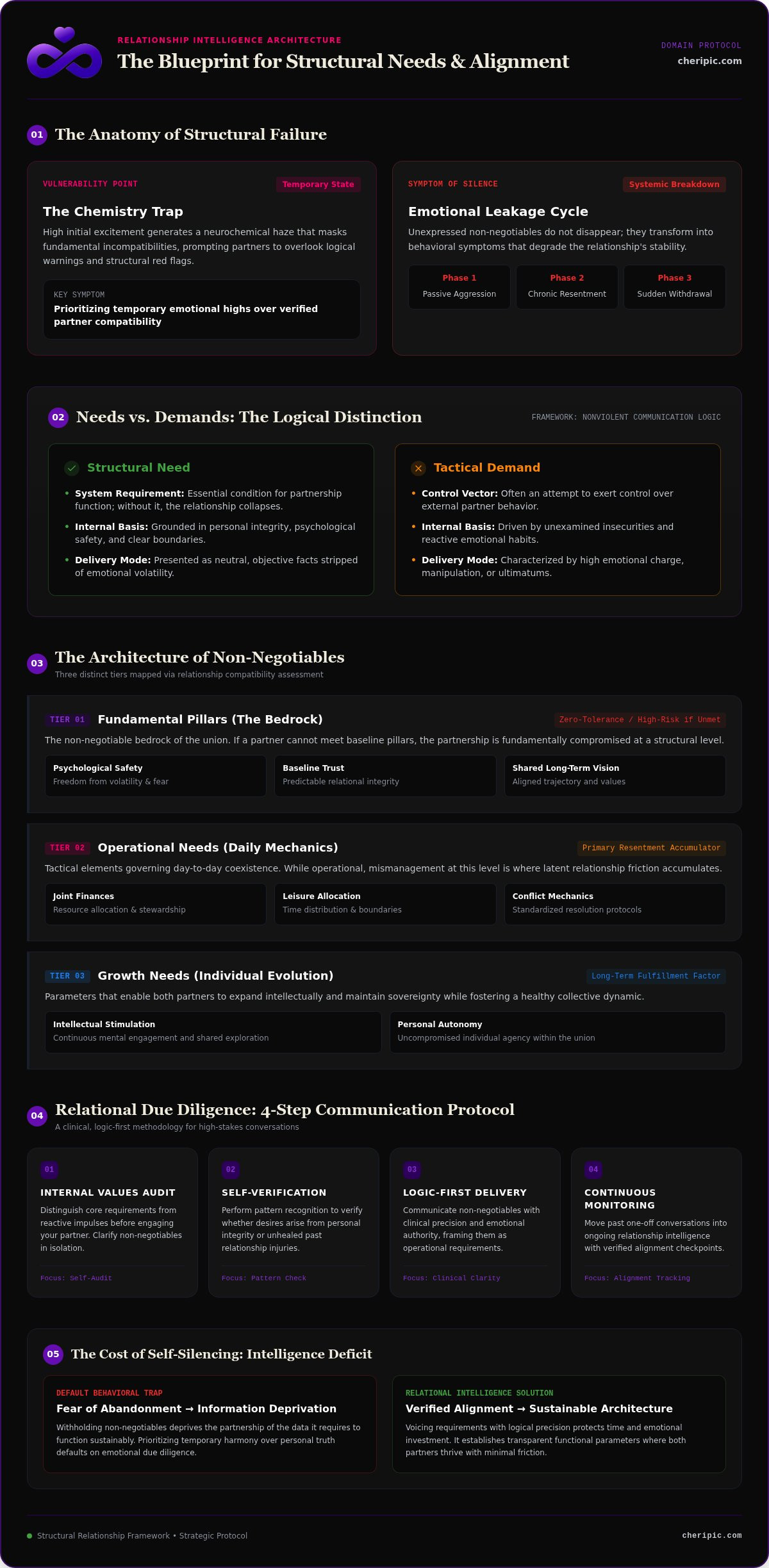
Standard advice suggests that talking it out solves every romantic friction. This is a logical fallacy. Many couples struggle not because they lack vocabulary, but because they have failed to perform the necessary due diligence on their structural alignment. High initial excitement, often called the Chemistry Trap, creates a neurochemical haze that masks fundamental incompatibilities. During this phase, it's common to fall into the why I ignore red flags pattern, where logical warnings are dismissed in favor of temporary emotional highs.
When these ignored requirements inevitably surface, they don't always appear as clear requests. Instead, they manifest as emotional leakage. This is the process where unexpressed needs transform into passive-aggression, chronic resentment, or sudden withdrawal. Before you can learn how to communicate your needs in a relationship, you must distinguish between a communication deficit and a terminal compatibility problem. If the structural values don't align, no amount of dialogue will bridge the gap. Precision matters more than volume.
The Psychology of Self-Silencing
Many individuals perceive the expression of a need as a confession of weakness. This perspective is often rooted in childhood attachment patterns where emotional requirements were met with neglect or volatility. In adulthood, this manifests as self-silencing. By withholding your non-negotiables, you create an intelligence gap. You're essentially depriving the partnership of the data it needs to remain functional. Fear of abandonment drives this behavior. However, the resulting lack of transparency is exactly what makes the relationship unsustainable over the long term.
Needs vs. Demands: The Logical Distinction
A rigorous approach to connection requires a clear distinction between a structural need and a tactical demand. A need is a requirement for the relationship to remain functional; without it, the system collapses. A demand, conversely, is often an attempt to exert control or seek external validation for internal insecurities. Utilizing a Nonviolent Communication framework helps strip away the emotional charge, allowing you to present your requirements as objective facts. High-level relationship intelligence involves auditing these requirements to ensure they are rooted in personal integrity rather than a desire to manipulate a partner’s behavior. It's about maintaining the integrity of the relationship's architecture. When you master how to communicate your needs in a relationship, you move from making demands to establishing clear, functional boundaries.
The Architecture of Needs: Categorizing Your Non-Negotiables
Effective connection requires a blueprint. If you treat every desire with the same weight, you risk structural collapse. Categorizing your requirements allows for a strategic approach to how to communicate your needs in a relationship. This isn't about a list of demands; it's about defining the parameters within which a partnership can thrive. By utilizing a relationship compatibility assessment, you can map your requirements across three distinct tiers: Fundamental Pillars, Operational Needs, and Growth Needs.
Fundamental Pillars represent the bedrock of the union. These include psychological safety, baseline trust, and a shared long-term vision. Without these, the relationship has no structural integrity. Establishing healthy communication patterns at this level ensures that the most critical requirements are never left to chance. If a partner cannot meet these baseline pillars, the partnership is fundamentally high-risk.
Operational Needs focus on the daily mechanics of life. This includes how you manage joint finances, allocate leisure time, and navigate conflict resolution. While these may seem tactical, they are often where resentment builds. Growth Needs, meanwhile, address intellectual stimulation and personal autonomy. A functional relationship must allow for individual evolution without compromising the collective bond. Identifying these categories helps you understand how to communicate your needs in a relationship with logical precision rather than emotional volatility.
Defining Your Core Values
Value alignment is the load-bearing wall of any partnership. If your core values are mismatched, no amount of compromise will stabilize the structure. You must distinguish between a "want," which is a preference like aesthetic tastes, and a "need," which is a non-negotiable. A Core Need is a non-negotiable value that sustains emotional safety. Understanding this distinction prevents you from compromising on the elements that define your personal integrity.
The Role of Identity Verification
You cannot build a sophisticated architecture on unstable ground. Attempting to express deep emotional requirements to an unverified partner is a high-risk investment. Establishing identity verification for dating ensures that both parties are operating from a foundation of truth. Without this verification, your communication lacks a secure destination. It's essential to verify the person before you reveal the blueprint of your inner world. For those seeking verified value alignment, joining the CheriPic community provides a secure environment where due diligence is the standard.
Relational Due Diligence: A Professional Approach to Self-Verification
Before you engage a partner in a high-stakes dialogue, you must perform internal due diligence. Communicating a need without first verifying its origin is like presenting a business proposal without reviewing the data. Self-verification is the analytical process of auditing your emotional readiness and ensuring your requirements are grounded in current reality rather than historical echoes. Without this step, you risk projecting past frustrations onto a present partnership, which undermines your credibility and complicates the process of how to communicate your needs in a relationship.
Pattern recognition is a vital component of this audit. You must determine if a specific "need" is a recurring response to a certain archetype of partner. If you consistently feel invisible, is it because your partner is genuinely dismissive, or have you historically selected partners with limited emotional availability? Utilizing an AI relationship coach like CheriAI provides an objective layer of analysis. By processing your relational history, these tools identify destructive cycles that the human mind often rationalizes away, allowing you to approach your partner with verified insights rather than reactive impulses.
The Pre-Communication Checklist
A structured internal review prevents emotional leakage during the conversation. Before speaking, ask yourself if the need is grounded in a current fact or a past trauma. You must be able to articulate the requirement without utilizing blame, focusing instead on the functional health of the union. Finally, define the "Minimum Viable Solution." Knowing exactly what action constitutes a "met need" prevents the conversation from devolving into vague dissatisfaction. This level of precision is the professional standard for how to communicate your needs in a relationship effectively.
Evaluating Your Partner’s "Rise Potential"
Relational intelligence requires an objective assessment of your partner’s emotional capacity. You must determine if they possess the "rise potential" to meet your non-negotiables. If you find yourself repeatedly explaining basic concepts of respect or empathy, you're no longer communicating; you're begging for fundamental structural integrity. Data-driven romantic clarity allows you to see the difference between a partner who is learning and one who is incapable. Strategic investment of your emotional energy requires knowing when to iterate on a conversation and when the partner lacks the necessary hardware to support your architecture.
The Strategic Communication Protocol: A Step-by-Step Framework
Generic advice often encourages you to "just be honest," yet honesty without a tactical protocol is merely emotional venting. Mastering how to communicate your needs in a relationship requires moving beyond vague transparency toward a structured delivery. The Strategic Communication Protocol is a methodical approach to relational alignment that prioritizes objective observation over emotional reactivity. By following this sequence, you ensure your requirements are treated as functional data rather than personal attacks.
- Step 1: Timing and Environment. Choose a neutral moment for an Architecture Review. Avoid discussing non-negotiables during active conflict or when either partner is cognitively depleted.
- Step 2: The Logic-First Opening. State your observation as a neutral fact. Remove the emotional charge by describing the behavior, not the person’s character.
- Step 3: The "I" Architecture. Frame the need as a requirement for your own functionality. Explain how the current dynamic impacts your ability to remain securely invested in the union.
- Step 4: The Verification Phase. Ask your partner to mirror their understanding. Seek a proposed solution from them to verify their willingness to participate in the relationship's maintenance.
- Step 5: The Follow-up Audit. Set a specific window, typically 30 days, to measure changes in behavioral patterns. A need that is acknowledged but never acted upon remains an unmet structural flaw.
To refine your approach before your next Architecture Review, secure your CheriPic Early Access Membership and begin practicing these protocols with clinical precision.
Tactical Scripting for High-Value Conversations
Precision in vocabulary is essential for maintaining authority. Replace accusatory language like "You never listen" with requirement-based phrasing such as "I require focused attention during our evening check-ins to feel emotionally safe." This shift moves the focus from their failure to your standard. During high-stakes dialogues, utilize the Strategic Pause. When you feel an emotional escalation, stop speaking for five seconds. This silence acts as a stabilizing force, preventing reactive statements that undermine your long-term goals. It allows both parties to return to the logical framework of the discussion.
Handling Defensive Responses
Defensiveness is a common response to the perceived threat of a new requirement. To de-escalate, restate your commitment to the relationship's success while holding your boundary firm. You must distinguish between a "bad day," which is a temporary lapse in capacity, and a "permanent pattern," which indicates a structural deficit. If your partner repeatedly meets logical requests with volatility or stonewalling, it is time to pivot from communication to comprehensive relationship due diligence. Understanding how to communicate your needs in a relationship also means knowing when a partner lacks the emotional hardware to process the data you are providing.
Beyond the Conversation: Using Relationship Intelligence for Long-Term Clarity
Long-term relational success isn't a static achievement. It's a continuous process of data collection and adjustment. While the Strategic Communication Protocol provides the initial blueprint, one conversation is rarely enough to ensure permanent alignment. You must move into a phase of continuous monitoring. This is where CheriAI acts as a Relationship Architect, identifying destructive patterns in real-time before they lead to structural failure. You transition from reactive "fixing" to proactive "building" by treating the partnership as a living architecture that requires regular structural audits to remain functional. Success depends on your willingness to verify that verbal agreements translate into consistent behavioral reality.
Curated real-world experiences serve as the ultimate testing ground for compatibility. Learning how to communicate your needs in a relationship is the theory; navigating a high-stakes travel itinerary or a joint financial investment is the application. These scenarios reveal whether your partner’s behavioral patterns match their verbal commitments. They provide the necessary verification that your shared vision is grounded in reality rather than aspiration. If a need is consistently ignored during these "stress tests," the data suggests a fundamental lack of rise potential that no amount of communication can resolve.
Leveraging AI for Emotional Logic
A relationship coach app like CheriAI provides an objective third-party perspective that human friends often lack. It uses data to track if your requirements are being met over a 30, 60, or 90 day window. This level of analysis reduces the "Emotional Tax" of dating by providing early warnings of pattern divergence. Instead of relying on gut feelings, you utilize personalized insights to determine if a partner is worth a continued strategic investment. It helps you master how to communicate your needs in a relationship by identifying exactly where the breakdown occurs.
The Future of Intentional Connection
High-value individuals are increasingly moving away from the chaos of traditional swipe-based dating. They are opting for membership-based intelligence platforms that prioritize due diligence and verified alignment. The shift from luck-based dating to architected partnerships represents a new standard of romantic maturity. It acknowledges that your time and emotional energy are finite assets that deserve professional-grade management. You don't have to leave your happiness to chance. To secure your emotional future and build a partnership based on verified value alignment, begin your journey with CheriPic Early Access.
Architecting a Legacy of Verified Alignment
Building a partnership that sustains long-term growth requires more than good intentions. It demands a commitment to structural integrity and rigorous emotional honesty. By moving away from the "Chemistry Trap" and adopting a logical framework for your non-negotiables, you protect your most valuable assets: your time and emotional energy. Mastering how to communicate your needs in a relationship is the critical first step toward establishing a union built on verified value alignment rather than temporary excitement.
True relational intelligence is found in the transition from luck-based dating to architected connection. This process is supported by sophisticated tools for relational due diligence that allow you to audit your progress with objective clarity. Through AI-driven pattern recognition for romantic clarity and access to a verified community of intentional individuals, you can ensure your requirements are met with consistent behavioral reality. Don't leave your emotional safety to chance. You deserve a connection that is as intentional as you are.
Secure your emotional future with CheriPic Early Access and begin building a partnership that reflects your highest standards today.
Relational Intelligence: Frequently Asked Questions
How do I know if my needs in a relationship are reasonable?
A need is reasonable if it functions as a structural requirement for your emotional safety and sustained investment in the partnership. You should distinguish between core non-negotiables, like trust and shared vision, and tactical preferences. If a requirement is essential for the relationship’s functional integrity and your mental well-being, it is valid. Perform an internal audit to ensure your needs are grounded in self-awareness rather than a reactive desire for control or validation.
What is the best way to start a conversation about unmet needs?
Initiate the dialogue during a neutral moment, which we define as an Architecture Review, rather than during active conflict. Use a logic-first opening that states an objective observation without emotional charge. Focus on how a specific behavior impacts the relationship's structural health. Mastering how to communicate your needs in a relationship involves providing your partner with actionable data rather than an emotional attack, which fosters a collaborative environment for long-term resolution.
What should I do if my partner gets defensive when I express a need?
Utilize a Strategic Pause to de-escalate the emotional charge and restate your commitment to the relationship’s success. Defensiveness often signals a perceived threat to the partner’s ego. You must determine if this is a temporary lapse in capacity or a permanent pattern of emotional unavailability. High-value connection requires both parties to have the rise potential to process feedback. If logical communication consistently triggers volatility, it is time to perform comprehensive due diligence on the partner’s compatibility.
Is it possible to have too many needs in a relationship?
A high volume of requirements often indicates a lack of internal verification or a fundamental compatibility gap. You must audit your list to separate core non-negotiables from minor preferences. If you require constant external reassurance to feel secure, you may be experiencing an intelligence gap in your own emotional readiness. Focus on the fundamental pillars that maintain the relationship's load-bearing walls. A functional architecture cannot support an infinite number of tactical demands without compromising its stability.
How can an AI relationship coach help me communicate better?
CheriAI provides an objective third-party perspective by identifying destructive patterns in your relational history that you might rationalize away. It acts as a sophisticated practice environment for high-stakes conversations, allowing you to refine your logic before engaging your partner. By using data-driven insights, the AI coach helps you move from emotional venting to precise, structural communication. This technology reduces the emotional tax of dating by vetting your internal logic and preparing you for verified value alignment.
What is the difference between a boundary and a need?
A need is a functional requirement you have from the partnership to remain invested, while a boundary is a limit you set on what you will accept. Think of a need as the material required to build the house and a boundary as the fence that protects it. Understanding how to communicate your needs in a relationship involves expressing what you require for growth, whereas setting boundaries defines the non-negotiable lines that protect your psychological safety.
How long should I wait for a partner to change their behavior?
Establish a 30-day Follow-up Audit after your initial Strategic Communication Protocol. This timeframe is sufficient to observe whether a partner is making a genuine, verified effort to adjust their behavioral patterns. If no change occurs despite clear, logical communication, you are dealing with a structural deficit. Waiting indefinitely for a partner to acquire emotional hardware they don't possess is a poor investment of your emotional energy. High-value individuals prioritize data over hope.
Can relationship intelligence platforms really improve my communication?
Yes, by shifting the focus from luck-based dating to architected partnerships. Platforms like CheriPic use identity verification and compatibility assessments to ensure you are communicating with intentional individuals who share your standards. These tools provide the data necessary for relational due diligence, allowing you to track if your needs are being met over time. By providing an analytical framework, these platforms stabilize the emotional landscape and foster connections built on verified structural alignment rather than fleeting chemistry.


