

What if you treated your emotional energy with the same level of due diligence that a venture capitalist applies to a high-stakes investment? Most people enter relationships based on chemistry, only to realize months later that their core values are fundamentally misaligned. You've likely experienced the exhaustion of realizing a match isn't who they claimed to be after you've already invested weeks of your life. It's a common pattern where fleeting excitement masks structural flaws in compatibility. This isn't just bad luck; it's a failure of the vetting process.
We agree that your time is a finite, non-renewable asset that deserves professional-grade protection. This guide provides a strategic framework for relationship assessment, moving beyond surface-level small talk into high-intelligence dating vetting questions. You'll gain the tools to identify long-term alignment and recognize red flags before they become emotional liabilities. We'll explore over 45 specific inquiries designed to verify identity, surface behavioral patterns, and ensure your next connection is built on a foundation of verified truth rather than hopeful projection. It's time to stop guessing and start auditing for the future you deserve.
Key Takeaways
- Learn to transition from reactive swiping to a professional standard of relationship due diligence that prioritizes structural integrity over fleeting chemistry.
- Implement a phased approach using high-intelligence dating vetting questions to audit for authenticity and emotional availability before the first encounter.
- Master pattern recognition techniques like the Rule of Three to differentiate between isolated incidents and systemic behavioral red flags.
- Understand how to decode the Ex-Factor to gain objective insights into a partner’s accountability and historical conflict resolution styles.
- Discover how verified communities and AI-driven coaching can mitigate vetting fatigue while ensuring higher standards for interpersonal connection.
Beyond the Spark: Why Strategic Vetting is Your Most Valuable Dating Asset
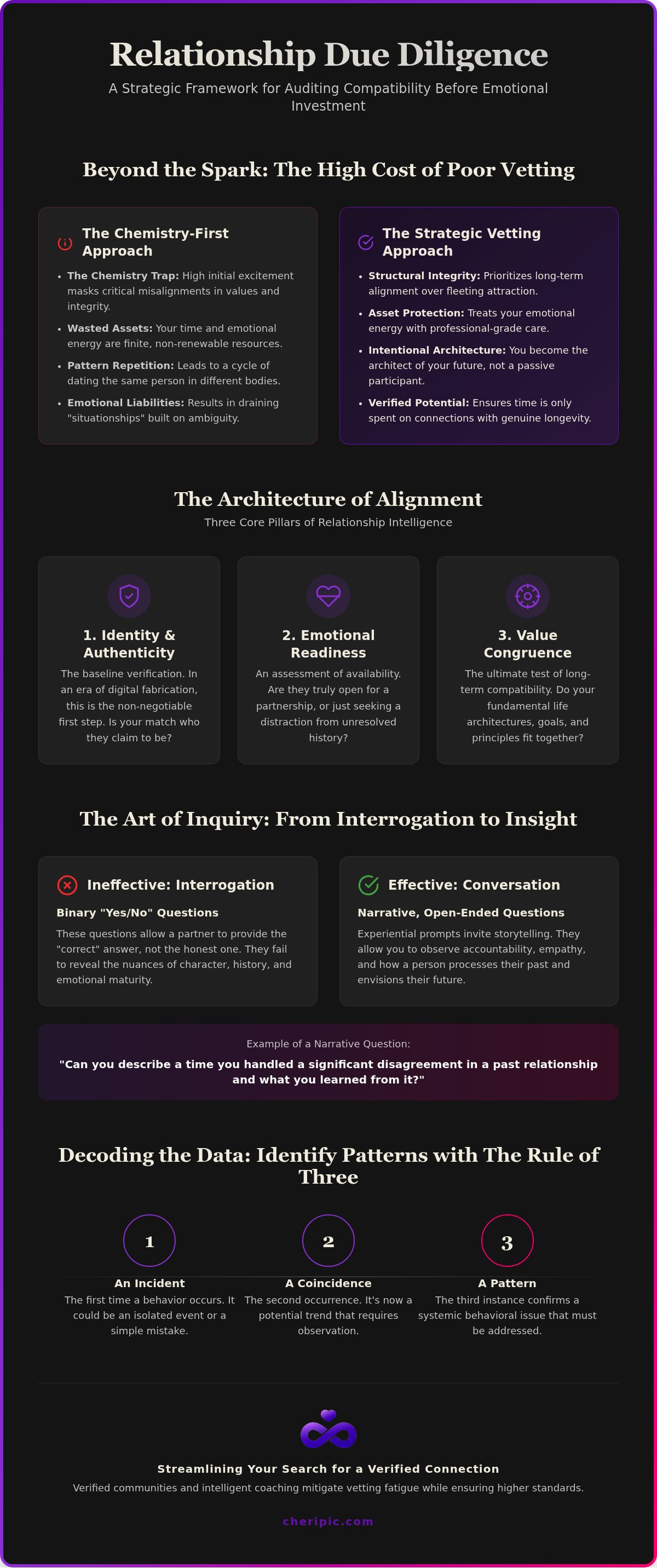
Modern dating often prioritizes the "spark," a biological reaction that frequently blinds us to fundamental incompatibilities. We must reframe our approach. Relationship due diligence is not an act of cynicism; it's a professional standard of self-care. By treating your emotional energy as a high-value asset, you shift from a passive participant to an intentional architect of your future. This shift is essential to avoid the "Chemistry Trap," where high initial excitement masks critical misalignments in values, lifestyle, and integrity.
Understanding the science of mate selection reveals that humans are often driven by subconscious biases that don't always serve our long-term interests. Without a strategic framework, we risk falling into a repetitive cycle of dating the same person in different bodies. This pattern occurs when we prioritize surface-level attraction over structural alignment. True selection intelligence requires moving from a scarcity mindset, where you hope to be chosen, to an intelligence-led process where you determine if a candidate is qualified for your life.
The Cost of Poor Vetting
The emotional and time tax of "situationships" is immense. These ambiguous connections often persist because the vetting process was bypassed in favor of convenience or physical attraction. When you fail to audit a partner's character early, you inevitably face the same behavioral patterns that led to past failures. Relationship Intelligence is the ability to assess compatibility before emotional investment. By applying this intelligence, you protect your peace and ensure that your time is spent only on connections with genuine potential for longevity.
Vetting vs. Interrogation: The Art of the Narrative Question
Effective vetting is not an interrogation. It is a sophisticated exchange of information. Binary "Yes/No" questions are ineffective because they allow a partner to provide the "correct" answer rather than the honest one. They fail to reveal the nuances of character and history. Instead, the power lies in open-ended, experiential prompts that invite storytelling. These narrative-driven dating vetting questions allow you to observe how a person processes their past and envisions their future.
When you ask a partner to describe a time they handled a significant disagreement, you aren't just looking for the facts of the story. You're looking for accountability, empathy, and emotional maturity. If you find yourself repeatedly overlooking clear indicators of misalignment, you may be experiencing "romantic blindness." You can learn more about this phenomenon in our analysis of Why I Ignore Red Flags. Mastering the art of the narrative question ensures that your vetting feels like a natural conversation while providing the data necessary for a logical assessment.
The Architecture of Alignment: Three Core Pillars of Relationship Intelligence
Building a connection requires more than mutual interest. It requires structural integrity. To achieve long-term success, you must move beyond the superficial and assess a partner through a systematic framework. Relationship intelligence rests on three structural pillars. These pillars act as a filter, ensuring your emotional investment is directed toward viable candidates. Without these foundations, you're merely gambling with your time.
The first pillar is Identity and Authenticity. This is the baseline verification that your match is who they claim to be. In an era of digital fabrication, asking dating vetting questions is useless without a foundation of identity verification for dating. The second pillar is Emotional Readiness. This involves assessing if a person is truly available or simply seeking a temporary distraction from unresolved history. Finally, the third pillar is Value Congruence. This is the ultimate test of whether your life architectures fit together. You can utilize important questions for a potential partner to probe for alignment on ambition, ethics, and lifestyle goals.
Verifying Identity and Professional Integrity
High-value singles don't leave psychological safety to chance. Profile verification is a baseline requirement for a sophisticated dating process. It isn't about being intrusive; it's about verifying professional claims to ensure a baseline of integrity. If someone claims a specific career trajectory, their narrative should remain consistent across their professional presence. Verified platforms attract individuals who respect their own time and yours. They signal a commitment to transparency that unverified, swipe-based apps simply cannot offer. This initial layer of verification allows you to focus on the person rather than wondering about the validity of their profile.
Assessing Emotional Readiness and Availability
Many daters are "lonely" rather than "ready." Readiness implies a person has processed their baggage and isn't seeking a partner to fill a void left by a previous relationship. Emotional Availability is the capacity for consistent, transparent engagement. Your vetting process must target their recent history and behavioral patterns. Ask about their last significant connection and listen for accountability. If they describe every former partner as the sole cause of conflict, it reveals a lack of self-reflection. Identifying these anomalies early prevents you from becoming a "placeholder" for their healing process. You might consider a compatibility assessment through CheriPic to gain objective clarity on these emotional patterns before moving forward.
The Vetting Checklist: 45+ High-Impact Questions for Every Stage
Vetting is a chronological process, not a sudden interrogation. Asking the right questions at the wrong time creates friction; asking the wrong questions at any time creates waste. To build a connection with structural integrity, you must deploy your dating vetting questions in phases. This methodical approach ensures you're only escalating your emotional investment as the candidate proves their viability. It's about protecting your most valuable asset: your time.
Phase 1: The Pre-Date Intelligence Check
The goal of the pre-date screen is simple: protect your schedule from low-alignment matches. You're looking for lifestyle compatibility and a growth mindset before a single minute is spent in person. Start with inquiries that reveal their daily reality and intentionality. Ask, "What does your ideal weekend look like?" to gauge if their pace matches yours. Follow up with, "What is one thing you’re currently working on improving in yourself?" to filter for self-awareness. Finally, ask, "What led you to join this platform?" This serves as a critical intentionality check, separating the casual browsers from those seeking a verified connection.
Phase 2: First Date Character Assessment
The first encounter is for assessing character, curiosity, and presence. You aren't looking for "the one" yet; you're looking for relational consistency and emotional regulation. Observe how they discuss their life. Ask, "How do you typically handle a stressful day?" to understand their coping mechanisms. Inquire about their long-term social health by asking, "Tell me about a friendship you’ve had for over five years." Longevity in platonic relationships is a strong indicator of commitment capacity. To ensure your boundaries align, ask, "What is a non-negotiable for you in a partnership?" This forces a moment of honesty that surface-level small talk often avoids.
Phase 3: The Long-Term Compatibility Audit
Phase three is the deep dive. At this stage, you're looking for vision alignment and resource management. Inquiries should target the practicalities of a shared future. Ask, "How do you view financial partnership in a relationship?" and "What does 'home' mean to you?" These questions reveal if your life architectures can actually coexist. You can further explore questions to deepen a relationship to move from intellectual data to emotional resonance. As you gather this data, it's vital to remain objective. For a comprehensive review of your findings, utilize our Relationship Compatibility Assessment. This professional framework helps you synthesize the information you've gathered, ensuring your decision to proceed is based on verified alignment rather than hopeful projection.
Decoding the Data: How to Identify Patterns and Red Flags
Gathering responses to your dating vetting questions is a preliminary step. The true value lies in your ability to synthesize that data into a coherent behavioral profile. You're looking for patterns, not isolated incidents. The Rule of Three is a critical tool here. One instance of a broken promise is an accident; two is a coincidence; three is a structural behavioral trait. If you see three similar anomalies, the data is telling you who they are. Trust it.
Listen closely to the "Ex-Factor." How a person describes their past partners is a preview of how they'll eventually describe you. If their history is a trail of "crazy" exes with no self-reflection, they lack the emotional maturity for a high-value connection. This reflects the Consistency Gap. High-intelligence dating requires comparing what they say to what they actually do. If their claims of "valuing honesty" are met with vague details about their daily life, the gap is your warning. Your "gut feeling" isn't mystical; it's your brain’s pattern recognition software processing these micro-inconsistencies before your conscious mind can articulate them.
Spotting Covert Red Flags
Be wary of the "Love Bombing" trap. If their answers to your vetting questions seem too perfect or perfectly mirrored to your own, they may be practicing performative alignment. This is often a precursor to a lack of authenticity. Similarly, watch for the "Vaguebooker." This individual avoids specific details about their career, history, or intentions, often under the guise of being "private." Integrity requires transparency. When you notice an inconsistency, don't rush to confront them. Instead, observe how the pattern develops. Gathering more data is always a superior strategy to premature emotional reaction.
Evaluating Conflict and Resolution Styles
Character is revealed not in the answer, but in the attitude toward the question. Defensive reactions to high-intelligence inquiries are red flags in themselves. When you ask about past disagreements, look for the "Accountability Check." Does the person admit fault? Do they explain how they grew from the conflict? A partner who cannot admit to being wrong is a partner who will eventually project all relationship failures onto you. If you're struggling to decode these patterns on your own, you can leverage CheriAI coaching to gain an objective, analytical perspective on your dating data. This ensures your judgment remains unclouded by the "Chemistry Trap" discussed earlier.
From Vetting to Verification: Streamlining Your Search with CheriPic
Manual due diligence is a vital skill, yet the cognitive load of constant assessment often leads to vetting fatigue. You shouldn't have to navigate this landscape alone. A relationship intelligence platform provides the structural support necessary to maintain your standards without the exhaustion of unverified swiping. CheriPic transforms the vetting process from a solitary burden into a streamlined, verified experience. It's the ultimate strategic investment for those who view their emotional health as a non-negotiable asset.
By integrating sophisticated identity verification with personalized coaching, the platform ensures that your dating vetting questions are met with transparency. You move beyond the digital screen faster, transitioning into curated real-world experiences where character is truly tested. This shift allows you to focus on the quality of the connection rather than the validity of the profile. This infrastructure ensures that your dating vetting questions serve as a bridge to truth rather than a shield against deception.
Personalized Insights with CheriAI
CheriAI acts as your personal Relationship Architect. It identifies destructive patterns and blind spots that your own biases might overlook. While our brains are wired for pattern recognition, they're also susceptible to the chemistry trap. Data-driven coaching provides an objective mirror, helping you break the cycle of poor choices. This transition from screening to experiencing is where true growth happens. You learn to trust your judgment because it is backed by structural verification. It's about moving from a state of anxious assessment to one of grounded observation.
Join the Future of Intentional Connection
The status quo of dating is broken, but you don't have to participate in it. High-value singles require a professional approach to love that mirrors their approach to career and health. CheriPic Early Access Membership offers an exclusive environment for those ready to prioritize long-term success over fleeting excitement. It's time to stop gambling on luck and start investing in intelligence. We invite you to step into a community where verification is the standard and intentionality is the baseline. Apply for CheriPic Early Access today.
Elevating Your Selection Standard
Transitioning from reactive swiping to intentional selection is the ultimate act of self-respect. By implementing a phased approach and utilizing high-intelligence dating vetting questions, you move beyond the "Chemistry Trap" and into the realm of verified compatibility. You now understand that your emotional energy is a finite asset requiring careful management through identity verification and rigorous pattern recognition. True connection isn't found by chance; it's built through the deliberate application of relationship intelligence.
You don't have to navigate this journey in isolation. Access the power of Verified Relationship Intelligence and our Identity Verification Standard to ensure your next match is structurally sound from the first interaction. Let CheriAI Pattern Recognition act as your mentor, identifying destructive cycles before they begin and providing the clarity you need to move forward with certainty. Master your relationship intelligence with CheriPic. You possess the framework to choose with confidence. The future of your connections is no longer a mystery; it's a strategic choice you're now equipped to make.
Frequently Asked Questions
Is it "weird" to ask vetting questions on a first date?
No, it is not "weird" to prioritize your emotional safety. High-value singles recognize that their time is a finite asset. Asking intentional dating vetting questions during a first encounter signals that you are looking for structural alignment rather than a temporary distraction. It filters for candidates who also value depth. If a person finds curiosity "weird," they likely lack the maturity required for a sophisticated, long-term connection.
How do I ask about someone’s past without sounding like a therapist?
You avoid the "therapist" label by focusing on storytelling rather than diagnosis. Instead of asking about trauma, ask how they've evolved from past challenges. Use phrases like "Tell me about a time when..." to invite a narrative flow. This allows you to observe their level of accountability and self-reflection in a natural way. The goal is to listen for behavioral patterns while maintaining the rhythm of a balanced conversation.
What are the top three red flags to look for in an answer?
The three most critical indicators are a lack of accountability, persistent vagueness, and defensive reactions. If a candidate blames every past failure on an external force, they likely lack self-awareness. Vague details about their professional or personal life suggest a lack of integrity or potential deception. Finally, if they react with hostility to reasonable inquiries, it reveals a lack of emotional regulation. These patterns indicate a high risk for future conflict.
Can I really trust someone’s answers to vetting questions?
You should treat words as data points that require external verification. While answers to dating vetting questions provide insight into how a person wants to be perceived, their actions reveal their actual character. This is why we prioritize identity and profile verification as a baseline. You aren't just listening to the content of the answer. You are observing the consistency between their claims and their real-world behavior over time. Verification reduces the risk of being misled.
How many dates should I wait before asking about long-term compatibility?
You don't need to wait for a specific number of dates to begin the assessment process. A phased approach is most effective. Start with lifestyle alignment before the first meeting. Use the first three encounters to observe character and consistency. By the fourth or fifth date, you should have enough data to initiate deeper inquiries about financial values and life vision. Delaying these questions only increases the risk of the "Chemistry Trap" blinding your judgment.
What should I do if someone gets defensive during vetting?
If a person becomes defensive, treat that reaction as a definitive answer. You don't need to justify your curiosity or argue for the right to ask. Defensiveness often signals a lack of transparency or unresolved emotional baggage. It indicates that the individual may not be ready for the level of intentionality you require. Calmly observe the reaction, conclude the interaction, and use that information to decide if they meet your standards for psychological safety.
How does CheriAI help with the vetting process?
CheriAI functions as a digital Relationship Architect by providing personalized pattern recognition. It helps you identify micro-inconsistencies and red flags that your own emotional biases might overlook. By analyzing your interactions through the lens of behavioral psychology, it offers objective insights to help you break cycles of poor selection. This data-driven coaching ensures you stay grounded in logic rather than getting lost in fleeting excitement. It turns your dating data into actionable intelligence.
What is the difference between vetting and being "too picky"?
Being "too picky" often involves a focus on surface-level traits like height or specific hobbies. Vetting, however, focuses on structural integrity and value congruence. You aren't being difficult; you are performing due diligence on a significant life investment. High standards for character, integrity, and emotional availability are necessary for long-term success. Protecting your time by filtering for these non-negotiables is a sign of maturity. It isn't about finding a perfect person, but a compatible partner.


