

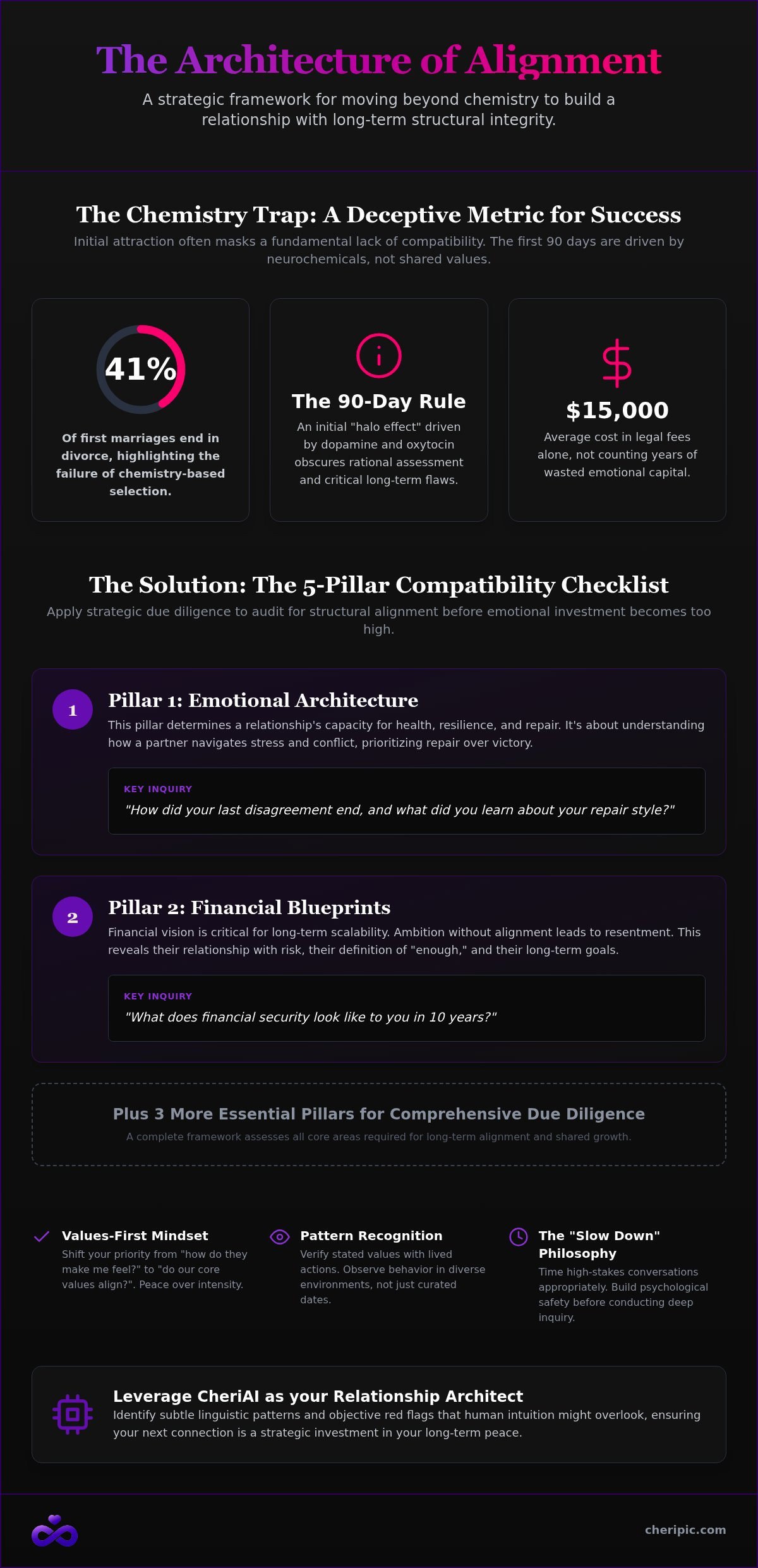
Chemistry is a deceptive metric for success; it is the spark that starts the fire but rarely the insulation that keeps the house warm. While 41% of first marriages end in divorce, the true cost isn't just the average $15,000 in legal fees, it's the years of emotional capital spent on a foundation that was never structurally sound. You've likely experienced the frustration of wasting months on a connection that felt electric, only to find your core values were fundamentally misaligned. To avoid these pitfalls, you need a precise set of questions to ask to determine long term compatibility before the emotional investment becomes too high to remain objective.
This guide offers a sophisticated framework for relationship due diligence. We'll move past the noise of initial attraction to focus on pattern recognition and behavioral verification. You'll gain a high-impact checklist designed to audit emotional maturity and structural alignment. By applying these principles of relational intelligence, you'll develop the confidence to identify red flags early and ensure your next connection is a strategic investment in your long-term peace.
Key Takeaways
- Shift your perspective from biological chemistry to structural integrity by understanding how the brain's infatuation phase can obscure critical long-term flaws.
- Implement a precise framework of questions to ask to determine long term compatibility across five essential pillars, including emotional architecture and financial scalability.
- Develop the skills for behavioral pattern recognition to verify the difference between a partner's stated values and their lived actions in diverse environments.
- Master the "Slow Down" philosophy to time high-stakes conversations appropriately, ensuring deep inquiry is built on a foundation of psychological safety.
- Leverage CheriAI as your personal Relationship Architect to identify subtle linguistic patterns and objective red flags that human intuition might overlook.
The Architecture of Alignment: Why Chemistry is a Poor Predictor of Success
Chemistry is a biological event, not a strategic roadmap. It's the physiological response to novelty that often masks a fundamental absence of shared values. While attraction is the catalyst for connection, it is a poor predictor of endurance. True interpersonal compatibility requires a synchronization of long-term trajectories that a dopamine spike simply cannot verify. Relationship Intelligence is the capacity to recognize this distinction. It's the ability to audit a partner's structural integrity before your emotional investment creates a sunk-cost fallacy.
The "90-Day Rule" explains why so many connections fail shortly after the three-month mark. During this initial phase, the brain is essentially intoxicated by oxytocin and dopamine. These neurochemicals create a "halo effect," causing you to project ideal traits onto a partner while your logical centers remain offline. You aren't seeing the person; you're seeing a high-resolution projection of your own desires. By the time the chemical haze lifts, you've already spent significant emotional capital on a foundation that may be riddled with cracks.
The Chemistry Trap vs. Structural Integrity
Surface-level commonalities are the lowest bar for success. Liking the same films or sharing a favorite travel destination doesn't build a life. These are "lifestyle preferences," not core values. Structural integrity is found in how two people navigate stress, manage resources, and repair after conflict. Shifting from a feeling-first to a values-first model requires you to prioritize logic over impulse. It's a move toward a more stable, protective form of connection that values peace over intensity.
The Professional Approach to Romantic Due Diligence
Your time and emotional energy are your most valuable assets. Treating them with the same rigor you'd apply to a professional partnership isn't cold; it's essential. The "wait and see" method is an inefficient drain on your resources. Instead, adopt a strategy of intentional inquiry. Utilizing a formal relationship compatibility assessment helps you bypass the guesswork and identify structural gaps early.
When you prepare specific questions to ask to determine long term compatibility, you're acting as the architect of your own future. This level of intentionality serves as the ultimate filter, attracting those with similar maturity and repelling those who rely on superficial charm. High standards don't limit your options; they refine them to ensure every connection you pursue has the potential for scalability and long-term security.
The 5-Pillar Compatibility Checklist: Essential Questions for Strategic Inquiry
Strategic due diligence requires a shift from performative conversation to intentional inquiry. While most people wait for red flags to appear naturally, a Relationship Architect seeks them out through proactive assessment. The goal isn't to find a perfect partner, but to ensure your internal architectures are compatible enough to withstand external pressures. The most effective questions to ask to determine long term compatibility focus on the "why" behind an answer, revealing the underlying logic of a person's behavior.
Pillar 1 & 2: Emotional and Financial Blueprints
Emotional architecture determines the ceiling of a relationship's health. You must understand how a partner handles the inevitable collapse of harmony. Ask them: "How did your last disagreement end, and what did you learn about your repair style?" This inquiry bypasses the "what" of the argument and targets their capacity for self-reflection. A high-functioning partnership aligns with the Gottman Institute's research-based qualities, prioritizing repair over victory. If they cannot articulate a lesson learned, they likely lack the tools for long-term emotional maintenance.
Financial vision is equally critical for scalability. Ambition without alignment leads to resentment. Ask: "What does financial security look like to you in 10 years?" This question reveals their relationship with risk, their definition of "enough," and their professional trajectory. It's not about the dollar amount; it's about whether your lifestyles are structurally compatible. Analyzing these responses with CheriAI Relationship Coaching can help you identify subtle linguistic patterns that suggest either deep alignment or hidden financial friction.
Pillar 3 & 4: Social Dynamics and Personal Growth
A healthy relationship requires a balance of autonomy and community. Pillar 3 examines the blueprint for household roles and social circles. Pillar 4 focuses on evolution. Ask: "How do you balance your need for independence with the demands of a partnership?" and "What is one area of your life where you are currently seeking growth or mentorship?" These inquiries reveal if a partner has the maturity to support your evolution without feeling threatened. You're looking for a "growth mindset" that views the relationship as a vehicle for mutual improvement rather than a static destination.
Pillar 5 addresses Integrity and Verification. It asks if past actions align with current claims. If a partner describes themselves as disciplined but lacks a history of following through on commitments, there is a structural gap. Verification is not about suspicion; it's about protecting your emotional assets. By prioritizing these pillars, you ensure that your connection is built on a foundation of reality rather than the fleeting excitement of a well-rehearsed dating profile.
Behavioral Pattern Recognition: Verifying Answers Beyond the Conversation
Words are a starting point, but they aren't proof. While the right questions to ask to determine long term compatibility can reveal a partner's intentions, only their actions reveal their character. Behavioral Pattern Recognition is the study of repeated actions over time. It's the analytical process of comparing what a person says against what they actually do when no one is watching. With curated digital personas becoming the norm, this audit is your most effective tool for maintaining psychological safety.
Authenticity must be the foundation of any connection. You can't perform due diligence on a ghost or a fabrication. This makes identity verification for dating a critical first step. It establishes a baseline of truth, ensuring that the person you're evaluating is who they claim to be. Once the identity is verified, the behavioral audit begins. You are looking for a track record, not just a promise.
The Consistency Audit
A person's "ideal self" often answers questions, but their "actual self" lives the life. Perform a consistency audit over a 30-day window. If a partner claims to prioritize emotional intelligence but reacts with defensiveness during a minor disagreement, you've identified Value Dissonance. This gap between stated and lived values is a structural flaw. Don't ignore these data points. When words and actions conflict, the actions are the only reliable source of truth. Consistency is the hallmark of a partner who is ready for a high-stakes commitment.
Analyzing Past Relationship Cycles
The past isn't just history; it's a blueprint. You can learn a significant amount about a partner's future behavior by analyzing their past cycles. Ask about their previous connections with curiosity rather than judgment. Listen for themes of accountability versus blame. If every previous partner is described as "unstable," the common denominator is likely the person telling the story. High-value partners take ownership of their role in past failures and can articulate what they've changed since then.
Objectivity is difficult when you're in the middle of a connection. Your brain's reward system wants the relationship to work, which can lead to "confirmation bias" where you only see evidence of compatibility. Using an AI relationship coach can disrupt this bias. These platforms provide an external, logical perspective, identifying linguistic patterns or behavioral anomalies that suggest a lack of alignment. This isn't about being suspicious. It's about being thorough. High-impact relationships require high-impact vetting.
Navigating High-Stakes Conversations: Timing and Delivery
Inquiry without safety is interrogation. To obtain high-fidelity data, you must cultivate an environment of Radical Candor. This requires moving at a pace that permits vulnerability while avoiding the brain's defensive "threat" response. The "Slow Down" philosophy is not about passivity; it is a tactical choice to build a foundation before testing the load-bearing walls of a partner's character. Strategic inquiry requires a graceful pivot from casual rapport to deep alignment. You aren't breaking the mood. You're elevating the connection to a professional standard of due diligence.
As you introduce specific questions to ask to determine long term compatibility, ensure the timing matches the level of intimacy you've established. Rushing deep inquiries can lead to performative answers, while waiting too long creates an emotional sunk-cost fallacy. To help navigate these phases with precision, consider joining the CheriPic Early Access Membership for tools that prioritize intentional connection over superficial swipes.
The Three Phases of Inquiry
- Phase 1: Casual Observation (Dates 1-3). Focus on temperament and basic respect. Observe how they handle minor inconveniences, their punctuality, and their treatment of service staff. This phase establishes the baseline of their character.
- Phase 2: Values Exploration (Dates 4-10). This is the optimal window for core questions to ask to determine long term compatibility. Use this time for deep dives into lifestyle scalability, professional ambitions, and their "blueprint" for a household.
- Phase 3: Structural Stress-Testing (Post-90 Days). After the initial chemical haze begins to fade, focus on conflict resolution and long-term planning. This is where you verify if their "lived values" match the "stated values" they shared in Phase 2.
Mastering the Art of the "Soft Ask"
Interrogation creates performance. Storytelling creates truth. Phrasing your inquiries to encourage narrative responses allows you to see the logic behind their values. Instead of asking "Are you good with money?", ask "What's a financial decision you made in your 20s that you'd change now?" This encourages reflection over simple "yes/no" validation.
The "Third-Party Scenario" technique is particularly effective for bypassing curated dating personas. Present a fictional dilemma involving a friend's relationship and ask for their perspective. This reveals their raw decision-making framework without the pressure of a direct personal question. Maintaining a sophisticated, non-judgmental tone is vital during these disclosures. If you react with judgment, you compromise the psychological safety required for future honesty. Your role is that of a Relationship Architect, calmly gathering the specifications for a potential partnership.
CheriAI: Leveraging Relationship Intelligence for Long-Term Clarity
Technology in the romantic sector has historically focused on the volume of connections rather than the quality of alignment. This reliance on superficial metrics has contributed to the exhaustion prevalent in traditional dating environments. CheriPic disrupts this cycle by functioning as a Relationship Intelligence Platform. Instead of passive browsing, it utilizes CheriAI to act as your personal Relationship Architect. This objective tool provides a stabilizing force, helping you manage your emotional assets with the same diligence you apply to your professional investments.
While you have mastered the specific questions to ask to determine long term compatibility, human intuition remains vulnerable to emotional bias. CheriAI bridges this gap by identifying linguistic patterns and behavioral anomalies that suggest a lack of structural integrity. It analyzes the depth of responses and the consistency of communication, highlighting potential red flags that your brain's reward system might intentionally overlook during the infatuation phase. It assists you in interpreting the answers to the questions to ask to determine long term compatibility, ensuring you don't miss subtle indicators of misalignment.
Data-Driven Romantic Clarity
The benefit of a sophisticated relationship coach app lies in its ability to provide data-driven clarity. CheriAI doesn't just match interests; it audits connections through the lens of behavioral psychology. By integrating Identity and Profile Verification, the platform ensures that every data point is rooted in authenticity. This foundation of truth allows you to focus your energy on vetting partners who have already cleared a high bar of transparency and maturity. You are no longer guessing; you are verifying.
Next Steps: Joining the Intentional Community
Transitioning from a theoretical checklist to a real-world partnership requires a controlled environment. The digital phase of a relationship is merely the initial vetting stage. True verification occurs during curated, real-world interactions where you can observe a partner's lived values in real time. We prioritize these "Premium Experiences" to move the connection from messaging to meaningful observation. This ensures that your structural audit is complete before deep emotional commitment takes place.
Securing your future requires a proactive approach to connection. The CheriPic Early Access Membership is a strategic investment for those who refuse to leave their long-term success to chance. By joining this intentional community, you gain access to the tools, verification, and AI coaching necessary to build a relationship that is not only electric but enduring. Join CheriPic Early Access and start building with intelligence.
Architecting Your Relational Future
Success in a long-term partnership isn't a matter of chance; it's the result of intentional due diligence. You've learned that chemistry is merely the entry point, while structural integrity is the endurance factor. By moving through the three phases of inquiry and applying behavioral pattern recognition, you ensure that your connection is built on a foundation of verified truth rather than chemical projection. Using specific questions to ask to determine long term compatibility allows you to audit a partner's values before your emotional capital is fully committed.
The path to clarity doesn't have to be walked alone. You can leverage verified relationship intelligence and AI-driven pattern recognition to identify blind spots that human intuition often misses. By joining an exclusive community of intentional professionals, you shift your focus from fleeting excitement to sustainable success. It's time to stop guessing and start building with precision. Your future self will thank you for the diligence you perform today.
Secure Your Strategic Advantage with CheriPic Early Access
Frequently Asked Questions
When is the right time to start asking compatibility questions?
The right time follows a phased approach to protect your psychological safety. Initial dates focus on temperament and basic respect. By the fourth date, you should begin integrating specific questions to ask to determine long term compatibility to ensure your trajectories align. Waiting past the 90-day mark without these inquiries risks the sunk-cost fallacy. A deliberate pace allows you to gather high-fidelity data before the brain's chemical reward system obscures your judgment.
How do I ask about long-term goals without sounding too intense?
You avoid intensity by shifting from interrogation to storytelling. Frame your inquiries as "Soft Asks" that encourage a partner to share their history rather than a list of demands. Use the "Third-Party Scenario" technique to discuss a fictional dilemma. This reveals their decision-making framework without the pressure of a direct personal audit. Maintaining a calm, sophisticated tone ensures the conversation feels like a collaborative exploration rather than a high-stakes interview.
What is the most important question for long-term compatibility?
The most critical inquiry targets conflict resolution and repair style. Ask how their last major disagreement ended and what they learned about their role in the process. Long-term success depends less on avoiding conflict and more on the ability to return to a state of safety. A partner who lacks accountability or cannot articulate a repair strategy presents a significant structural risk to any potential partnership. You need a partner who prioritizes repair over victory.
Can an AI really help me determine if someone is compatible?
CheriAI provides an objective layer of analysis that human intuition often lacks. It identifies subtle linguistic patterns and behavioral anomalies that may suggest a lack of alignment. By processing the answers to your questions to ask to determine long term compatibility, the AI highlights blind spots or red flags hidden by initial chemistry. This relationship intelligence allows you to make decisions based on logical verification rather than fleeting emotional excitement or confirmation bias.
What should I do if our values align but our lifestyle habits don’t?
You must distinguish between negotiable preferences and non-negotiable structural flaws. Core values are the load-bearing walls of a relationship; lifestyle habits are the interior design. If your visions for the future align, habits can often be managed through clear communication and compromise. However, if a habit reflects a deeper misalignment in discipline or respect, it may indicate a fundamental value gap that requires a more rigorous audit. Focus on the scalability of the connection.
How do I know if someone is lying about their compatibility?
Verification is achieved through Behavioral Pattern Recognition rather than verbal confirmation alone. You must observe if their lived actions match their stated values over a consistent period. Identity and Profile Verification establish a baseline of authenticity from the start. If a partner's history or daily choices contradict their verbal claims, the behavior is the only reliable data point. Trust is a result of consistent verification, not a blind assumption or a hopeful feeling.
Is chemistry or compatibility more important for a 50-year marriage?
Compatibility is the structural integrity that sustains a 50-year marriage. While chemistry acts as the initial catalyst, it naturally fluctuates over time. Structural alignment on finances, emotional repair, and growth ensures the relationship remains scalable through life's inevitable stressors. A partnership built solely on intensity will eventually collapse when the chemical haze lifts. Prioritizing compatibility creates a stabilizing force that allows a connection to evolve into a lasting, protective commitment that survives the decades.
What are the red flags to look for in their answers to these questions?
Look for defensiveness, lack of accountability, and vague responses that avoid concrete details. A high-value partner can articulate their growth and past mistakes with self-awareness. If they blame all previous partners for past failures, they are signaling a lack of emotional maturity. Inconsistency between their verbal promises and their daily actions is the most significant red flag. These patterns suggest a structural weakness that will eventually compromise the relationship's long-term success and your emotional peace.


