

What if stating a boundary doesn’t push the right person away, but gives the relationship a clearer foundation? If you’re setting healthy boundaries in a new relationship, you may wonder which needs matter, how to voice them, and whether honesty could create conflict. Early connection can make these questions feel high-stakes. But boundaries aren’t tests of whether someone cares, and they aren’t instructions for controlling another person. They clarify what you need to feel respected and secure.
This guide will help you identify your personal limits, communicate them calmly, and maintain them without turning a boundary into a demand or ultimatum. You’ll find practical examples involving time, emotional openness, physical closeness, and personal space, along with language that keeps conversations direct and respectful.
You’ll also learn how to assess what happens next. A partner’s response, especially when it’s consistent over time, can offer meaningful information about how they approach your needs. The goal isn’t to avoid every disagreement or guarantee the relationship will continue. It’s to build early clarity, protect your self-respect, and make deliberate choices about whether the connection is right for you.
Key Takeaways
- For setting healthy boundaries in a new relationship, start by noticing discomfort and identifying the need beneath it.
- Separate flexible preferences from limits tied to your safety, values, or wellbeing.
- Use a calm, timely conversation to explain the situation, state your need, and name the limit.
- Look for respect in both the conversation and your partner’s actions over time.
- Revisit expectations as trust and circumstances change, making room for mutual understanding.
What healthy boundaries in a new relationship actually protect
Wanting to protect your wellbeing doesn’t mean you’re closed to connection. It means you’re paying attention to what helps you feel respected, safe, and able to show up as yourself. In a new relationship, that awareness matters because expectations are still taking shape.
A boundary is a personal limit that guides what you choose to share, allow, give, or participate in. It can shape your choices around access, time, privacy, and involvement. A boundary doesn’t guarantee compatibility or dictate what another person must do. It clarifies what you will do to care for your own wellbeing. For a broader introduction to personal boundaries, consider how limits help distinguish your choices from another person’s.
Which boundaries matter most when a relationship is new?
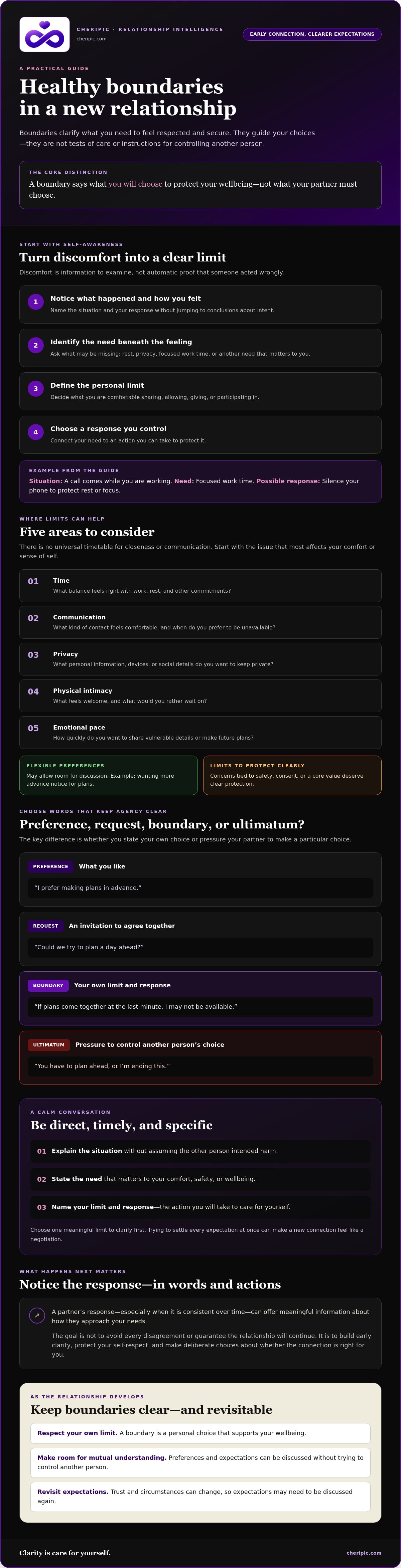
There’s no universal timetable for closeness or communication. Your needs depend on your circumstances, values, and comfort. Consider where being specific would help most:
- Time: How much time together feels balanced with work, rest, and other commitments?
- Communication: What kind of contact feels comfortable, and when do you prefer to be unavailable?
- Privacy: What personal information, devices, or social details do you want to keep private?
- Physical intimacy: What feels welcome, and what do you want to wait on?
- Emotional pace: How quickly do you want to share vulnerable details or make future plans?
Before an important conversation, choose one meaningful limit to clarify. Trying to settle every expectation at once can make a new connection feel like a negotiation. Start with the issue that most affects your comfort or sense of self.
Boundary, preference, request, or ultimatum?
These distinctions can help you communicate clearly without trying to manage your partner’s independent choices. A preference describes what you like: “I prefer making plans in advance.” A request invites mutual agreement: “Could we try to plan a day ahead?” A boundary names your own limit and response: “If plans come together at the last minute, I may not be available.”
An ultimatum applies pressure by making the other person responsible for preventing a consequence: “You have to plan ahead, or I’m ending this.” The difference isn’t simply whether a statement sounds firm. It’s whether you’re stating what you will choose or demanding control over what your partner chooses. When setting healthy boundaries in a new relationship, a calm, specific limit gives both people clearer information without treating an ordinary difference as proof of bad intent.
How to identify your boundaries before you communicate them
Clarity usually begins before the conversation. To identify a boundary, move through four steps: notice discomfort, identify the need, define the limit, then choose the response you control. This process turns a vague feeling into something you can explain without assuming the other person intended harm.
Use discomfort as information, not an automatic verdict
Before deciding what to ask for, make a brief note of what happened, how you felt, and what need may have gone unmet. For example: “They called while I was working; I felt distracted; I need focused work time.” Discomfort deserves attention, but it doesn’t by itself prove someone acted wrongly. Check whether the limit reflects a personal value, a preference, a fear, or a temporary circumstance. That pause can help you respond thoughtfully instead of reactively.
A boundary connects a need to an action you can take to protect it. If the need is rest, the limit might be not taking calls after a certain point in the evening, with the response of silencing your phone. If the need is privacy, you might choose not to share a personal detail until you’re ready. The Mayo Clinic Health System’s guidance on maintaining healthy boundaries also frames limits as part of supporting wellbeing.
Choose boundaries for time, communication, privacy, and intimacy
Consider what would make the connection feel sustainable for you. Your answer doesn’t need to match someone else’s. One person may enjoy frequent messages, while another prefers to talk at the end of the day. You might want to protect time for friends or rest, keep certain information private, or agree on a pace for physical intimacy that feels comfortable to both of you.
Separate preferences from non-negotiable concerns. A preference, such as wanting more advance notice for plans, may allow room for discussion. A limit tied to safety, consent, or a core value deserves clear protection. Consent is ongoing: you can pause, decline, or change your mind, even if you previously agreed.
- Need: “I need time to myself after work.”
- Limit: “I’m not available for calls during that time.”
- Your response: “If a call comes in, I’ll reply when I’m free.”
Decide in advance what you’ll do if the limit isn’t respected. That might mean ending a conversation, leaving a situation, or reconsidering what level of access feels right. If you notice recurring patterns and want help reflecting on your needs, CheriAI relationship coaching can offer personalized insights. Use that reflection to prepare; the boundary itself still needs to be communicated directly.
How to communicate a boundary clearly without sounding controlling
A boundary is easier to discuss when you raise it before frustration takes over. Choose a calm, reasonably private moment rather than introducing the limit for the first time in the middle of an argument. You don’t need a perfect speech. Aim to describe what’s happening, state what you need, explain the limit you’ll follow, and invite your partner to respond.
“I enjoy spending time with you, and I need some evenings to myself, so I’m going to keep Wednesday free. How does that fit with your plans?” This is direct without demanding that your partner feel or act a particular way. It names your choice and leaves room for an honest conversation.
What can you say when you need to set a limit?
Adapt the wording to your own needs. These examples are starting points, not rules about how often people should communicate or how quickly intimacy should develop:
- Communication pace: “I like hearing from you, but I can’t keep up with messages during work. I’ll reply when I’m available.”
- Personal time: “I need quiet time after work. I’m not available to talk then, but I’d like to catch up later.”
- Privacy: “I’m not ready to share that detail. If the conversation keeps going in that direction, I’ll change the subject.”
- Physical intimacy: “I want to take this at a pace that feels comfortable. If I feel unsure, I’ll pause.”
Each script names a need and an action you control. Your partner may have a different preference and can say so. The purpose isn’t to secure automatic agreement. It’s to make your limit understandable and give both people a chance to assess whether their expectations can work together.
How to talk about boundaries without overexplaining
A short explanation can provide useful context, but you don’t need to defend a limit until your partner approves it. Listen to their perspective and ask clarifying questions. At the same time, keep ownership of your choice. You might say, “I understand that you prefer spontaneous plans. I still need notice to know whether I’m available.”
Notice whether you’re explaining to create understanding or talking yourself out of what you need. If a conversation leaves you uncertain about your own judgment, you can reflect on the psychology of ignoring red flags. That’s a prompt for reflection, not a diagnosis of you or your partner.
When setting healthy boundaries in a new relationship, clarity matters more than persuasive wording. State the limit, hear the response, and decide what you’ll do if it can’t be respected.
How to respond when a new partner reacts to your boundary
A partner’s first reaction can bring up uncertainty, but surprise or disagreement alone doesn’t establish disrespect. They may need a moment to understand what you mean, or they may have different expectations. Pay attention to what happens next: do they listen, seek clarity, and make a genuine effort to respect your limit?
Look for a pattern, not a perfect first conversation. A respectful response might include a clarifying question, such as, “Would you prefer I text before calling?” Your partner may also suggest an alternative that respects both people’s needs. Negotiation can be constructive, as long as it doesn’t require you to abandon a limit that matters to your wellbeing.
What does a respectful response look like in practice?
Respect becomes clearer through follow-through. If you’ve said you’re unavailable during work, notice whether your partner adjusts over time, rather than relying only on reassuring words. Allow reasonable room for adjustment, especially when the expectation is new. One awkward conversation or misunderstanding isn’t enough to define someone’s character. The more useful question is whether they take your concern seriously and make an effort to act differently.
What if your boundary is misunderstood or challenged?
Restate the limit calmly and check whether you were specific: “I’m not asking you to stop calling. I’m saying I can’t answer during work, and I’ll get back to you when I’m free.” A good-faith misunderstanding often leaves room for clarification. Repeated pressure, retaliation, or deliberate disregard after you’ve made the limit clear deserves closer attention. Avoid diagnosing your partner; focus on the behavior, its effect on you, and whether it continues.
If a response involves coercion or makes you afraid, prioritize your safety over resolving the disagreement. Consider reaching out to someone you trust or a qualified local support resource. You don’t have to manage a frightening situation alone.
For optional reflection on recurring dynamics, explore relationship pattern recognition and AI coaching. It can help you consider what you’re noticing, but it doesn’t replace direct communication or your own judgment. Setting healthy boundaries in a new relationship also means observing whether respect holds over time. For personalized insights that can support this reflection, explore CheriAI relationship coaching.
How to maintain healthy boundaries as a new relationship develops
Boundaries aren’t fixed terms that you sign once and follow unchanged. As trust grows, schedules shift, and you learn more about each other, a limit may need clarification or adjustment. What matters is that changes are discussed openly, not assumed. Regular check-ins can help both people understand what still works and what needs a fresh conversation.
Flexibility doesn’t mean every preference must match. Compatibility also shows in how you handle differences: whether you can talk honestly, consider each other’s needs, and respect individual limits without treating them as obstacles to overcome. The aim of setting healthy boundaries in a new relationship isn’t to eliminate disagreement. It’s to see whether both people can work through it respectfully.
How to revisit a boundary without sending mixed signals
When something changes, be specific about three points: what has changed, what still matters, and what adjustment you’re asking for. For example: “My work schedule has changed, so I can’t talk during the afternoon anymore. Staying in touch matters to me, and I’d like to catch up in the evening instead.” This explains the shift without leaving your partner to guess what you mean.
A change in circumstances or comfort doesn’t erase consent, and a previous agreement doesn’t obligate you to continue if it no longer feels right. Invite your partner to share their perspective, too. You can consider a mutual alternative while keeping your own limits under your control. A check-in is a conversation, not a contract that either person must uphold regardless of changing needs.
When to pause, seek support, or reconsider the relationship
Look beyond one difficult discussion. Consider whether the same limit is repeatedly dismissed, whether you feel able to speak freely, and how interactions affect your sense of safety and wellbeing. A respectful relationship can include adjustment and occasional miscommunication. Repeated pressure, fear, or punishment for expressing a limit calls for more careful assessment.
If you feel unsafe or can’t evaluate the situation clearly on your own, pause the conversation and reach out to someone you trust or a qualified professional. Relationship tools are not a substitute for safety support. You don’t have to decide everything immediately, but you can take your concerns seriously and choose support that fits the situation.
For a wider perspective on shared values and areas where differences may need discussion, use a relationship compatibility assessment as a reflection tool. It can help you organize questions to discuss, but it can’t replace direct communication or determine the relationship for you.
Take Your Next Step With Greater Clarity
Setting healthy boundaries in a new relationship is a practice of self-awareness, clear communication, and ongoing attention. Start by identifying the need behind a limit, then explain what you will do to honor it. As the relationship develops, revisit expectations and look for respect in consistent actions, not just reassuring words.
Boundaries don’t require you and your partner to share every preference. They help you understand whether differences can be discussed with care, and whether the connection supports your wellbeing. You’re allowed to adjust a limit as your circumstances or comfort change. You’re also allowed to pause and reconsider if your concerns are repeatedly dismissed.
For additional perspective as you make relationship decisions, CheriPic offers identity verification and compatibility assessments, while CheriAI provides relationship insights and pattern recognition. These tools can support reflection, but direct communication and your judgment remain central. Explore CheriPic’s relationship intelligence platform and take your next step at a pace that respects your needs.
Clarity is something you can build, one thoughtful conversation at a time.
Frequently Asked Questions
Is it too early to set boundaries in a new relationship?
No. You can communicate a limit whenever it becomes relevant, including early in dating. Clear expectations can prevent avoidable confusion about time, privacy, communication, or physical intimacy. You don’t need to present a complete list or define the entire relationship at once. Start with the need that matters now, explain it calmly, and leave room for both people to learn how the other approaches closeness.
How do you set boundaries without pushing someone away?
State what you need and what you’ll do, without demanding that the other person feel or behave exactly as you wish. For example: “I enjoy talking with you, but I can’t text during work. I’ll reply when I’m free.” A partner may have a different preference, and that can be discussed. Setting healthy boundaries in a new relationship creates clarity, not a guarantee that you’ll agree on everything.
What are examples of healthy boundaries when dating someone new?
Examples depend on your needs and circumstances. You might keep certain evenings for personal time, choose not to share private information before you’re ready, or agree on a communication rhythm that works for both of you. You can also set a limit around physical intimacy, such as pausing when you feel unsure. A useful boundary names your choice, rather than prescribing a universal rule for how dating should work.
Can boundaries change as a relationship develops?
Yes. Your needs may shift as you build trust, learn more about each other, or face changes in work, health, or daily routines. Bring up the change directly: explain what’s different, what still matters, and what adjustment you’d like to discuss. A previous agreement doesn’t remove your ability to reconsider or change your mind. Check in with each other, while recognizing that each person remains responsible for their own limits.
What is the difference between a boundary and an ultimatum?
A boundary describes a limit and the action you’ll take to care for yourself: “If I’m not comfortable, I’ll pause the conversation.” An ultimatum pressures the other person to comply by attaching a threat: “Do this, or I’ll make you regret it.” Firmness alone doesn’t make something an ultimatum. Focus on whether you’re naming your own next step or trying to control your partner’s independent choice.
What should you do if someone keeps crossing your boundaries?
Restate the limit clearly once, if it feels safe, and observe whether the behavior changes. A misunderstanding may be resolved through clarification; repeated disregard, pressure, or retaliation is more concerning. Decide what action you control, such as ending a conversation, leaving, or reconsidering the relationship. If you feel afraid or coerced, prioritize safety and contact someone you trust or a qualified local support service. You don’t have to assess the situation alone.
How do you talk about physical intimacy and consent early in a relationship?
Raise the topic before you’re in a moment where it feels difficult to pause. Use direct language about what you’re comfortable with, what you want to wait on, and how you’ll signal that you need to stop. For example: “I’d like to take this slowly, and I may want to pause. Please check in with me.” Consent can change; you can say no, pause, or change your mind at any time.


