

What if becoming emotionally close isn’t about revealing more, faster, but noticing whether trust is growing on both sides? If you’re wondering how to build emotional intimacy with a new partner, it can be hard to judge how much to share. You may worry that holding back seems distant, while opening up too quickly leaves you exposed. Strong chemistry can add to the confusion, but it doesn’t show whether trust is mutual.
That uncertainty makes sense. Emotional closeness needs honesty, but it also needs room for each person to feel safe and respond freely. You don’t have to choose between staying guarded and telling your whole story at once.
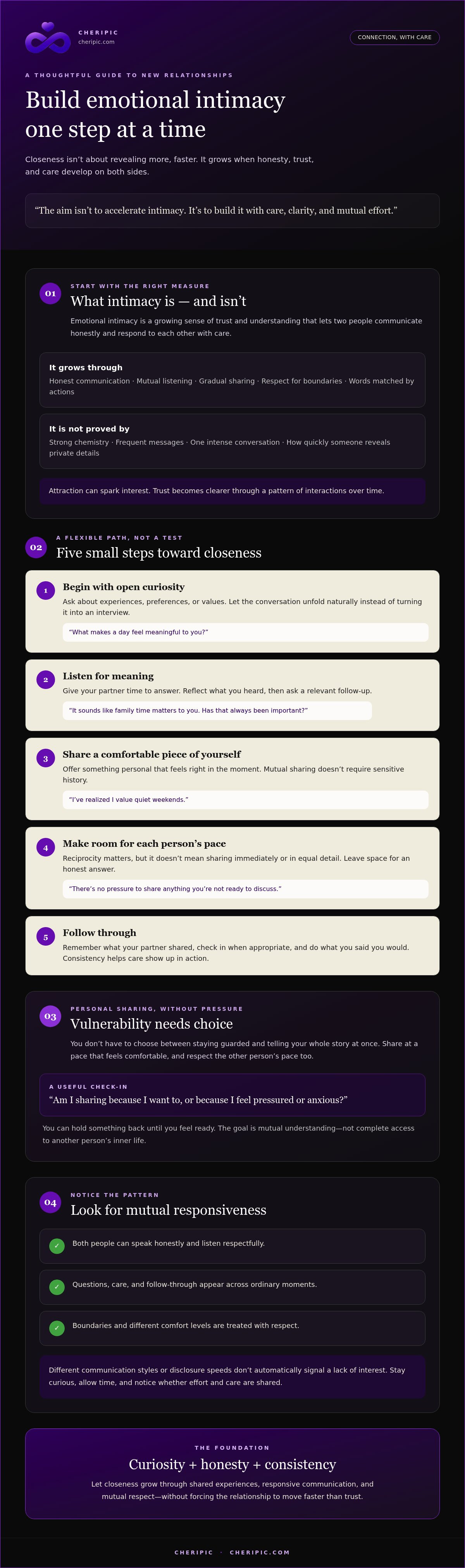
In this article, you’ll learn how to build trust through consistent, reciprocal communication and share personal thoughts at a comfortable pace. We’ll cover the difference between vulnerability and oversharing, how small moments of responsiveness deepen connection, and what to notice as you assess whether both partners are contributing. The aim isn’t to accelerate intimacy. It’s to build it with care, clarity, and mutual effort.
Key Takeaways
- Understand why emotional intimacy depends on growing trust and honest communication, not chemistry or constant messaging alone.
- Learn how to build emotional intimacy with a new partner through curiosity, gradual sharing, and follow-through.
- Recognize when personal disclosure supports connection and when pressure or anxiety may be pushing you to share more than feels right.
- Use low-pressure questions and shared experiences to create meaningful connection between dates.
- Assess whether closeness is developing through mutual responsiveness and respect for boundaries, without treating every difference in communication style as a warning sign.
What emotional intimacy means when a relationship is new
Emotional intimacy is a growing sense of trust and understanding that allows two people to communicate honestly and respond to each other with care. It develops as partners learn about one another’s values, experiences, needs, and boundaries. The overview of emotional intimacy also identifies trust, communication, and self-disclosure as central elements. In a new relationship, those elements are still taking shape.
Attraction may spark interest, and frequent messages may create momentum, but neither tells you by itself how well you know each other or whether trust is mutual. Intimacy isn’t measured by how quickly someone shares private details. Look instead at whether both people can speak honestly, listen respectfully, and gradually feel understood.
How emotional intimacy differs from attraction
Attraction can be immediate. A person’s humour, confidence, or attentiveness may feel compelling before you know how they handle disagreement, respect a boundary, or follow through on what they say. Early excitement is real, but it isn’t evidence of shared values or emotional availability. Treat it as a reason to stay curious, not as proof of long-term compatibility.
Understanding comes from a pattern of interactions. One thoughtful conversation may feel promising. Over time, notice whether each person asks questions, remembers what matters to the other, and responds consistently. That is how to build emotional intimacy with a new partner: give the connection time to be supported by what you learn and experience together.
Why a new relationship needs time and trust
Trust grows when words and actions align in ordinary moments. Making plans and keeping them, sharing a concern and being heard, or repairing a small misunderstanding can help each person form a clearer picture of the other. These experiences build predictability. One intense conversation may offer insight, but it can’t establish a reliable pattern on its own.
People also differ in how quickly they feel comfortable discussing personal subjects. One partner may be ready to talk about family history while the other prefers to share gradually. Neither pace automatically signals a lack of interest. Ask, listen, and leave room for an honest answer instead of treating disclosure as a test of commitment.
Emotional conversations still require consent and boundaries. You can say, “I’d like to understand more, but only if you’re comfortable sharing,” or hold something back until you feel ready. Respecting that choice helps build safety. The goal isn’t complete access to another person’s inner life. It’s mutual understanding that develops without pressure.
How to build emotional intimacy with a new partner, step by step
Closeness grows through small exchanges, not one perfect question or a single revealing conversation. If you’re learning how to build emotional intimacy with a new partner, focus on curiosity, measured honesty, and what each of you does after sharing. Use these steps as a flexible guide, not a test your partner has to pass.
- Begin with open curiosity. Ask about experiences, preferences, or values: “What do you enjoy most about your work?” or “What makes a day feel meaningful to you?” Let the conversation develop naturally rather than firing off questions. The goal is to understand, not interview.
- Listen for meaning. Give your partner time to answer. Reflect what you heard, then ask a relevant follow-up, such as, “It sounds like having time with family matters to you. Has that always been important?” Attentive responses build more connection than a long list of prompts.
- Offer a proportionate piece of yourself. Share something personal that feels comfortable in the moment: “I’ve realized I value quiet weekends,” or “I’m hoping to make more time for creative projects.” This makes the exchange mutual without requiring either person to disclose sensitive history.
- Make space for their pace. You might say, “I’m happy to tell you more, but there’s no pressure to share anything you’re not ready to discuss.” Reciprocity matters, but it doesn’t mean matching each other’s disclosure immediately or in equal detail.
- Follow through. Remember what your partner shared, check in when appropriate, and do what you said you would. Consistency helps you see whether the care shown in conversation is also present in action.
Use curiosity and active listening to create connection
Questions about hopes, meaningful experiences, or values can invite depth without demanding private details. The Gottman Institute offers prompts to deepen emotional intimacy. Choose one that fits the moment, then listen closely. A thoughtful pause or relevant follow-up can show more attention than quickly moving to the next question.
Reciprocal self-disclosure supports growing closeness when each partner shares at a comfortable pace and responds with attention and care. Look for that exchange over time rather than expecting one conversation to confirm trust.
Share personal experiences at a comfortable pace
Before sharing something sensitive, pause and ask yourself: Do I feel ready? Is it relevant to this conversation? Do I trust this person to respond respectfully? You can invite openness without demanding it: “I’ve shared a little about what matters to me. Is there anything you’d like me to understand about you?” Then accept their answer, including a choice not to answer yet.
If reflecting on your relationship patterns would help you make clearer decisions, CheriAI Relationship Coaching may offer optional perspective alongside direct communication with your partner.
Is vulnerability the same as oversharing in a new relationship?
Vulnerability is choosing to share something personal because it feels relevant and you’re ready to let the other person understand you better. Oversharing can happen when disclosure is driven by pressure, anxiety, or a need for immediate reassurance rather than mutual connection. The difference isn’t simply how private the information is. Consider whether sharing feels thoughtful, appropriate to the moment, and safe for you.
Closeness doesn’t require revealing everything early. You can be sincere while keeping parts of your history private until trust develops. Boundaries aren’t evidence of rejection; they help make honest sharing possible by clarifying what feels comfortable. There’s no single correct pace. If you’re considering how to build emotional intimacy with a new partner, notice whether both people can share, pause, and respond without pressure.
Signs that disclosure feels mutual and respectful
Look at the pattern, not one moment. A partner may listen attentively, respond with care, and share something of their own over time. Just as important, they accept it if you’d rather pause or change the subject. Notice whether that consideration also appears in everyday behavior, such as respecting plans and boundaries. Warm words or one especially personal conversation can’t establish someone’s intentions on their own.
How to respond when your comfort levels differ
Different disclosure preferences don’t automatically mean either person is doing something wrong. Name your comfort clearly without blaming, testing, or apologizing for a boundary. For example: “I’m not ready to talk about that yet. I’d like to come back to it when I feel more comfortable.” You can also ask, “Would you be comfortable telling me what sharing this topic is like for you?”
Stay curious about differences, but don’t negotiate away a firm limit to prove your interest. A respectful partner may have a different comfort level, yet should still be willing to hear your boundary. What matters is whether you can discuss the difference honestly and continue at a pace that respects both people.
Practical ways to deepen emotional intimacy between dates
Connection doesn’t depend on long messages or constant contact. Small, intentional moments between dates can help you learn how each person pays attention, shares experiences, and follows through. If you’re considering how to build emotional intimacy with a new partner, choose practices that invite closeness without making either person feel examined.
Conversation prompts that invite meaningful answers
Ask because you’re genuinely curious, not because you’re checking a box. Give your partner room to answer, share your own perspective, and let the conversation move on if it feels complete. Prompts might include:
- “What helps you feel understood or appreciated?”
- “What’s something you enjoyed recently, and what made it meaningful?”
- “What’s a value you’ve become more intentional about over time?”
There’s no need to ask all three in one conversation. A single thoughtful exchange, followed by attentive listening, can reveal more than a sequence of questions asked like a compatibility test.
Build trust through shared experiences and follow-through
Choose activities that leave room to talk without requiring constant disclosure, such as taking a walk, visiting a market, or cooking a meal together. Shared experiences give you something to reflect on afterward: What did you each enjoy? How did you make decisions together? Those observations can open useful conversations about preferences and values. For a structured way to consider shared priorities, see this guide to relationship compatibility assessment.
Reliability matters in ordinary details. Keep plans when you can, and communicate clearly if something changes. The Gottman Institute describes partners “turning toward” one another’s bids for connection as a meaningful relationship pattern. Its reported research found that couples who remained married turned toward bids 86% of the time, compared with 33% among couples who later divorced. That finding isn’t a prediction about any new relationship, but it underscores the value of repeated responsiveness. Dependable follow-through can build trust by making care visible through consistent actions.
Misunderstandings happen. Try to repair them with curiosity and accountability: “I think I misunderstood what you meant. Can you tell me more?” If your words landed poorly, acknowledge the impact, clarify what you intended, and check that you’ve understood their response. Then follow up through your actions. Repair isn’t about winning the exchange; it’s about making room for both perspectives.
If you’d like optional support reflecting on relationship patterns, explore CheriAI Relationship Coaching. Use reflection as a complement to direct communication, not a substitute for it.
How to keep emotional intimacy growing without forcing the relationship
Emotional intimacy can deepen without a fixed timeline or constant reassurance. Look for gradual progress: you can speak more honestly, both of you respond with care, and personal boundaries are respected. Different communication styles or moments of uncertainty don’t automatically mean you’re incompatible. What matters is the pattern you build together.
Notice patterns without rushing to a conclusion
Try not to make a sweeping judgment after one awkward conversation or missed cue. Consider what happens across repeated interactions: Can you clarify a misunderstanding, listen to each other’s perspective, and make a reasonable effort to repair it? A misstep followed by accountability may be different from repeatedly disregarding a boundary you’ve clearly stated.
Pay attention without diagnosing your partner or treating one behavior as proof of their intentions. Ask yourself: Do I feel increasingly able to be honest? Is responsiveness mutual, even if we show it differently? Can I say no or ask for a pause without being pressured? These observations offer useful information, not certainty. If relationship concerns are affecting your well-being or feel difficult to work through, consider speaking with a qualified professional you trust.
Use reflection tools to clarify what matters to you
Before discussing the relationship, identify your own values, needs, and intentions. You might want more regular check-ins, value time together without distractions, or need a slower pace around personal topics. Being clear with yourself can help you express a preference directly rather than hoping your partner will infer it.
AI relationship coaching and pattern recognition can serve as optional reflection tools as you consider recurring dynamics and what matters to you. They shouldn’t replace direct conversation with your partner or professional therapy when that support is needed. Use any insight as a starting point for a real discussion, not a verdict about the relationship.
Learning how to build emotional intimacy with a new partner means allowing the connection to develop while staying attentive to your own experience. You don’t need to force a timeline. Notice what’s becoming more honest, mutual, and respectful, then talk openly about what you want to keep building.
Explore CheriPic for relationship intelligence tools that can support reflection and clearer relationship decisions.
Let trust develop through steady, mutual effort
Emotional intimacy isn’t proven by instant chemistry or a single revealing conversation. It takes shape as you learn about each other, communicate honestly, and see whether care and respect remain consistent over time. Sharing gradually isn’t holding back; it’s a way to protect your comfort while making room for trust to grow.
As you consider how to build emotional intimacy with a new partner, focus on three things: curiosity that invites conversation, disclosure that feels voluntary, and follow-through that makes reliability visible. Different communication styles or an occasional misunderstanding don’t automatically define the relationship. Notice the broader pattern, including whether both people can listen, repair, and respect boundaries.
CheriPic offers optional tools that may support reflection, including CheriAI relationship insights and pattern recognition, identity and profile verification, and relationship compatibility assessments. These tools can help you think more clearly, but direct conversation remains essential.
Explore CheriPic for thoughtful relationship intelligence tools. Take your time, stay attentive to what you experience together, and let genuine connection grow at a pace that feels right for both of you.
Frequently Asked Questions
How long does it take to build emotional intimacy with a new partner?
There’s no universal timeline for emotional intimacy. It develops as you have conversations, share experiences, and see whether care and respect remain consistent. Rather than measuring closeness by dates or messages, notice whether you’re gradually learning about each other and becoming more comfortable communicating honestly. If you’re wondering how to build emotional intimacy with a new partner, focus on mutual effort and steady trust, not a deadline.
Can you build emotional intimacy without sharing your deepest secrets?
Yes. Emotional intimacy can grow through honest conversations about everyday preferences, hopes, values, and feelings. You don’t need to disclose painful or private experiences before you feel ready. Share what feels appropriate and notice whether your partner listens respectfully. Keeping some details private is a valid boundary, not proof that you’re emotionally unavailable. Deeper disclosure can happen later if trust and comfort develop for both of you.
What are the signs of emotional intimacy in a new relationship?
Signs may include feeling able to express a preference, ask a question, or voice a concern without being mocked or pressured. You may notice that both of you listen, respond with consideration, remember what matters to each other, and make an effort to follow through. Look for a pattern rather than relying on one intense conversation or affectionate gesture. Emotional closeness includes respect for boundaries, even when you see things differently.
How do I talk about feelings with someone I just started dating?
Start with a specific, low-pressure statement about your own experience, then invite a response. For example, say, “I’ve enjoyed getting to know you, and I’d like to keep seeing where this goes. How are you feeling about it?” Choose a calm moment, speak plainly, and leave space for an honest answer. You don’t need to resolve the whole relationship at once. One clear conversation can open the door to another.
Is it normal to feel nervous about emotional intimacy?
Yes. Sharing personal thoughts can feel exposing, especially when you’re still learning whether the other person will treat them with care. Nervousness doesn’t automatically mean you should withdraw, and it doesn’t mean you need to push through a boundary. Try sharing something manageable and notice how you feel during and afterward. You can pause, change the subject, or say you’d rather discuss it another time.
Can emotional intimacy grow if partners open up at different speeds?
Yes, if both people respect each other’s pace and remain willing to connect. One person may feel comfortable discussing emotions sooner, while the other needs more time. Talk about what feels manageable instead of treating disclosure as a test or expecting an equally personal response. Notice whether you can still show interest, communicate honestly, and respect a request to pause. Different speeds can work when neither person is pressured or dismissed.
What should I do if my new partner does not want to talk about feelings?
Ask calmly whether they’re uncomfortable with the topic, need time, or prefer another way to communicate. You could say, “I don’t need an answer right now, but emotional conversations matter to me. Could we revisit this later?” Respect their boundary, but also be honest about your own needs. If they repeatedly refuse any meaningful discussion, consider whether the relationship can offer the communication and closeness you’re looking for.
Explore CheriPic to learn about its relationship intelligence tools, including CheriAI coaching, identity and profile verification, and compatibility assessments.


