

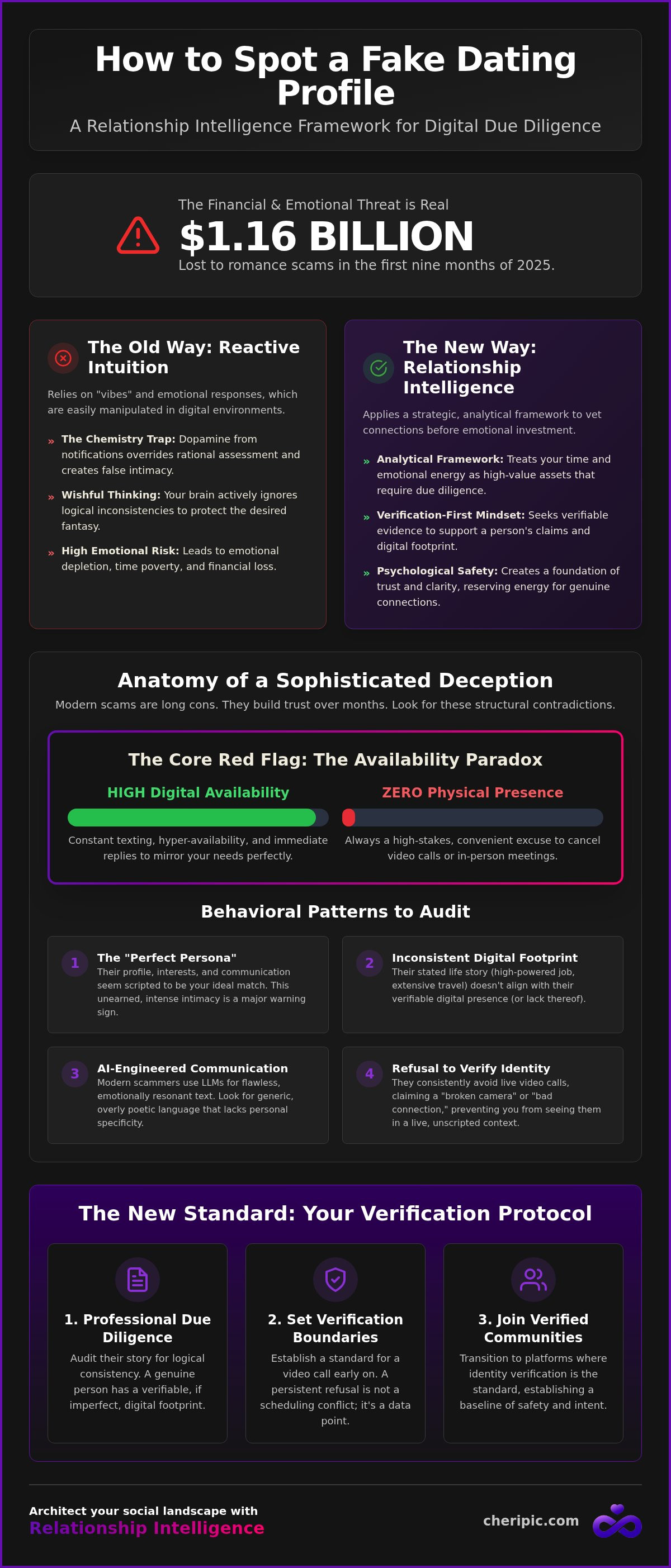
What if the key to digital safety isn't sharper intuition, but a more rigorous standard of due diligence? With over $1.16 billion lost to romance scams in the first nine months of 2025, learning how to spot a fake dating profile is no longer just a skill; it's a necessity for protecting your emotional and financial assets. You've likely felt the specific exhaustion that comes from moving through a landscape where authenticity feels like a rare luxury. It's draining to treat every new notification with suspicion, yet the current prevalence of digital deception makes this defensive posture feel mandatory for your psychological safety.
This guide moves beyond superficial red flags to provide a master analytical framework for identifying deception. You'll learn to transition from a reactive mindset to a proactive verification standard that treats your time as a high-value asset. We will examine the behavioral patterns of sophisticated actors, analyze the structural integrity of genuine profiles, and outline a repeatable process for vetting connections. By the end of this assessment, you'll have the tools to move from uncertainty to clarity, ensuring your emotional energy is reserved for a verified community of peers.
Key Takeaways
- Shift from reactive intuition to an analytical framework of Relationship Intelligence to identify sophisticated psychological manipulation.
- Recognize the critical behavioral contradiction where a connection offers intense digital availability while maintaining a persistent physical absence.
- Master how to spot a fake dating profile by auditing "average" personas for logical inconsistencies rather than searching for obvious model-like photos.
- Implement a professional due diligence standard to ensure a contact's stated life story aligns with their verifiable digital footprint.
- Transition to identity-verified communities to establish a foundation of psychological safety and prioritize long-term connection over fleeting excitement.
Beyond Intuition: Why Spotting a Fake Dating Profile Requires Relationship Intelligence
Relationship Intelligence (RI) is the strategic framework used to evaluate the structural integrity of a digital connection before committing emotional capital. It is the transition from a passive observer to a disciplined Relationship Architect. Adopting Relationship Intelligence allows you to vet connections with the same precision you apply to your professional life. In a digital environment, RI replaces the haphazard nature of swiping with a consistent verification standard. Traditional intuition often fails because it was designed for face-to-face interaction, not for environments shaped by deceptive engineering. When you prioritize "vibes" over verification, you risk significant emotional depletion and time poverty. Understanding how to spot a fake dating profile is the first step in protecting your most valuable assets: your time and your peace of mind.
The Chemistry Trap: Why Your Brain Ignores Digital Red Flags
Digital interactions are designed to trigger dopamine loops. Every notification acts as a micro-reward, creating a sense of momentum that can feel like genuine chemistry. This neurobiological feedback loop often disables the brain's executive function, leading to what we call the Chemistry Trap. During the first 90 days of a connection, "wishful thinking" often fills the gaps left by a lack of real-world evidence. You want the person to be real, so your brain actively filters out logical inconsistencies in their narrative. This psychological blind spot makes it easy for scammers to build rapport without ever providing proof of identity.
The Chemistry Trap is a biological blind spot where the pursuit of emotional connection overrides the capacity for rational assessment.
The Evolution of Deception: From Bots to AI-Engineered Personas
The landscape of deception has shifted from clumsy bots to high-fidelity AI personas. Modern scammers use Large Language Models (LLMs) to generate scripted intimacy that mimics emotional readiness with startling accuracy. This evolution makes traditional tools like reverse image search less effective; AI can now generate unique, non-indexed faces that bypass standard detection. This Romance scam overview illustrates how these personas are built to lower your guard through sophisticated psychological mirroring. While AI-generated photo detection improved to 97% by early 2026, scammers have pivoted to more complex, multi-modal personas that are harder to flag. These engineered profiles simulate a deep, intellectual bond to bypass your skepticism. Learning how to spot a fake dating profile in this new era requires recognizing these patterns of artificial emotional intelligence before you invest your heart.
High-value connections require high-value due diligence. You wouldn't invest your finances without an audit; your emotional life deserves the same level of scrutiny. By adopting a "verification-first" mindset, you stop being a target and start being an architect of your own social landscape.
Anatomy of a Sophisticated Deception: Behavioral Patterns to Audit
The shift from low-effort bots to high-fidelity deception requires a more nuanced audit of human behavior. Modern actors don't always ask for money in the first week. Instead, they often play the "long con," investing months to build an artificial foundation of trust. Understanding how to spot a fake dating profile in this environment means looking for structural contradictions in their persona. One of the most glaring data points is the paradox of hyper-availability paired with a total physical absence. A high-value peer has a life, a career, and social obligations that create natural friction. An emotional parasite, however, is available at all hours to mirror your needs, yet they always possess a convenient, high-stakes reason why a video call or meeting is impossible.
The 'Emotionally Available Model' Archetype
This persona offers high emotional intensity with zero logistical friction. They appear to be the perfect partner, yet they offer unearned intimacy almost immediately. In a healthy connection, trust is earned through a series of small, consistent interactions over time. If a profile presents a role that seems scripted to fit your exact desires without the messy reality of human scheduling, it's a signal to pause. Differentiating between a genuine peer and a scripted role requires looking for the specific, mundane details of a person's life that AI or scammers often omit. A real person has flaws, inconsistent availability, and a life that doesn't revolve entirely around a digital screen.
Scripted Intimacy: Detecting Canned Emotional Language
Love bombing remains the primary weapon of digital fakes. It's a strategy designed to overwhelm your logical defenses with a flood of validation. You can often identify this by applying the "Copy-Paste" test. Generic responses that lack specific context or fail to address the nuances of your previous messages are a red flag. These fakes rely on a library of canned emotional language to maintain multiple connections simultaneously. They use broad, sweeping statements about "fate" or "soulmates" to bypass the necessary stages of getting to know someone.
By utilizing tools like CheriAI relationship coaching, you can gain a second perspective on these communication patterns. Pattern recognition is your strongest defense. Fakes often follow a predictable rhythm of escalation that a trained eye or AI can flag before you become emotionally entangled. A key red flag in 2026 is a user's immediate resistance to remaining on a secure platform, often pushing to move to Telegram or WhatsApp to avoid platform-level security. When you understand how to spot a fake dating profile through these behavioral markers, you move from a place of anxiety to one of quiet confidence. Remember, "too good to be true" isn't a cynical assumption. It's a vital data point indicating that the profile lacks the structural integrity required for a real-world connection.
Myth-Busting the 'I’ll Know It When I See It' Fallacy
Overconfidence is a significant vulnerability in digital spaces. Many high-achieving professionals believe their intuition is a sufficient shield against deception; however, sophisticated actors specifically target this sense of security. Scammers no longer rely exclusively on stolen photos of models or celebrities. They've shifted their tactics to exploit your desire for relatability. Understanding how to spot a fake dating profile requires moving past the assumption that fakes are always visually obvious or "too perfect." In reality, a masterfully engineered deception often looks remarkably average. It's designed to blend in, not to stand out.
Myth: Low-Quality Photos Equal Fake Profiles
Scammers frequently use "candid," slightly blurry, or low-resolution photos to appear more authentic. This strategy of relatability is a deliberate psychological tactic. It counters the stereotypical image of a bot and makes the profile feel grounded in reality. By using photos that look like they were taken by a friend at a park or a dimly lit restaurant, fakes bypass your initial skepticism. Auditing a profile's integrity requires looking at the metadata and the consistency of the lighting across different images, rather than just the aesthetic quality of the shots. A real person's photos will show a logical progression of time and setting; a fake profile often feels like a collection of disparate moments that don't quite align.
Myth: Reverse Image Search is a Foolproof Shield
Google Lens and other reverse image tools are increasingly limited by the rise of Generative Adversarial Networks (GANs). These AI systems create unique, high-fidelity faces that have never existed in the physical world. Because these images are "fresh" and original, they haven't been indexed by search engines, rendering traditional image verification obsolete. While AI detection accuracy reached 97% by early 2026, many traditional apps still lack the infrastructure to flag these synthetic personas in real time. True connection involves more than a visual match; establishing the foundations of a healthy relationship requires a standard of verification that goes beyond simple image checks.
The "verified" badge on many traditional platforms is often a low-bar security measure. While Tinder implemented mandatory Face Checks in 2025 and Bumble’s Deception Detector blocked 95% of spam in early testing, these tools often verify that a person matches their photo, not that their identity is legitimate. A badge doesn't guarantee a peer's intentions or their history. Learning how to spot a fake dating profile means recognizing that "real" people have natural red flags; inconsistencies in a fake profile, however, are structural gaps in a manufactured narrative. High-value connections require a proactive verification standard that confirms identity at the source, ensuring you are investing your emotional energy into a verified community.
Strategic Vetting: A Professional Framework for Digital Due Diligence
Applying professional due diligence to your personal life isn't a sign of cynicism. It's a hallmark of high emotional intelligence. In your career, you wouldn't enter a high-stakes partnership without auditing the other party's credentials; your romantic life deserves an identical standard of care. The most effective way to understand how to spot a fake dating profile is to implement a "Logic Check" on every new narrative. Does their stated life story align with their digital footprint? A "Senior Partner" at a global law firm who has no professional citations, no LinkedIn presence, and inconsistent knowledge of their own industry is a structural failure in logic. These gaps aren't just oversights; they are indicators of a manufactured persona that lacks the integrity of a real human life.
The Three Pillars of Digital Due Diligence
A disciplined vetting process relies on three specific pillars of assessment. First is Structural Integrity. You must evaluate if the profile has depth and a chronological history that makes sense. A genuine peer has a life that leaves a trail of mundane, verifiable facts over years. Second is Emotional Consistency. Using ai for relationship pattern analysis helps you vet whether their tone, values, and responsiveness remain stable over time. Deceptive actors often struggle to maintain a consistent persona during high-stress or complex interactions. Third is Real-World Friction. A fake profile is designed to exist only in the digital vacuum. If every attempt to transition to a video call or a physical meeting is met with a high-stakes emergency, the friction is intentional. They are protecting the deception, not their privacy.
Verification vs. Investigation: Setting High Standards
You should stop being a detective and start being a Relationship Architect. Spending hours cross-referencing photos and searching for inconsistencies is an inefficient use of your emotional energy. It keeps you in a reactive state, constantly looking for what might be wrong. Instead, you should demand a proactive verification standard. Requiring identity verification for dating isn't "untrusting"; it's a strategic investment in your own safety. When you prioritize platforms that mandate identity checks, you eliminate the need for manual investigation and move directly into the phase of assessing compatibility.
Transitioning from manual digital vetting to relationship coach app insights allows you to focus on the quality of the connection rather than the validity of the person. You deserve access to a community where the baseline is already established. Secure your spot in a verified community of high-value peers with CheriPic Early Access Membership. By shifting your focus to verified environments, you master how to spot a fake dating profile by simply refusing to engage with unverified noise. This methodical approach ensures that every connection you pursue has the structural integrity required for a long-term, real-world experience.
Identity Verification: The New Strategic Standard for Intentional Dating
The era of unverified digital connection is a failed experiment. For years, the burden of safety has been placed entirely on the individual, forcing users to develop complex defensive skills just to avoid basic deception. This reactive posture leads to emotional burnout and a pervasive sense of anxiety. Instead of asking how to spot a fake dating profile as a survival tactic, high-value individuals are now choosing to exit the unverified "Wild West" entirely. A Verified Relationship Intelligence Platform represents a necessary evolution. It shifts the focus from manual detective work to intentional connection, ensuring that your emotional energy is a strategic investment rather than a gamble. By establishing identity as a prerequisite for entry, we eliminate the noise of low-fidelity actors before they can enter your social landscape.
Restoring Psychological Safety via Mandatory Verification
Mandatory verification acts as a natural filter for intent. A person who is unwilling to confirm their identity is, by definition, a low-intent participant or a deliberate actor of deception. When a community requires Identity and Profile Verification, it establishes a baseline of psychological safety that unverified platforms cannot match. This standard allows you to engage with a sense of calm authority. You no longer need to spend the first week of a connection looking for inconsistencies in a narrative. Knowing that every profile represents a real person allows you to build a foundation of trust before you even send the first message. It's a return to maturity and self-awareness in human connection.
How CheriPic Architects Secure, High-Value Connections
CheriPic functions as a Relationship Architect tool, moving beyond the exhausted cycle of endless messaging. We integrate rigorous Identity and Profile Verification with CheriAI Relationship Coaching to ensure behavioral consistency across our community. This dual-layer approach provides a level of intelligence that traditional platforms lack. We prioritize quality over quantity, focusing on "Premium Experiences For The Few" rather than the frantic energy of mass-market apps. Our platform uses Relationship Compatibility Assessments to guide you toward peers who share your standards for structural integrity and long-term success. It's about moving from the digital screen to real-world experiences with total confidence.
The future of connection belongs to those who value their time enough to demand verification. You don't have to navigate the risks of digital deception alone. By joining the CheriPic Early Access Membership, you gain access to a sanctuary of verified peers and sophisticated AI coaching. Stop worrying about how to spot a fake dating profile and start investing in a community where authenticity is the standard, not the exception. Take the next step toward a more intentional, secure, and high-value social life today.
Transitioning from Reactive Defense to Proactive Connection
Mastering how to spot a fake dating profile is the foundational step in reclaiming your emotional sovereignty. By applying a rigorous logic check and moving beyond the "I'll know it when I see it" fallacy, you effectively shield your time from digital parasites. True connection requires structural integrity and verifiable identity. You don't need to settle for the persistent anxiety found in unverified spaces. It's time to prioritize your psychological safety through mandatory verification and AI-driven Relationship Intelligence. This shift allows you to move from a state of constant suspicion to one of grounded, reflective evaluation.
Transition to a community where the vetting is already done for you. Apply for CheriPic Early Access Membership to access mandatory identity verification and curated real-world experiences. By choosing a platform that values due diligence, you ensure that every interaction is a strategic investment in a genuine peer rather than a gamble on a manufactured persona. Reclaim your peace of mind and focus on building the high-value connections you deserve. Your future experiences are worth the standard of verification you set today.
Frequently Asked Questions
Is identity verification for dating actually effective against scammers?
Identity verification is highly effective because it creates a mandatory barrier that most scammers cannot cross. In late 2024, Bumble reported its Deception Detector blocked 95% of accounts identified as spam. While no system is perfect, platforms that prioritize Identity and Profile Verification provide a significantly higher level of psychological safety. It forces actors to prove they are real before they can access your emotional energy; it effectively filters out low-intent individuals.
What are the most common red flags of a fake dating profile in 2026?
Key red flags in 2026 include a user's immediate push to move the conversation to Telegram or WhatsApp. This "stay-in-app resistance" is a major indicator of a potential scam. Other markers involve "love bombing" early in the connection and a consistent refusal to participate in video calls. Understanding how to spot a fake dating profile also requires noticing the paradox where a person is hyper-available digitally but perpetually unavailable for physical meetings.
Can AI-generated profiles bypass standard dating app verification?
Sophisticated AI-generated profiles can sometimes bypass basic verification by using unique faces created by Generative Adversarial Networks. These images aren't indexed by search engines, making reverse image searches ineffective. However, by early 2026, detection accuracy for synthetic photos reached 97%. Modern fakes now rely on Large Language Models to script emotional intimacy. This is why CheriPic emphasizes behavioral pattern recognition alongside traditional identity checks to ensure total structural integrity and safety.
How do I ask someone to verify their identity without being rude?
Framing the request as a commitment to mutual safety and high standards is the most effective approach. You can state that you prioritize intentional connections and only engage with verified peers to protect your emotional assets. This isn't about lack of trust; it's about establishing a professional due diligence standard. A genuine peer will respect your boundaries and appreciate the shared focus on security. If they resist, it's a clear signal of low compatibility.
Why do scammers target intentional dating platforms?
Scammers target intentional platforms because they seek high-value individuals who are ready for serious commitment. High-income professionals and individuals who are newly divorced are often targeted for "pig butchering" scams, which resulted in over $1.3 billion in losses in 2024. These actors mimic emotional readiness to lower your guard. Protecting yourself requires shifting from a reactive mindset to a proactive verification standard that refuses to engage with unverified or inconsistent personas in any digital space.
What should I do if I suspect a profile is fake?
If you suspect a profile lacks structural integrity, you must prioritize your safety by disengaging immediately. Do not provide personal financial details or move to unverified messaging apps. Report the profile to the platform's security team to protect the wider community. Use the "Logic Check" to evaluate if their stated life story aligns with their digital footprint. Remember that your emotional energy is a valuable asset that requires careful management before being shared with anyone.
How does CheriAI help in identifying relationship red flags?
CheriAI acts as a Clarity Coach by analyzing communication patterns for inconsistencies that the human brain might miss during "The Chemistry Trap." It identifies unearned intimacy and scripted language, helping you maintain a reflective perspective. By highlighting these behavioral red flags early, the AI coaching tool allows you to pause and evaluate the connection's integrity. This pattern recognition is essential for moving from a reactive state to one of strategic Relationship Intelligence and long-term success.
Is it possible to spot a fake profile in under 60 seconds?
While you can quickly flag obvious bots, learning how to spot a fake dating profile with high-fidelity deception requires a more methodical approach. Sophisticated fakes are designed to withstand a 60-second scan by using relatable, "average" photos and AI-scripted personas. Speed often leads to errors in judgment. Adopting a slower, more analytical framework ensures you conduct proper due diligence; it protects you from long-con scams that rely on building trust over several weeks.


