

If 86% of unmarried young adults expect to marry someday, why are so few actively dating? The answer lies in a systemic lack of trust and the recurring failure of chemistry-led connections. We must treat the foundations of a healthy relationship not as a stroke of luck, but as a deliberate architectural project. You're likely tired of repeating toxic patterns or finding that digital dating spaces feel like a gamble with your emotional safety. It's common to feel that your standards are high, yet the results remain inconsistent. Ignoring red flags because of early chemistry is a logical error, not a character flaw. It happens when we prioritize pulse over profile.
This article provides a strategic blueprint for 2026 to help you apply relationship intelligence and avoid the 90-day chemistry trap. You'll learn how to prioritize due diligence over fleeting excitement and build a connection based on verified values. We'll explore the essential pillars of structural integrity, offer a concrete checklist for partner evaluation, and show you how to regain confidence in your own judgment. By shifting from a search mindset to a verification mindset, you can secure a partnership that's engineered to last.
Key Takeaways
- Learn to define the foundations of a healthy relationship as a structural blueprint built on psychological safety, mutual respect, and radical honesty.
- Understand why initial chemistry is often a false positive and how to apply Relationship Intelligence (RI) to assess long-term compatibility objectively.
- Develop the ability to identify structural weaknesses early by treating red flags as cracks in your connection's foundation before investing emotional capital.
- Apply logic to your dating process to ensure your partnership is a functional relationship where specific inputs lead to predictable, healthy outputs.
- Transition from accidental swiping to intentional architecture by prioritizing value alignment and verification over fleeting excitement.
The Architectural Blueprint: Trust and Structural Integrity
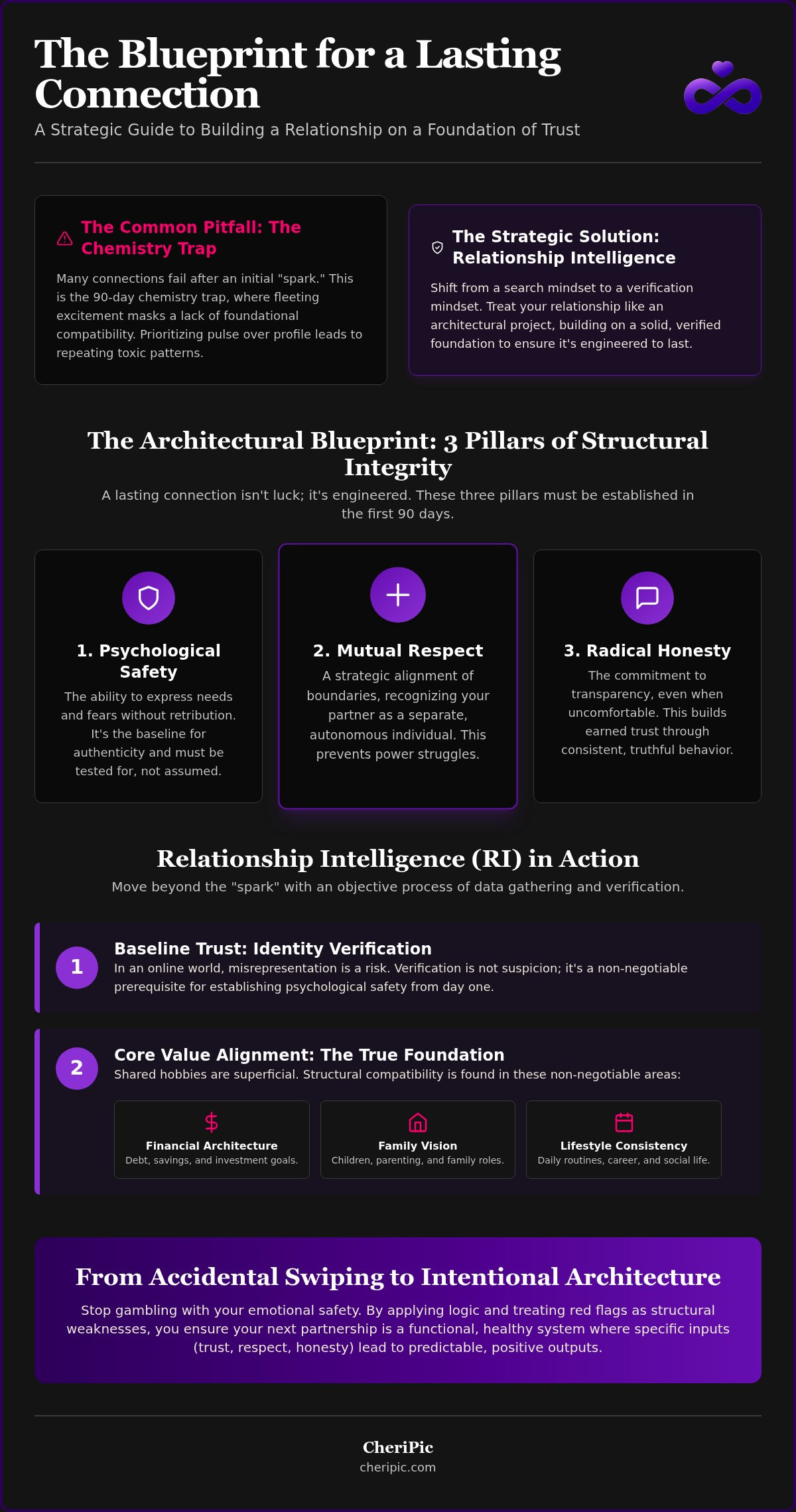
A lasting connection is not a product of luck or overwhelming chemistry. It's an engineered outcome. When we discuss the foundations of a healthy relationship, we're talking about a structural blueprint rather than a fleeting emotional state. Many people operate on passive trust, which is the assumption of integrity until proven otherwise. This is a strategic error that leads to repeating toxic patterns. Instead, mature partners prioritize earned trust, a status achieved through consistent behavioral alignment over time. The first 90 days of an interpersonal relationship represent the critical foundation phase. This is where structural supports are either set in stone or left to crumble under the weight of future expectations.
To build a connection that survives external pressure, three primary pillars must be established during this initial assessment period:
- Psychological Safety: The baseline for all authentic interaction and vulnerability.
- Mutual Respect: The alignment of personal boundaries and individual autonomy.
- Radical Honesty: The commitment to transparency, even when the truth is uncomfortable.
Psychological Safety: The Foundation of Authenticity
Psychological safety is the ability to express needs, fears, and boundaries without the threat of retribution or emotional withdrawal. It's the most critical element in the foundations of a healthy relationship because it dictates how you'll handle future conflict. You don't find safety; you test for it. Early in the connection, make small, vulnerable disclosures and observe the response. Does your partner hold space for your perspective, or do they minimize it? A partner who provides safety early on demonstrates the capacity for long-term emotional regulation and constructive conflict resolution.
Mutual Respect and the "Due Diligence" Mindset
Respect is a strategic alignment of boundaries. It requires recognizing your partner as a separate entity with full autonomy. Without this recognition, the connection becomes a power struggle rather than a functional partnership. This is why we advocate for a relationship due diligence mindset. Treating the early stages of dating as an assessment phase isn't cold; it's an act of respect for both your time and theirs. It ensures you're building on ground that can support a shared future. By verifying values early, you protect your emotional energy from being invested in a structurally unsound connection.
Relationship Intelligence: Verifying Foundations Before Building
Chemistry is often a false positive for structural health. It's a biological lure that can mask significant incompatibilities, leading many to invest in a connection that lacks the necessary supports. To establish the foundations of a healthy relationship, you must move beyond the "spark" and utilize Relationship Intelligence (RI). RI is the capacity to assess compatibility objectively, treating the early stages of a connection as a period of data gathering rather than emotional surrender. It requires a shift from "do I like them?" to "is this person a viable partner for the life I'm building?"
Before any emotional investment occurs, a baseline of trust must be established through identity verification. In an environment where approximately 39% of heterosexual couples meet online, the risk of misrepresentation remains a significant barrier to safety. Verification isn't an act of suspicion; it's a prerequisite for psychological safety. Once the identity is confirmed, the focus shifts to verifying core values. These include:
- Financial Architecture: Alignment on debt, savings, and long-term investment goals.
- Family Vision: Agreement on children, parenting philosophies, and extended family roles.
- Lifestyle Consistency: Matching expectations for daily routines, careers, and social obligations.
Value Alignment vs. Superficial Interests
Shared hobbies are pleasant, but they don't sustain a partnership during a crisis. Liking the same music is a superficial interest; having compatible conflict resolution styles is a structural necessity. Using a relationship compatibility assessment allows you to look beneath the surface of early conversation. This "Vision Audit" ensures both partners are building the same house on the same plot of land. Without this alignment, you're merely roommates with a shared playlist.
The Vetting Process: Restoring Trust in Digital Connections
The chaotic nature of modern dating has made dating apps with identity verification the new professional standard. Verification restores the trust that older, swiping-based models eroded. It allows you to verify emotional readiness and character consistency before the first real-world experience. This methodical approach ensures that when you finally meet, the foundations of a healthy relationship are already being laid. If you're ready to stop guessing and start verifying, you can explore intentional connection tools that prioritize your long-term success.
Identifying Structural Weakness: Pattern Recognition and Red Flags
Red flags are not merely inconveniences or personality quirks. They are cracks in the foundation of a healthy relationship that manifest long before the structure collapses. Most individuals fail to recognize these cracks because they focus on the aesthetic of the connection rather than its integrity. This romantic blindness is a psychological blind spot that prevents us from seeing behavioral patterns that repeat across multiple partnerships. Recognizing a "type" is the first step in structural assessment. If you find yourself consistently attracted to partners who lack emotional availability or transparency, the weakness may lie in your selection process rather than the dating market itself.
The Chemistry Trap: Why Your Brain Ignores Red Flags
The honeymoon phase is a biological state characterized by a dopamine surge that effectively mutes the prefrontal cortex. This is where logical vetting fails. When your brain is flooded with reward chemicals, it prioritizes immediate attachment over long-term stability. The Chemistry Trap is a biological override of logical vetting. This neurochemical fog makes it easy to dismiss a partner's inconsistency or lack of boundaries as "minor issues." These warning signs are the earliest indicators that the foundations of a healthy relationship are not being established. You can explore the mechanics of this phenomenon further in our analysis of Why I Ignore Red Flags.
AI and Pattern Recognition: Breaking the Cycle
Breaking the cycle of destructive partner selection requires an objective mirror. Human judgment is susceptible to bias, nostalgia, and loneliness. An AI relationship coach provides this objectivity by identifying recurring themes in your dating history. It moves you from a fallible gut feeling to data-driven clarity. By using ai for relationship pattern analysis, you can audit your own emotional readiness and selection criteria. This technology detects subtle behavioral cues that the human eye often misses during the excitement of a new connection. It allows you to identify if you are selecting partners based on actual value alignment or simply repeating a familiar, yet flawed, structural template. By shifting the focus from external partner behavior to internal selection patterns, you gain the agency required to build a connection that lasts.
Relational Functions: Is Your Connection a 'Function' of Health?
In the study of systems, we often ask: which relationship is a function? While this query originates in mathematics, it provides a powerful framework for evaluating romantic integrity. A functional relationship is defined by predictability and proportionality. It's a system where a specific input, such as consistent communication or vulnerability, leads to a predictable, healthy output, such as emotional safety or mutual growth. When the foundations of a healthy relationship are structurally sound, the partnership acts as a reliable function for personal development. You put in the work; you receive the security.
Dysfunctional connections, by contrast, lack this logical consistency. They are chaotic systems where high levels of emotional input often result in zero or negative outputs. This structural failure creates a state of perpetual anxiety. If you're constantly investing energy but receiving only conflict or confusion in return, the relationship function is fundamentally broken. It's no longer an asset; it's a liability that drains your emotional capital without providing a return on investment.
The Input-Output Model of Romantic Success
To assess the health of your connection, you must audit the exchange of resources. High-value relationships require specific inputs to maintain their structural integrity. These include vulnerability, time, and uncompromising integrity. When these inputs are processed through a healthy foundation, they produce tangible outputs:
- Peace: The absence of unnecessary drama and the presence of emotional rest.
- Productivity: A partnership that enhances your ability to succeed in other areas of life.
- Longevity: A connection that scales over time rather than eroding through friction.
If you find that your inputs are high but your outputs are diminishing, it's time to pause and evaluate the system's logic. A functional connection shouldn't feel like a bottomless pit for your effort. It should feel like a strategic investment where the dividends are clear and consistent.
Achieving Relational Stability
Stability is the ultimate objective of a functional relationship. It's the state where the foundations of a healthy relationship are so secure that you can take calculated risks with confidence. Moving in together, traveling, or merging financial lives shouldn't feel like a gamble. These milestones are merely the next logical steps in a well-engineered blueprint. Maintaining this stability requires constant monitoring and objective feedback. Utilizing a relationship coach app can help you track the health of your connection function over time, ensuring that small deviations don't lead to systemic failure. If you want to ensure your connection remains a high-performing asset, you can apply for early access to our relationship intelligence tools today.
Engineering the Future: Moving from Accidental to Intentional Love
The evolution from traditional swiping to Relationship Architecture represents a fundamental shift in how we approach human connection. For years, digital dating has relied on high-volume, low-intent interactions that prioritize fleeting chemistry over structural integrity. This accidental approach has contributed to a "dating recession" in 2026. While 86% of young adults still expect to marry, many have withdrawn from active dating due to a lack of trust and confidence. Building the foundations of a healthy relationship requires moving beyond reactive swiping toward a proactive, intentional build. It's about trading the chaos of unverified messaging for the clarity of premium, real-world experiences.
CheriPic facilitates this transition by providing the tools necessary for romantic due diligence. By integrating identity verification and AI-driven coaching, the platform ensures that your emotional energy is invested in verified connections rather than digital mirages. This methodical approach protects your time and psychological safety. It's the difference between hoping for a relationship and engineering one. When you prioritize verification over luck, you create a connection that's built to withstand the pressures of modern life.
The Intentional Build: A 3-Step Audit
Before committing your time or emotional capital, perform a structural audit of your connection. This process moves you from hope to verification, ensuring the foundations of a healthy relationship are actually present. Follow these three steps to evaluate your connection's integrity:
- Step 1: Verify the Identity. Establish baseline trust through profile verification to eliminate misrepresentation. This is the prerequisite for any safe interpersonal exchange.
- Step 2: Assess the Values. Conduct a vision audit to ensure your long-term goals for finances, family, and lifestyle are in structural alignment.
- Step 3: Analyze the Patterns. Use AI-driven insights to detect recurring selection errors and gain clarity on your own emotional readiness.
Join the Future of Relationship Intelligence
The foundations of a healthy relationship aren't discovered by chance. They're the result of deliberate decision-making and strategic investment. By joining the CheriPic Early Access Membership, you gain access to a platform designed for high-standard individuals who prioritize quality over quantity. Use CheriAI Relationship Coaching to conduct your first pattern analysis and identify the behavioral triggers that have historically compromised your judgment. It's time to stop swiping and start building. Experience the Future of Relationship Intelligence at CheriPic.
Securing Your Romantic Future through Strategic Intelligence
Building the foundations of a healthy relationship requires a departure from the passive, swipe-heavy habits that have defined the last decade. It's time to treat your emotional energy as a high-value asset that demands rigorous due diligence and structural verification. By shifting your focus from fleeting chemistry to architectural integrity, you move from a state of reactive dating to one of intentional partnership. You've learned that trust must be earned through behavioral alignment and that identity verification is the prerequisite for psychological safety in digital spaces.
The future of connection belongs to those who prioritize quality over quantity and real-world results over endless messaging. You don't have to repeat the same toxic patterns or ignore the red flags that have compromised your judgment in the past. With the right tools, you can replace gut-level anxiety with data-driven clarity. Take the first step toward a partnership engineered for longevity. Join the CheriPic Early Access Membership to build your relationship foundation with intelligence and access CheriAI personalized coaching. Your journey toward a secure, verified connection starts with a single, deliberate choice. You're ready to build something that lasts.
Frequently Asked Questions
What are the 5 main foundations of a healthy relationship?
Psychological safety, mutual respect, radical honesty, value alignment, and identity verification are the 5 main foundations of a healthy relationship. These pillars ensure that the connection is built on a structural blueprint rather than a fleeting feeling. By establishing these early, you create a framework that can withstand external pressures. Each foundation requires deliberate verification and due diligence to ensure long-term stability and psychological safety for both partners.
How can I tell if my relationship is a "function" of healthy growth?
A relationship is a function of health when specific inputs like vulnerability and communication lead to predictable outputs like peace and growth. If your effort results in chaotic or destructive outcomes, the system is dysfunctional. Functional connections provide a reliable return on your emotional investment. This mathematical approach to romance helps you evaluate if your partnership is an asset or a liability that drains your energy without providing security.
Why do I keep ignoring red flags in the early stages of dating?
You likely ignore red flags because of the neurochemical surge known as the Chemistry Trap. During the honeymoon phase, dopamine effectively mutes your prefrontal cortex, which is responsible for logical vetting and judgment. This biological override makes it easy to dismiss structural cracks as minor inconveniences. Recognizing this pattern is the first step toward reclaiming your objectivity and prioritizing your long-term psychological safety over temporary excitement.
Can an AI relationship coach really help me find a better partner?
An AI relationship coach like CheriAI provides an objective mirror that human judgment often lacks. It identifies recurring selection errors and destructive behavioral patterns in your dating history. By moving from a gut feeling to data-driven clarity, you can audit your emotional readiness and partner selection criteria. This technology detects subtle cues that allow you to make more informed, strategic choices in your connections and avoid past mistakes.
What is the "90-day rule" in relationship architecture?
The 90-day rule in relationship architecture refers to the critical phase where the foundations of a healthy relationship are tested and assessed. This period is vital for verifying values and identity before deep emotional investment occurs. It's a time for proactive due diligence rather than passive acceptance. Establishing clear boundaries during these first three months prevents the later collapse of an unsound or incompatible connection that lacks structural integrity.
How does identity verification improve trust in online dating?
Identity verification restores trust by eliminating the misrepresentation common in traditional digital dating spaces. It provides a baseline of psychological safety, ensuring that the person you're engaging with is verified and accountable. This reduces the risk of emotional manipulation and allows you to focus on assessing compatibility. Verification is a prerequisite for any mature, intentional interpersonal relationship that seeks to move beyond the superficiality and risks of unverified messaging.
What is the difference between chemistry and long-term compatibility?
Chemistry is a biological lure characterized by a spark, while compatibility is the structural alignment of core values and lifestyle goals. Chemistry is often a false positive for health; it can exist even in toxic connections. Compatibility requires a Vision Audit to ensure both partners are building toward the same future. True relationship intelligence involves prioritizing long-term alignment over the temporary intensity of early attraction and biological impulses that cloud judgment.
How do I build a healthy relationship after a toxic one?
Building a healthy connection after a toxic one requires a shift toward relationship architecture and intentionality. You must first audit your past selection patterns to understand why you chose structurally unsound partners. Prioritize verification and slow down the decision-making process to ensure your new connection is built on earned trust. By using compatibility assessments, you can ensure that your next partnership is a functional, safe environment for long-term growth.


