

The sensation of "feeling ready" for a new partner is often the most unreliable metric in your emotional toolkit. While most people wait for a transient burst of confidence or a period of calm to signal their return to the dating market, these internal states rarely correlate with long-term success. Relying on intuition alone frequently leads to a cycle of repeating the same mistakes and wasting valuable emotional energy on unverified connections. You might feel a deep sense of chemistry, yet find yourself structurally ill-equipped for the due diligence required in a high-value partnership. This relationship readiness quiz serves as a strategic audit to replace emotional guesswork with psychological certainty.
It's common to feel frustrated when intense chemistry fails to translate into a stable, compatible partnership. You deserve a method that protects your emotional assets from unnecessary risk. This article promises to move you beyond the myth of readiness and into a rigorous, psychology-backed evaluation of your relational intelligence. We'll provide a framework for identifying your personal red flags and offer a strategic path toward intentional connection. By the end of this audit, you'll have a clear understanding of your current maturity and the tools needed to prioritize structural integrity over fleeting excitement.
Key Takeaways
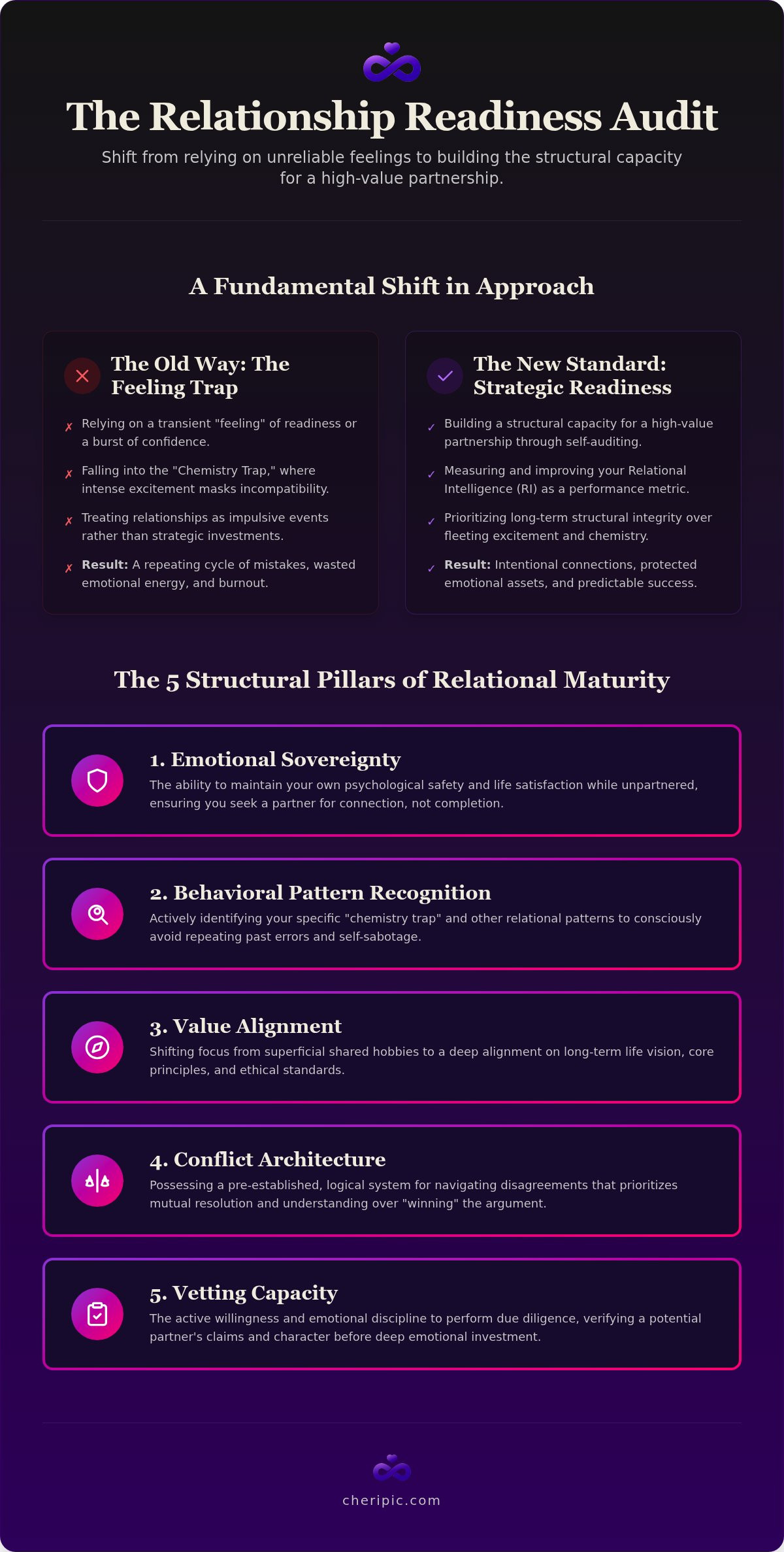
- Shift your perspective from waiting for a "feeling" of readiness to building a structural capacity for a high-value partnership.
- Complete the relationship readiness quiz to uncover hidden behavioral patterns and assess your current level of emotional sovereignty.
- Identify the "Chemistry Trap" where intense initial excitement often masks significant long-term compatibility gaps.
- Establish a framework for romantic due diligence that emphasizes verification and strategic investment over impulsive decision-making.
- Gain a clear roadmap for transitioning from unverified connections to intentional, high-intelligence relationships.
Why Relationship Readiness is a Strategic Asset, Not a Feeling
Most people view the search for a partner as a search for a specific feeling. They wait for a visceral reaction, often labeled as "chemistry," to signal their readiness to commit. This approach is fundamentally flawed. It treats one of life's most significant decisions as an impulsive event rather than a strategic investment. True readiness isn't an emotional vibration. It's a structural capacity to perform due diligence and manage the complexities of a high-value partnership. When you rely on feelings, you're vulnerable to patterns that haven't been audited.
High-value professionals don't enter business ventures based on a gut feeling without examining the data. They shouldn't treat their personal lives differently. Entering a connection without prior assessment carries a high cost in emotional burnout and lost time. By utilizing a relationship readiness quiz, you shift from passive waiting to active auditing. You begin to view relational intelligence as a tangible asset that can be measured and improved. This shift allows you to prioritize long-term success over fleeting excitement.
The Myth of 'The Right Person' vs. 'The Right State'
A common pitfall is the belief that the right person will naturally resolve your internal friction. This is a dangerous projection. Even a high-compatibility partner cannot provide stability for someone in a state of internal chaos. Psychological safety must be an internal baseline before it becomes a shared experience. When you find yourself "waiting for a spark," you might actually be seeking the high-arousal state of uncertainty. This is often a sign of emotional immaturity rather than a signal of connection. Readiness means being in the right state, not just finding the right face.
Relational Intelligence (RI) as a Performance Metric
Think of RI as a performance metric for your personal life. It's built on the foundations of emotional intelligence, including self-regulation and pattern recognition. RI allows you to navigate complex emotional landscapes with logic rather than reacting to old triggers. Without this metric, you're likely to repeat history, essentially dating the same person in different bodies. Integrating a relationship readiness quiz into your process ensures that self-verification happens before you attempt partner-verification. It turns romantic success into a predictable outcome of high-level intelligence rather than a stroke of luck.
The 5 Structural Pillars of Relational Maturity
Relational maturity is not a byproduct of age. It is a set of structural capacities that allow you to engage in a partnership without losing your internal stability. Before you can successfully vet a partner, you must first audit your own readiness. This isn't about perfection; it's about having the architecture in place to handle the complexities of a shared life. Academic research on commitment readiness suggests that an individual’s internal preparation is a more reliable predictor of relationship health than the specific traits of a partner. To build a high-value connection, you must secure these five pillars:
- Emotional Sovereignty: The ability to maintain psychological safety and life satisfaction while unpartnered.
- Behavioral Pattern Recognition: Identifying your specific "chemistry trap" to avoid repeating past relational errors.
- Value Alignment: Shifting the focus from shared hobbies to shared long-term visions and ethical standards.
- Conflict Architecture: Possessing a logical system for disagreement that prioritizes resolution over winning.
- Vetting Capacity: The active willingness to perform due diligence and verify a partner's claims before investing emotional capital.
By using a relationship readiness quiz, you can objectively measure where your pillars are strong and where they require reinforcement. This methodical approach ensures you aren't just looking for a connection, but are prepared to sustain one.
Emotional Sovereignty and the Single State
True readiness begins with emotional sovereignty. If you seek a partner for "completion," you are essentially looking for an external stabilizer for an unstable foundation. This creates a dependency that eventually erodes the partnership. High-value connections are built on "expansion," where two sovereign individuals choose to build something larger than themselves. You must be able to audit your life satisfaction independent of romance. If your happiness is contingent on another person's presence, you aren't ready for a strategic partnership. You are looking for a distraction. Performing this level of due diligence is easier when you leverage verified profile data to ensure you're investing in a high-value connection.
The Science of Value Alignment
Shared hobbies are often mistaken for compatibility. While enjoying similar activities is pleasant, it is not a predictor of longevity. You must differentiate between "negotiables," like weekend plans, and "non-negotiables," like financial ethics or family vision. Evidence shows that long term relationship compatibility is fundamentally rooted in shared values. Testing for shared visions requires a 5-year and 10-year outlook. If your trajectories aren't aligned, no amount of chemistry will bridge the gap. A relationship readiness quiz helps you clarify these non-negotiables before you enter the dating market, saving you from the high cost of mismatched investments.
The Relationship Readiness Quiz: A 15-Point Self-Audit
This relationship readiness quiz is a rigorous diagnostic tool designed to replace subjective intuition with objective data. It requires radical honesty. Rate each of the following statements on a scale of 1 to 5, where 1 represents "Not at all true of my current reality" and 5 represents "Completely true of my current reality." Do not answer based on your future aspirations or who you hope to become. Base your score on your actual behavior over the last six months. If you find yourself justifying a high score without evidence, you're compromising the integrity of your own audit.
Section A: Internal Sovereignty Questions
This section evaluates your ability to maintain psychological safety without external validation. If your foundation is unstable, any partnership you build will eventually tilt.
- I can identify my emotional triggers in real-time without blaming an external source or my partner.
- My life feels full, productive, and complete even when I am not in a romantic relationship.
- I have a defined set of personal boundaries regarding my time, finances, and values that I am unwilling to compromise.
- I regulate my own nervous system through established self-care routines rather than relying on others to soothe me.
- I am comfortable saying "no" to a connection that feels good but lacks structural integrity.
Section B: Historical Pattern Questions
Your past is a data set. If you haven't audited your history, you're destined to repeat it. This section measures your level of behavioral pattern recognition.
- I can clearly articulate the logical reasons why my last three connections failed without resorting to "they were crazy" or "it was bad luck."
- I recognize the specific "type" of person I am habitually attracted to who is ultimately detrimental to my long-term goals.
- I have fully completed the grief cycle for my past significant relationships and no longer seek "closure" from an ex.
- I can identify the specific role I played in the dissolution of my previous partnerships.
- I no longer feel a "pull" toward chaotic or high-drama romantic scenarios.
Section C: Strategic Vetting Questions
Strategic readiness requires a shift from passive "dating" to active due diligence. This section audits your willingness to verify before you invest.
- I am prepared to walk away from intense chemistry if a partner's core values do not align with mine.
- I prioritize identity verification and radical transparency over early-stage mystery and "the chase."
- I have a clear, documented 5-year vision for my life that a potential partner must be able to integrate into.
- I vet potential partners for their conflict resolution style before committing to a long-term connection.
- I view a relationship as a strategic investment of my time and emotional capital rather than a source of entertainment.
Scoring Guide: Interpreting Your Readiness Quotient
Total your points to determine your current Readiness Quotient (RQ). A score of 15-35 indicates "High Risk." You're likely seeking a partner to fill a structural gap in your own life, which often leads to dependency. A score of 36-55 suggests "Developing Intelligence." You've identified your patterns but haven't yet built the systems to avoid them. A score of 56-75 represents "Strategic Readiness." You're operating from a place of sovereignty and are prepared for a high-value partnership built on verification and shared vision.
Decoding the Results: Why 'Chemistry' Is Often a Red Flag
A high score on the relationship readiness quiz often correlates with a refined ability to distinguish between a biological rush and a structural fit. For many, the "spark" is not a sign of potential; it is a warning. This is the "Chemistry Trap," a state where high physiological excitement masks low fundamental compatibility. When you experience an immediate, overwhelming pull toward a stranger, you aren't feeling love. You're feeling familiarity. Often, this familiarity is rooted in your "Dating Shadow," the recurring character in your romantic history who feels comfortable because they trigger known emotional patterns, even if those patterns are destructive.
Reactive dating relies on these fleeting spikes of dopamine to justify investment. It is an impulsive approach that ignores the necessity of due diligence. Transitioning to intentional investment requires you to view a potential partner through a lens of structural integrity rather than emotional intensity. High-value connections are built on the quiet, steady verification of shared visions rather than the frantic energy of unverified attraction. If your history is a sequence of high-intensity failures, it's time to audit the data behind your desires.
Chemistry vs. Compatibility: A Psychological Breakdown
The biological rush of attraction is a primitive response, while structural fit is a product of relational intelligence. Many individuals mistake the physiological symptoms of anxious attachment, such as a racing heart or obsessive thoughts, for a "true connection." This confusion leads to the pursuit of partners who trigger insecurity rather than safety. Understanding the distinction between chemistry and compatibility is the most critical requirement for navigating the complexities of modern dating with clarity. Compatibility is the infrastructure of a relationship; chemistry is merely the electricity that may or may not power it long term.
Pattern Recognition: The CheriAI Approach
Human intuition is frequently compromised by biological bias and past trauma. This is where CheriAI serves as an objective Relationship Architect, utilizing AI to identify behavioral red flags that you might be conditioned to overlook. By analyzing data points rather than just "gut feelings," this technology provides a stabilizing force in the early stages of connection. It allows you to move from a reactive state to one of data-driven romantic clarity. You can gain strategic insights through CheriAI coaching to ensure your next investment is based on verified alignment rather than fleeting chemistry.
From Awareness to Action: Implementing Relationship Due Diligence
Awareness is the precursor to action, but it is not a substitute for it. Once you have utilized the relationship readiness quiz to identify your structural vulnerabilities, you must transition into a phase of active due diligence. In a landscape often defined by impulsive choices and unverified claims, the high-value individual adopts a standard of "Trust but Verify." This is not about cynicism; it's about protecting your emotional and temporal assets from unnecessary risk. Implementing Relationship Compatibility Assessments allows you to move beyond the superficial and audit the actual alignment of a potential partner's values and vision with your own.
The Vetting Process: Why Identity Matters
Intentionality requires transparency from the first point of contact. In digital-first connections, a significant "Trust Gap" often exists because of the anonymity typical of traditional platforms. Eliminating this gap is essential for establishing a baseline of psychological safety. Identity and Profile Verification serve as the structural foundation for this safety. When profiles are verified, the focus shifts from questioning a person's basic honesty to evaluating their long-term fit. This level of transparency ensures that you aren't wasting energy on connections that lack the integrity required for a strategic partnership. Vetting is not a hurdle; it's a filter that preserves your time for high-value connections. By integrating the insights from your relationship readiness quiz with a platform built for verification, you transform dating from a game of chance into a strategic pursuit.
Your Next Strategic Move
Maintaining your relational intelligence is a continuous process of refinement. Joining the CheriPic Early Access Membership provides you with the tools necessary to bridge the gap between internal readiness and external connection. Your CheriAI coach acts as a persistent stabilizer, helping you recognize patterns and maintain your standards long after the initial audit is complete. This AI-driven support ensures that your decision-making remains logical and vision-aligned, even when faced with the distraction of early-stage chemistry. Readiness is not a static destination you reach once; it's a state of being that you actively manage through better judgment and superior tools. Audit your growth, secure your foundation, and start dating with the intelligence your future deserves.
Elevating Your Relational Standards
True partnership requires more than a chance encounter or a fleeting spark. It demands a structural foundation built on emotional sovereignty and behavioral pattern recognition. By completing this relationship readiness quiz, you've taken the first step toward treating your emotional energy as a high-value asset. You now understand that chemistry is often a false signal and that intentional connection is the result of rigorous due diligence. Shifting from reactive dating to strategic investment is the only way to ensure long-term psychological safety.
Your journey toward relational excellence doesn't end with an audit. It requires the right tools to maintain these high standards in a chaotic dating landscape. Audit your relational intelligence and join CheriPic Early Access today. You'll gain access to personalized insights via CheriAI and secure identity verification within a community focused on intentional, high-value connection. This is your opportunity to move beyond the noise of traditional platforms and prioritize structural integrity. You're now equipped to build a future defined by clarity and uncompromising quality. Your commitment to self-awareness is the most reliable predictor of your future success.
Frequently Asked Questions
How do I know if I'm ready for a relationship or just lonely?
Loneliness seeks a distraction while readiness seeks an expansion. If you feel an urgent need for someone to soothe your boredom or emotional pain, you're likely experiencing loneliness. Readiness is marked by emotional sovereignty, where your life feels functional and complete while single. You're ready when you want to share your abundance rather than fill a void. Loneliness often leads to impulsive choices that compromise your long-term standards.
Can a relationship readiness quiz really predict success?
A relationship readiness quiz predicts success by measuring your structural capacity for a partnership rather than your desire for one. Success in modern dating is a byproduct of relational intelligence and pattern recognition. While no tool can account for every variable, auditing your internal sovereignty and conflict architecture provides a reliable baseline. It identifies whether you're likely to repeat past mistakes or if you're prepared for a high-value, intentional connection.
What are the biggest red flags that I'm NOT ready to date?
The most significant red flags include an inability to identify your past relationship patterns and a reliance on "sparks" over structural alignment. If you're still in a grief cycle from a previous connection or if you view dating as a form of entertainment, you lack the necessary vetting capacity. Other indicators include having poorly defined personal boundaries or seeking a partner to solve your financial or emotional instability. These signals suggest a need for internal auditing.
How long should I wait after a breakup before taking a readiness quiz?
There is no universal timeline, but taking a relationship readiness quiz is most effective once the acute emotional volatility of a breakup has subsided. You should wait until you can discuss your past connection with logical detachment rather than reactive anger or sorrow. This period allows you to complete the grief cycle and begin the process of behavioral pattern recognition. Readiness is a state of psychological stability, not a specific date on a calendar.
Is it possible to be 'too ready' or too picky in relationships?
You cannot be "too ready," but you can misidentify rigid defense mechanisms as high standards. True readiness involves a clear vision of your non-negotiables while remaining open to the expansion a partner brings. High-value individuals are often labeled as "too picky" because they prioritize structural integrity and due diligence over fleeting chemistry. This is not a flaw; it's a strategic decision to avoid wasting emotional capital on unverified connections that don't align with your vision.
What is the difference between chemistry and compatibility in a quiz?
Chemistry is a physiological response to familiarity or attraction, while compatibility is the alignment of values, visions, and conflict styles. A strategic quiz prioritizes compatibility because it's the only reliable predictor of long-term stability. Chemistry can exist in highly toxic environments, often masking significant red flags. Compatibility requires a logical audit of your non-negotiables. You must ensure that your partner's long-term trajectory integrates with your own 5-year and 10-year outlook.
How does an AI relationship coach help with readiness?
An AI relationship coach like CheriAI provides an objective perspective that human intuition often lacks. It utilizes personalized pattern recognition to identify behavioral blind spots and helps you maintain your relational intelligence during the early stages of a connection. By acting as a stabilizing force, the coach ensures your decisions remain vision-aligned rather than reactive. It bridges the gap between your quiz results and the real-world application of intentional, high-value connection.
What should I do if my quiz results say I'm not ready?
View a "not ready" result as a strategic opportunity for refinement rather than a failure. This is the time to focus on building your internal pillars, such as emotional sovereignty and behavioral pattern recognition. Use this period to focus on your personal growth and clarify your life vision. Engaging with CheriAI coaching can help you navigate this growth phase. Readiness is a journey of continuous improvement, and identifying gaps now prevents the high cost of future relational failures.


