

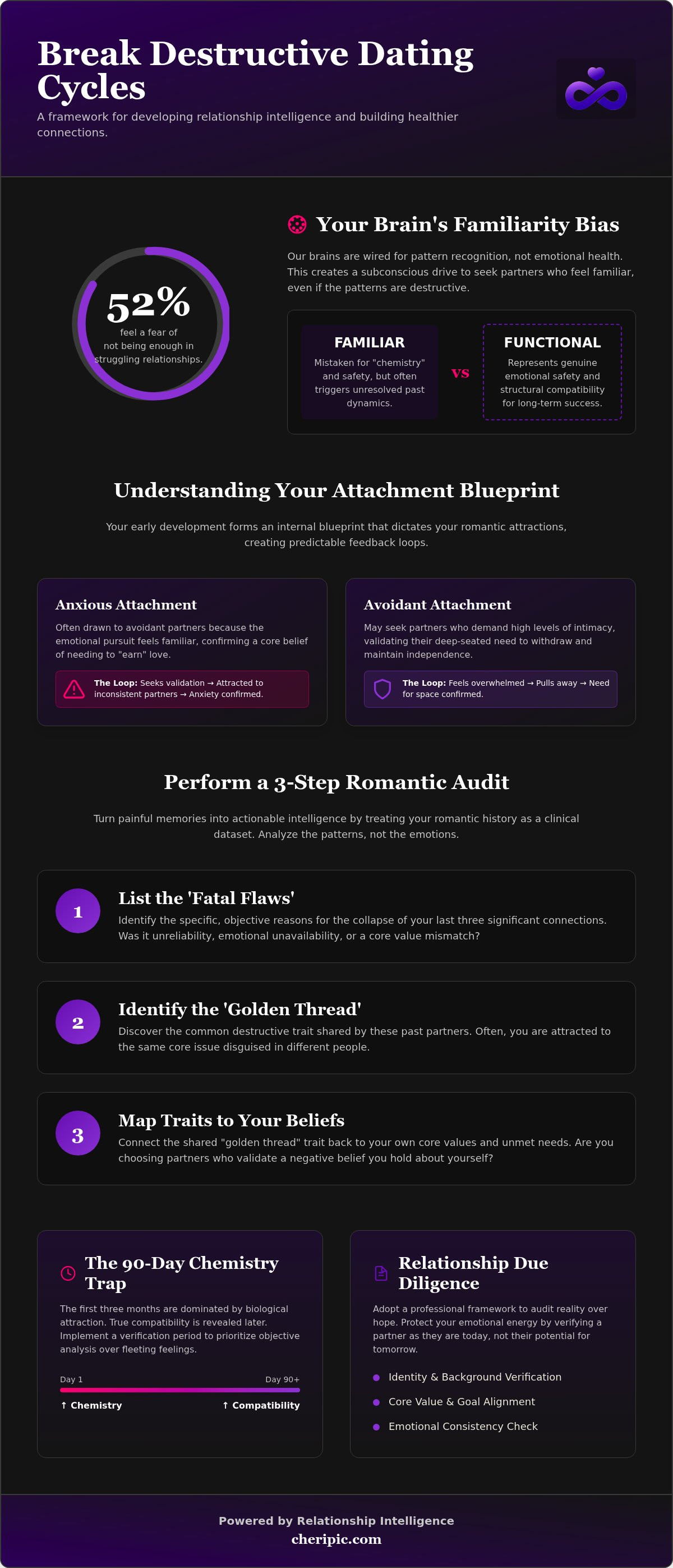
What if the recurring heartbreak you've experienced isn't a matter of bad luck, but a predictable result of your internal psychological blueprint? Many people treat romance as a series of random collisions, yet research shows that 52% of individuals in struggling relationships feel a deep-seated fear of not being enough. This isn't a coincidence. It's the byproduct of a subconscious operating system that governs how you connect, react, and withdraw.
You've likely felt the emotional exhaustion of another failed connection and the stinging self-doubt that follows. It's draining to feel like you're wasting years on partners who are fundamentally incompatible. Understanding your attachment style in dating is the critical first step toward reclaiming your time. By identifying these patterns, you can transition from reactive intuition to proactive relationship intelligence. It's time to stop leaving your emotional safety to chance.
This guide explores the psychological architecture behind your romantic choices and provides a system to break destructive cycles forever. We'll outline a structured framework for evaluating compatibility and performing rigorous romantic due diligence. You'll gain the tools to identify red flags before emotional investment, ensuring your next connection is a strategic investment in your long-term success.
Key Takeaways
- Learn to distinguish between genuine emotional safety and the brain's tendency to mistake familiar, destructive patterns for romantic chemistry.
- Master the process of understanding your attachment style in dating by treating your romantic history as a dataset for objective, structural analysis.
- Navigate the 90-day Chemistry Trap by implementing a verification period where structural compatibility is prioritized over fleeting biological attraction.
- Adopt a professional due diligence framework that utilizes identity verification and value alignment to protect your emotional energy.
- Discover how relationship intelligence tools like CheriAI act as a stabilizing force to identify and interrupt your subconscious triggers in real-time.
The Anatomy of a Pattern: Why Your Brain Chooses Familiar over Functional
The human brain is optimized for pattern recognition, not necessarily for emotional health. This neurological efficiency creates a phenomenon known as repetition compulsion. In the context of modern romance, this is the subconscious drive to seek out partners who mirror the unresolved dynamics of our past. We don't choose what is functional; we choose what is recognizable. This cycle persists because the brain prioritizes the "known" as a survival strategy, even when the known is objectively harmful.
Your nervous system often confuses familiarity with safety. When you meet someone who triggers a familiar emotional response, your brain registers this as "chemistry." In reality, it's often a biological bias toward the predictable. This bias leads us to ignore early warning signs, dismissing red flags as mere quirks because the overall pattern feels comfortable. It's a survival mechanism that has become a liability in the modern dating environment. Transitioning to a state of Relationship Intelligence requires you to interrupt this loop by prioritizing objective data over subjective feelings. You must learn to distrust the "spark" when it feels too much like a fire you've already been burned by.
The Role of Attachment Theory in Repeated Mistakes
Mastering the art of understanding your attachment style in dating requires more than just self-reflection; it requires a structural audit of your attractions. Your romantic choices aren't random collisions. They're dictated by internal blueprints formed in early development. Research into the four primary attachment styles reveals how these blueprints influence who we find attractive. Anxious individuals may be drawn to avoidant partners because the pursuit feels familiar. Avoidant individuals might seek out those who demand too much, validating their need to pull away. This creates a feedback loop where we choose people who confirm our deepest insecurities. Success in understanding your attachment style in dating comes from analyzing these dynamics as they happen. You must learn to view a partner's behavior as a structural data point rather than a reflection of your inherent value.
Cognitive Dissonance and the Potential Trap
We often fall into the trap of loving a person's potential instead of their present reality. This is cognitive dissonance in action. You see the red flags, but you invent a narrative where your love "fixes" the underlying issue. The psychological cost of this investment is immense. It drains your emotional assets on a project that may never yield a return. You aren't a rehabilitation center for undeveloped partners. Relationship Due Diligence is the act of auditing reality over hope. It is a commitment to seeing a partner exactly as they are today, not as you wish them to be tomorrow.
Auditing Your Romantic History: Identifying Your Subconscious Blueprint
To move beyond the cycle of repetition, you must treat your romantic history as a clinical dataset. It's not enough to feel regret; you must perform a structural audit of your past connections. This process turns painful memories into actionable intelligence. By understanding your attachment style in dating through the lens of past data, you strip away the emotional noise and reveal the architecture of your choices. You are looking for patterns, not excuses.
Begin your audit with a three-step evaluation of your previous partners. This methodical approach removes the fog of nostalgia and replaces it with clarity.
- Step 1: List the 'Fatal Flaws.' Identify what specifically caused the collapse of your last three significant connections. Was it a lack of reliability, emotional withdrawal, or a mismatch in core values?
- Step 2: Identify the 'Golden Thread.' Look for the common trait shared by these three individuals. You will often find that you're attracted to the same destructive quality disguised in different personalities.
- Step 3: Map the Traits. Connect these shared traits back to your core values and unmet needs. Are you choosing partners who validate a negative belief you hold about yourself?
The 'Dating the Same Person' Phenomenon
Many people eventually realize they've been dating the same person in different bodies. The faces and backgrounds change, but the emotional dynamic remains static. You might be attracted to a new partner's "intensity," only to realize months later it was actually volatility in a different mask. This is why it's vital to understand why I ignore red flags during the initial attraction phase. Recognizing the mask requires a high level of pattern recognition and a refusal to accept familiarity as a substitute for character.
Quantifying Your Values and Emotional Readiness
Chemistry is a poor predictor of relationship longevity. Shared interests like travel or cuisine are secondary to structural value alignment and emotional maturity. The science of adult attachment suggests that secure connections are built on consistency and accessibility. You need to define your non-negotiables with the precision of an architect. Utilizing a relationship compatibility assessment allows you to quantify these variables before you're emotionally compromised.
Performing this audit is a strategic investment in your future. It's the due diligence required for any high-stakes commitment. If you find your internal data is consistently leading to destructive outcomes, engaging with the tools at cheripic.com can help you recalibrate your selection process and protect your emotional assets.
Chemistry vs. Compatibility: Overcoming the First 90 Days
The initial phase of a romantic connection is often governed by neurobiology rather than character assessment. Biological chemistry is a surge of dopamine and oxytocin designed to facilitate bonding; it's not a signal of long-term viability. Structural compatibility, however, is the alignment of values, life goals, and emotional regulation. Confusing the two is a primary reason why many find themselves in destructive cycles. The first 90 days are the most dangerous period for objective judgment because your brain is effectively under the influence of its own reward system.
During this window, dopamine masks a lack of value alignment. You might overlook a partner's inconsistency or volatility because the physical attraction feels "right." This is the Chemistry Trap. Success in understanding your attachment style in dating depends on your ability to resist this biological pull. You must treat the first three months as a probationary period where you prioritize observation over emotional investment. It's a time for data collection, not for finalizing a life strategy. If you don't slow down, you'll likely miss the structural flaws that lead to eventual collapse.
The Strategic Pause: Slowing Down the Connection
A deliberate pace is the most effective way to build stronger, healthier connections. High-frequency digital messaging often creates a false sense of intimacy that isn't supported by reality. To truly evaluate a partner, you must prioritize quality-focused interaction over constant contact. This strategic pause allows your logical brain to catch up with your emotional responses. Consider these methods for maintaining your objectivity:
- Set boundaries early. Testing a partner's reaction to "no" provides immediate insight into their emotional regulation and respect for your autonomy.
- Prioritize real-world experiences. Digital flirting is a curated performance; real-world environments reveal authentic character patterns and stress responses.
- Limit communication frequency. Avoid the urge to text 24/7. Space creates the necessary room for objective reflection and pattern recognition.
Verification as a Form of Self-Protection
In a landscape where digital deception is common, verification is a mandatory act of self-care. Implementing identity verification for dating ensures that you're engaging with a verified individual before sharing your emotional assets. This step reduces the risk of "personality catfishing," where a partner projects a false version of their character to secure your interest. Understanding your attachment style in dating means recognizing when your desire for connection might lead you to bypass these critical due diligence steps. Verification isn't about a lack of trust; it's about establishing a foundation of authenticity from the outset.
Relationship Due Diligence: Implementing a Verification Framework
Mastering the art of understanding your attachment style in dating requires a transition from passive observation to active verification. In a professional context, you wouldn't sign a high-stakes contract without rigorous background checks; your emotional future deserves the same level of scrutiny. This professional approach to love replaces the "hope and pray" method with a structured verification framework. It's a commitment to protecting your most valuable assets: your time and your psychological safety.
A comprehensive due diligence process consists of four essential steps designed to filter out incompatibility before you're emotionally compromised:
- Step 1: Identity Verification. Authenticity is the baseline. You must ensure the individual is who they claim to be to prevent personality catfishing.
- Step 2: Value Alignment Check. You need to verify if your long-term visions actually match. Chemistry cannot bridge a gap in fundamental life goals.
- Step 3: Pattern Recognition. Use your "Golden Thread" data to see if this person triggers your old, destructive blueprints.
- Step 4: Real-World Stress Test. Observe their behavior in non-controlled environments. Watch how they handle a delayed flight, a rude server, or a minor disagreement.
The Architecture of a Healthy Evaluation
Most daters focus on the wrong question: "Do they like me?" This mindset places you in a position of weakness. A strategic evaluation flips the script to ask: "Are they qualified to be in my life?" This shift in perspective allows you to assess their emotional readiness alongside their compatibility. You aren't looking for a "spark"; you're looking for structural integrity. Utilizing a relationship coach app can provide the necessary distance to maintain this objectivity when biological chemistry attempts to cloud your judgment.
Identifying Red Flags Through Behavioral Data
Intuition is often just a collection of subconscious biases. To break your cycle, you must shift toward Behavioral Pattern Recognition. This involves documenting and reflecting on micro-moments-those small, recurring behaviors that signal a repeat of past mistakes. If they're inconsistent with their communication now, they'll likely be unreliable in a crisis. Implementing a rigorous due diligence process is a profound act of self-worth that signals your emotional energy is a finite, high-value asset.
Don't leave your emotional future to chance. Secure your seat in the CheriPic Early Access Membership to begin applying professional-grade intelligence to your romantic selections.
Leveraging Relationship Intelligence: How CheriAI Breaks the Cycle
Traditional dating platforms are designed for high-frequency interaction and fleeting excitement. They often lack the structural safeguards necessary for long-term psychological safety. CheriPic functions as a stabilizing force in an often chaotic emotional landscape. It moves beyond the simple swipe-match model to provide a comprehensive relationship intelligence platform. This system is designed to help you transition from reactive intuition to proactive, data-driven decision-making. You deserve a method that treats your time as a valuable asset.
CheriAI acts as your personal Clarity Coach, identifying destructive patterns before they escalate into heartbreak. While your "gut feeling" is often influenced by biological chemistry or past trauma, intelligent insights are rooted in objective behavioral data. Understanding your attachment style in dating becomes a practical application rather than an abstract concept when you have a system that monitors your choices in real-time. It's about auditing your connections with professional-level rigor. This technology identifies uncomfortable truths about your selection process that you might otherwise ignore.
Personalized Insights and Pattern Recognition
The core of this strategic approach is an AI relationship coach that analyzes your inputs to reveal hidden blind spots. Unlike traditional therapy, which often occurs weekly, relationship intelligence is available in the moments you need it most. This ensures you have a mentor for real-time romantic due diligence during critical moments of interaction. Choosing a membership is a strategic investment in your emotional future. It provides the tools necessary to recognize when you're gravitating toward a "Golden Thread" mistake before you've made a significant emotional commitment. By quantifying value alignment, you eliminate the guesswork that leads to wasted years.
From Digital Verification to Real-World Connection
The platform doesn't just stop at digital assessment. It facilitates a secure transition from verified profiles to curated real-world experiences. This philosophy of Premium Experiences ensures that your connection is built on a foundation of intentionality and high standards. You aren't just meeting a stranger; you're engaging with a verified individual who has undergone a thorough relationship compatibility assessment. This methodical approach ensures that every connection has a high probability of structural integrity. It's time to stop leaving your happiness to chance and start treating your personal life with the intelligence it deserves. Secure your Early Access Membership and stop repeating the past today.
Architecting Your Romantic Future
The transition from reactive dating to relationship intelligence is the most significant investment you can make in your emotional future. Breaking destructive cycles requires you to prioritize structural compatibility over fleeting biological chemistry. By auditing your history and implementing a rigorous verification framework, you replace hope with certainty. The process of understanding your attachment style in dating isn't a passive exercise; it's a strategic necessity for anyone seeking long-term stability.
CheriPic provides the stabilizing force needed to navigate this transition. Through CheriAI-powered pattern recognition and data-driven compatibility assessments, you can identify blind spots before they become liabilities. You're invited to join a verified high-value community where authenticity is the standard, not the exception. It's time to stop leaving your connections to chance and start applying the due diligence your life deserves.
Secure your Early Access Membership and start your Relationship Due Diligence. You possess the intelligence to break the cycle. Now is the time to build a connection that reflects your true worth.
Frequently Asked Questions
How can I tell if I'm repeating a relationship mistake early on?
You can identify a recurring mistake by monitoring your physiological and emotional responses during the initial 90-day window. If you feel a familiar sense of "intensity" that mirrors past volatile connections, you're likely experiencing repetition compulsion rather than healthy chemistry. Pay close attention to inconsistencies in communication or a partner's refusal to respect early boundaries. These micro-moments are structural data points that signal a return to old blueprints.
What is the difference between relationship coaching and therapy?
Therapy typically focuses on retrospective healing and processing past trauma to understand its origins. Relationship coaching, particularly through a relationship intelligence platform, is proactive and outcome-oriented. It provides real-time tools for assessment and decision-making in your current dating life. While therapy helps you understand your "why," coaching focuses on the "how"-specifically how to implement due diligence and verify compatibility before forming deep emotional attachments.
Why do I keep attracting the same type of person?
You keep attracting the same type because your brain prioritizes familiarity over functionality as a survival mechanism. This biological bias draws you toward individuals who validate your existing self-beliefs or mirror unresolved childhood dynamics. Understanding your attachment style in dating reveals that what you perceive as "chemistry" is often just your nervous system recognizing a known pattern. Breaking this cycle requires moving from intuition-based selection to a data-driven verification framework.
Can an AI relationship coach really understand human chemistry?
AI doesn't "feel" chemistry; it analyzes the behavioral data that humans often ignore when they are chemically compromised. CheriAI acts as a Clarity Coach by identifying linguistic patterns, consistency levels, and value alignment that signal long-term compatibility or risk. While you experience the dopamine surge of attraction, the AI maintains objectivity, providing a stabilizing force that helps you distinguish between fleeting biological excitement and structural relationship integrity.
How do I bring up due diligence or verification without sounding suspicious?
Frame the request as a commitment to mutual safety and intentionality rather than a lack of trust. You might say, "I value my time and emotional energy, so I prioritize identity verification and value alignment early on." High-value partners will respect this professional approach to love because they also value their own security. Presenting due diligence as a standard operating procedure signals that you have high standards for who enters your life.
What are the most common relationship red flags people ignore?
The most frequently ignored red flags include inconsistent communication, a lack of profile authenticity, and a partner's negative reaction to simple boundaries. People often dismiss these as minor quirks during the first 90 days because dopamine masks the lack of value alignment. Other critical signs include a refusal to engage in identity verification or a history of "short-term intensity" without long-term stability. Documenting these micro-moments is essential for maintaining objective judgment.
How long does it take to truly break a relationship pattern?
Breaking a pattern is a methodical process of neurological rewiring that requires consistent, deliberate practice. While there is no universal timeline, most individuals see significant shifts after three to six months of active pattern recognition and boundary setting. It takes time for your logical brain to override the subconscious pull toward familiar, destructive choices. Success depends on your willingness to slow down the dating process and prioritize structural compatibility over immediate gratification.
Is it possible to change my 'type' of attraction?
Yes, you can recalibrate your attraction by consciously prioritizing security and consistency over "spark" and intensity. As you gain proficiency in understanding your attachment style in dating, you'll begin to find healthy, stable behaviors more attractive than the volatile patterns of the past. This shift happens when you stop viewing drama as passion and start viewing reliability as a prerequisite for connection. It's a transition from seeking excitement to seeking structural integrity.


