

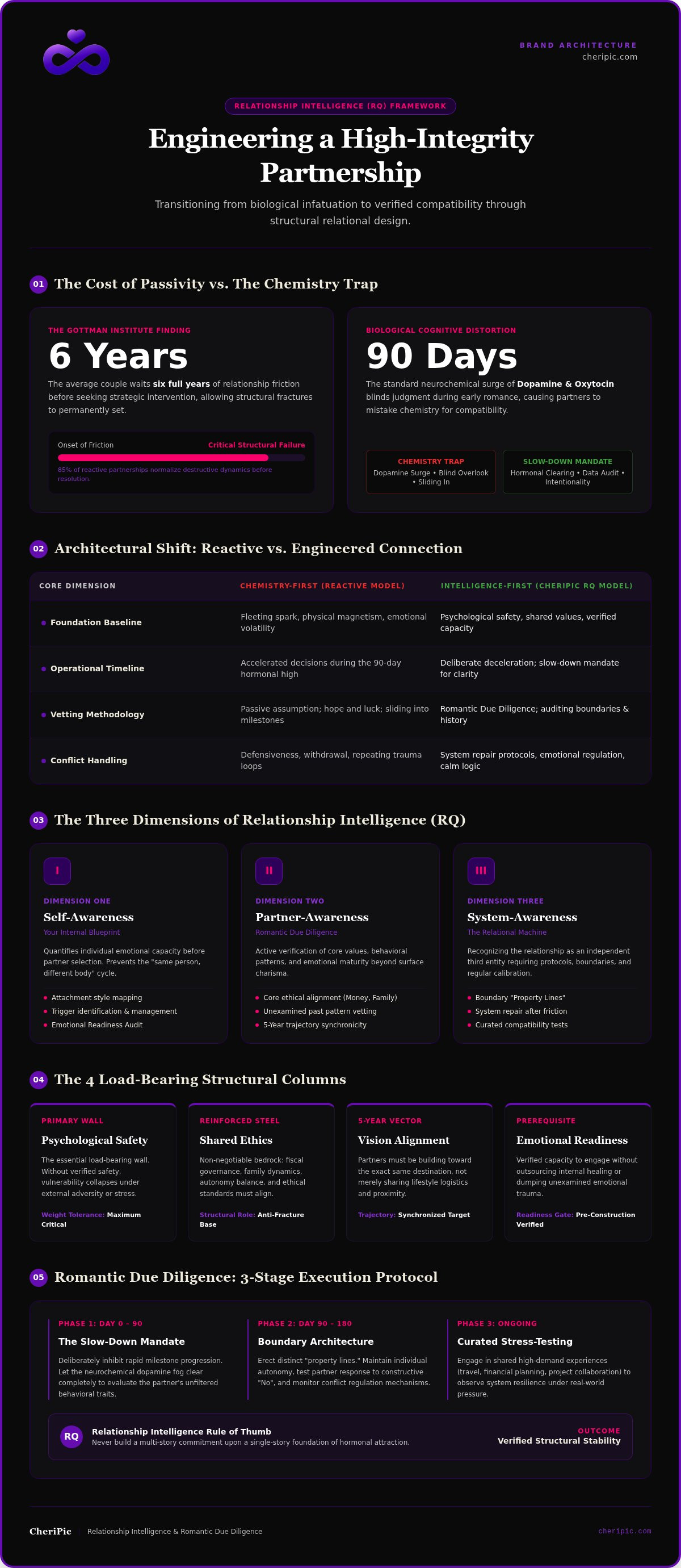
The Gottman Institute reports that the average couple waits six years from the onset of relationship friction before seeking professional intervention. By that time, destructive patterns are often baked into the foundation. You likely recognize the exhaustion of investing emotional capital into connections that feel intense but lack structural integrity. It's frustrating to mistake a momentary spark for long-term stability, only to find yourself back at the beginning of a familiar cycle. Understanding how to build a healthy relationship in 2026 requires moving beyond the luck of the draw.
This guide introduces the strategic principles of Relationship Intelligence (RQ) to help you engineer a partnership built on verified compatibility. You'll master a framework for auditing potential partners with the precision of an architect. We'll examine the mechanics of emotional regulation, the data of compatibility assessments, and the intentional design required for a secure connection. By shifting from passive discovery to active verification, you'll protect your most valuable asset: your emotional energy. It's time to stop sliding into milestones and start building with intent.
Key Takeaways
- Shift your focus from fleeting chemistry to structural integrity by defining a partnership as a high-integrity, functional commitment.
- Master the three dimensions of Relationship Intelligence (RQ) to gain a quantifiable understanding of yourself, your partner, and the system you create together.
- Implement a rigorous vetting process through "Romantic Due Diligence" to ensure verified alignment on core values and emotional history.
- Discover how to build a healthy relationship by establishing clear boundaries that act as property lines, protecting individual identity within the connection.
- Transition from passive dating to a strategic partnership by prioritizing curated experiences that test and strengthen your long-term compatibility.
Redefining the Foundation: What is a Healthy Relationship?
Healthy relationships are often romanticized as accidental discoveries or strokes of biological luck. In reality, a sustainable connection is a functional, high-integrity partnership that is intentionally engineered. Most people utilize a "Chemistry-First" strategy, assuming that a spark provides a sufficient foundation. This is a structural error. To understand how to build a healthy relationship, you must adopt an "Intelligence-First" approach. This perspective treats the bond as a project requiring a blueprint, where psychological safety serves as the primary load-bearing wall. Without this safety, the structure cannot support the weight of future conflict or vulnerability. Mastering relational intelligence allows you to move from a reactive state of "falling" into love to a proactive phase of designing it.
The Load-Bearing Pillars of Connection
Building a partnership that lasts requires more than shared hobbies or aesthetic attraction. It demands structural integrity. Shared values act as the reinforced steel in your foundation. If your core ethics regarding money, family, or autonomy don't align, the relationship will eventually fracture under external pressure. Vision alignment is equally critical. You aren't just living together; you're building toward a common five-year destination. These interpersonal relationship dynamics are the metrics that determine long-term success. Before starting construction, you must evaluate emotional readiness. If one party lacks self-awareness or remains tethered to unexamined past patterns, the project is stalled before the first stone is laid.
The Chemistry Trap vs. Functional Compatibility
Biology is often the enemy of logic in early romance. During the first 90 days of a connection, the brain is flooded with dopamine and oxytocin, creating a cognitive blind spot. This biological "high" causes many to ignore glaring red flags in favor of fleeting excitement. It's easy to mistake intense chemistry for compatibility, but chemistry is merely a catalyst, not a foundation. Functional compatibility is the logical fit between two lives and two sets of habits. To avoid the chemistry trap, you should implement a "slow-down" mandate. This deliberate deceleration allows the chemical haze to dissipate, revealing the true character of the person across from you. It ensures your investment is based on verified data rather than a temporary hormonal surge. When you prioritize assessment over impulse, you learn how to build a healthy relationship that survives the transition from infatuation to reality.
The Pillars of Relationship Intelligence (RQ)
Relationship success isn't a byproduct of luck; it's the result of high Relationship Intelligence (RQ). Think of relational intelligence as a quantifiable skill set that governs how you interact, connect, and repair. This framework moves beyond abstract feelings and focuses on three specific dimensions: self-awareness, partner-awareness, and system-awareness. Mastering these pillars is essential for anyone learning how to build a healthy relationship that can withstand the pressures of time. This approach mirrors The Gottman Institute's Sound Relationship House theory, which treats connection as a structure requiring deliberate maintenance and positive perspective.
Without a high level of RQ, you're prone to "same person, different body" syndrome. This occurs when you unconsciously select partners who trigger the same destructive cycles, leading to wasted emotional energy. Positioning RQ as a strategic investment in your future well-being allows you to break these cycles. By treating your relational capacity as a skill to be refined, you ensure that your next partnership is built on a foundation of logic and verified compatibility rather than repetitive trauma.
Self-Awareness: Your Internal Blueprint
Quantifying your relational capacity begins with a deep dive into your internal blueprint. You must identify your attachment style and recognize the specific emotional triggers that cause you to withdraw or overreact. A "Relationship Readiness Audit" is a necessary step to determine if you're prepared for a high-value partner. Emotional Readiness is the verified capacity to engage in a partnership without projecting unhealed past trauma onto a new connection. Understanding your own data is a prerequisite for knowing how to build a healthy relationship with another person. If you aren't clear on your own property lines, you'll struggle to respect someone else's.
Pattern Recognition: Avoiding Structural Flaws
Pattern recognition serves as your early warning system. It allows you to identify recurring destructive behaviors before they manifest in a new connection. While human bias often clouds our judgment, technology offers a stabilizing force. Utilizing a relationship coach app can help you track behavioral data and highlight romantic blind spots you might otherwise miss. By integrating CheriAI relationship coaching into your process, you gain an objective perspective on your relational history. This data-driven approach ensures you are no longer "sliding" into connections but are instead making calculated decisions based on pattern recognition and strategic alignment.
Executing Romantic Due Diligence: Vetting for Values
The selection phase is the most overlooked stage of how to build a healthy relationship. Most individuals treat the initial meeting as a gamble, relying on hope rather than verification. Romantic Due Diligence is a necessary shift in perspective. It treats the early stages of connection as a professional-grade audit of character, professional identity, and emotional history. This isn't about cynicism; it's about safeguarding your future stability. High-value dating requires a commitment to truth, which is why identity verification for dating has become a strategic standard. Verification restores the trust that has been eroded by digital anonymity. It is an ethical practice that respects the time and emotional assets of both parties, allowing you to focus on how to keep your relationship healthy without the distraction of basic safety concerns.
The Vetting Framework: What to Verify
Effective vetting requires a structured framework to assess three critical areas. First, verify authenticity. Ensure the person's real-world behavior mirrors their digital representation. Second, look for value consistency. Observe whether their daily actions align with their stated principles. Finally, test for emotional availability. A pattern of responsiveness and transparency is a primary indicator of structural readiness. If a potential partner cannot provide consistent communication, they lack the "permitting" required for a long-term build. By prioritizing these markers, you learn how to build a healthy relationship that is grounded in reality rather than projection.
The Comparison: Swipe Culture vs. Intentional Vetting
Traditional platforms prioritize volume, which often leads to decision fatigue and low-quality connections. Shifting to a quality-focused model allows for a more analytical assessment of a partner's potential. By focusing on "The Few"-a curated selection of verified individuals-you eliminate the noise of unvetted connections and increase the probability of long-term success.
| Metric | Traditional Swipe Culture | Intentional Vetting (CheriPic) |
|---|---|---|
| Primary Goal | Maximized Engagement | Verified Compatibility |
| Interaction Type | Disposable Quantity | Strategic Quality |
| Verification | Self-Reported/Unverified | Mandatory Identity Checks |
| Attribute Category | Superficial Attributes | Strategic Compatibility Markers |
|---|---|---|
| Financials | Current Income/Status | Financial Ethics and Debt Management |
| Communication | Witty Banter | Conflict Regulation and Response Patterns |
| Future | Vague Interests | Documented Values and Vision Alignment |
Structural Maintenance: Boundaries and Conflict Intelligence
Boundaries aren't walls; they're property lines. They define where you end and your partner begins. This clarity is essential for long-term psychological safety. If you don't establish these lines early, you risk a "merger" that leads to resentment. Understanding how to build a healthy relationship requires viewing boundaries as a collaborative contract rather than a defensive posture. It's also vital to understand why I ignore red flags during the infatuation phase. Recognizing these romantic blind spots in real-time allows for immediate course correction before patterns become entrenched. To maintain structural integrity, implement a "Check-In" ritual. This is a scheduled audit where both parties evaluate the relationship's health against its original blueprint, ensuring that the partnership remains aligned with your shared vision.
The Boundary Architecture
Establishing these lines should happen during the selection phase, not after conflict arises. You must identify your non-negotiables before you're emotionally invested. Communicating these lines doesn't have to create friction; it creates clarity. High-RQ individuals treat boundaries as operational requirements for the partnership to function. Use the "Red Flag" Protocol to categorize issues as either repairable cracks or structural failures that require you to demolish the connection. This methodical approach ensures your emotional energy is spent on viable connections rather than sinking resources into a failing structure.
Collaborative Conflict Resolution
Maintaining a high level of conflict intelligence means fighting for the build rather than for the win. When ruptures occur, use "I" statements to preserve the psychological safety of the interaction. This shifts the focus from blame to experience. If emotions escalate, apply the 24-hour rule: a strategic pause that allows the nervous system to regulate before resuming the discussion. For objective mediation, many high-RQ individuals seek AI relationship coach insights to identify data-driven patterns in their communication. This removes the "he-said, she-said" bias and focuses on systemic improvement. Learning how to build a healthy relationship means treating conflict as an opportunity to reinforce the structure rather than tear it down.
Secure your emotional investment by applying for CheriPic Early Access Membership and building with verified intelligence.
Strategic Intentionality: Engineering Your Long-Term Partnership
The final stage of relational architecture is the transition from "dating" to a "strategic partnership." This shift marks the moment when two individuals move beyond the vetting phase and begin the active construction of a shared life. A strategic partnership isn't based on spontaneity alone; it's grounded in a mutual commitment to long-term growth and structural maintenance. Understanding how to build a healthy relationship in 2026 requires recognizing that your partnership is a living system. It requires ongoing investment, data-driven check-ins, and a shared vision for the future. This is the highest ROI investment you'll ever make. A secure connection provides the psychological stability necessary for success in all other areas of life, acting as a force multiplier for your professional and personal ambitions.
The Transition to Real-World Depth
CheriPic prioritizes "experience over messaging" because digital communication is a poor proxy for real-world compatibility. You can't verify a partner's emotional regulation or core values through a screen. True depth is discovered in diverse, high-stakes environments, such as wellness retreats or curated luxury events. These settings move you beyond the "interview" phase and into the "application" phase. Testing compatibility in these contexts reveals how a partner handles stress, social dynamics, and shared leisure. It's about building memories that serve as the mortar between your foundational stones. By moving beyond the screen, you ensure that your connection is rooted in shared reality rather than digital projection.
Continuous Improvement with CheriAI
Maintaining a partnership requires more than just initial alignment; it requires the ability to detect "drift." Over time, even the most secure couples can begin to diverge in their goals or communication styles. Leveraging a relationship intelligence platform provides the tools necessary to identify these shifts before they become fractures. CheriAI offers personalized insights that help you deepen intimacy and trust by highlighting subtle changes in behavioral patterns. This isn't about surveillance; it's about clarity. It provides a reflective mirror that allows you to see the relationship's health with clinical objectivity. By joining the CheriPic Early Access Membership, you enter a community of intentional builders who treat connection as a discipline. This platform ensures that your journey to learning how to build a healthy relationship doesn't end at the first milestone. It provides a roadmap for continuous improvement, ensuring your partnership remains a high-integrity asset for a lifetime.
Mastering the Blueprint for Lasting Connection
Sustainable partnerships are not the result of chance; they are the outcome of rigorous design and high Relationship Intelligence. By shifting from a chemistry-first mindset to one of intentional architecture, you protect your emotional energy and ensure your investment is placed in a verified connection. You now have the framework for how to build a healthy relationship through due diligence, clear boundaries, and continuous alignment. Every decision you make during the selection phase defines the integrity of the final structure. Choosing to prioritize logic over impulse is the most protective act you can perform for your future well-being.
The era of unverified, high-friction dating is ending. It's time to transition into a space where compatibility is a quantifiable metric and psychological safety is the standard. Join the CheriPic Early Access Membership to start building with intelligence. Our compatibility-focused architecture, identity-verified community, and CheriAI personalized coaching provide the tools you need to engineer a partnership that thrives. Your future self will thank you for the due diligence you perform today. You deserve a connection built on a foundation of truth, logic, and shared vision.
Frequently Asked Questions
What are the 3 most important things in a healthy relationship?
Shared values, psychological safety, and emotional regulation form the essential architecture of a lasting bond. Shared values ensure long-term alignment on core life goals. Psychological safety creates a stable environment where vulnerability is met with support rather than retaliation. Emotional regulation ensures that conflict is managed as a constructive tool for growth. Together, these pillars provide the structural integrity required to move beyond fleeting chemistry toward a functional, high-integrity partnership.
How do you build trust with someone new in 2026?
Trust is built through a methodical process of verification and consistent behavioral data. In an era of digital anonymity, utilizing identity and profile verification tools is the necessary first step toward establishing safety. Beyond initial vetting, trust grows when a partner's actions consistently mirror their stated principles over time. It requires a deliberate "slow-down" mandate where you prioritize observation over impulse, ensuring that intimacy is earned through demonstrated reliability rather than granted prematurely.
What is the difference between chemistry and compatibility?
Chemistry is a biological catalyst, while compatibility is a structural alignment. Chemistry often involves a dopamine-driven intensity that can mask serious red flags during the initial stages of a connection. Compatibility, conversely, is the logical fit between two lives, covering financial ethics, communication styles, and long-term vision. Learning how to build a healthy relationship involves prioritizing compatibility markers over a temporary chemical spark to ensure your partnership can survive the transition from infatuation to reality.
How can an AI relationship coach help me build a better connection?
An AI relationship coach provides objective, data-driven insights into your relational patterns. It identifies "drift" in alignment and highlights blind spots that human bias often overlooks. By analyzing your history and compatibility assessments, tools like CheriAI offer personalized coaching to deepen intimacy and trust. This technological mediation removes the emotional noise from conflict, allowing you to focus on systemic improvements and intentional growth within your strategic partnership. It acts as a stabilizing force for your connection.
What are the early red flags I should look for when vetting a partner?
Early red flags include inconsistent communication, a lack of identity verification, and defensive reactions to boundaries. Pay close attention to "ghosting" patterns or a refusal to engage in deep, value-based conversations. If a potential partner's digital representation doesn't match their real-world actions, it indicates a lack of authenticity. Recognizing these structural flaws early prevents you from wasting emotional capital on connections that lack the "permitting" required for a stable, high-value connection.
Is it possible to build a healthy relationship if I have a history of bad ones?
Yes, provided you audit your internal blueprint and master Relationship Intelligence (RQ). Repeating destructive cycles is often the result of unexamined attachment styles or unverified selection processes. By utilizing personalized pattern recognition, you can identify why you have selected incompatible partners in the past. Shifting your strategy to one of "Romantic Due Diligence" allows you to break these habits and engineer a partnership based on verified compatibility rather than familiar, repetitive trauma.
How do I set boundaries without scaring a potential partner away?
Communicate boundaries as operational requirements for psychological safety rather than as defensive ultimatums. High-value partners respect clear property lines because they understand that boundaries facilitate deeper, more secure connections. If a potential partner is "scared away" by your non-negotiables, it is a clear indicator of fundamental incompatibility. Setting these standards during the selection phase acts as a necessary filter, ensuring that you only invest in individuals who are emotionally ready for a high-integrity partnership.
What is relationship intelligence (RQ) and why does it matter?
Relationship intelligence is the quantifiable capacity to decode relational dynamics and practice active repair. It matters because it transforms connection from a matter of luck into a masterable skill set. High RQ involves self-awareness, partner-awareness, and system-awareness. Mastering RQ is fundamental to understanding how to build a healthy relationship, as it provides the analytical tools needed to depersonalize conflict, recognize destructive patterns, and maintain the structural integrity of your long-term connection over time.


