

Your emotional energy is your most finite asset, yet most people invest it with less due diligence than they would a minor financial transaction. It's a common, painful cycle. You prioritize chemistry, ignore the quiet dissonance of a red flag, and eventually find yourself entangled with someone whose core values don't mirror your own. This isn't just a streak of bad luck. It's a failure of structural assessment. Relying on intuition alone in an era of digital deception is no longer a viable strategy for those seeking a high-quality, long-term partnership.
Adopting a strategic relationship vetting process is the only way to reclaim your time and protect your psychological safety. You deserve a method that filters for identity authenticity and structural compatibility before you become emotionally vulnerable. This guide provides a sophisticated framework for evaluating potential partners with the precision of a relationship architect. We'll explore how to move from chaotic uncertainty toward a disciplined, intelligence-based approach. You'll learn to verify identity, recognize behavioral patterns, and ensure a potential partner truly aligns with your long-term vision for the future.
Key Takeaways
- Shift from recreational dating to intentional relationship building by treating your search as a strategic audit of identity and values.
- Implement a structured relationship vetting process that evaluates a potential partner’s behavioral patterns and identity authenticity before emotional investment occurs.
- Move beyond superficial social media searches to address the modern risks of lifestyle inflation and unverified digital identities.
- Establish a personal vetting framework using the "90-Day Rule" to observe the consistency between a person’s words and their long-term actions.
- Prioritize psychological safety by engaging with pre-vetted communities that value transparency and professional-grade verification.
The Evolution of the Relationship Vetting Process in 2026
By 2026, the romantic landscape has shifted from passive participation to active, strategic management. A sophisticated relationship vetting process is now the standard for those who view their time and emotional health as valuable assets. This isn't merely "having standards"; it's a comprehensive audit of a potential partner’s identity, core values, and behavioral history. While recreational dating focuses on the immediate dopamine hit of a new match, intentional relationship building requires a slower, more analytical approach. It’s a transition from luck-based outcomes to intelligence-led decisions.
Modern singles are increasingly adopting a "due diligence" mindset. They recognize that the digital world is rife with unverified claims and carefully curated personas. To navigate this, they utilize Relationship Intelligence, a framework that prioritizes data and pattern recognition over superficial charm. This evolution reflects a growing refusal to leave one's future to chance. It's about protecting your emotional and temporal assets through rigorous evaluation.
Why Vetting is the New Standard for High-Value Singles
The cost of a dating mistake has never been higher. Beyond the immediate disappointment, the toll on mental health and personal safety can be profound. High-value individuals don't have time to waste on incompatible matches or deceptive identities. Vetting restores the "pause" in a culture that demands instant gratification. It allows for a period of observation and reflection before emotional energy is fully committed. Utilizing a relationship intelligence platform provides the structural support needed for this evaluation. By prioritizing Intelligence-Led Verification, you protect your most finite resources from those who don't meet your criteria for integrity.
The Shift from Chemistry-First to Compatibility-First
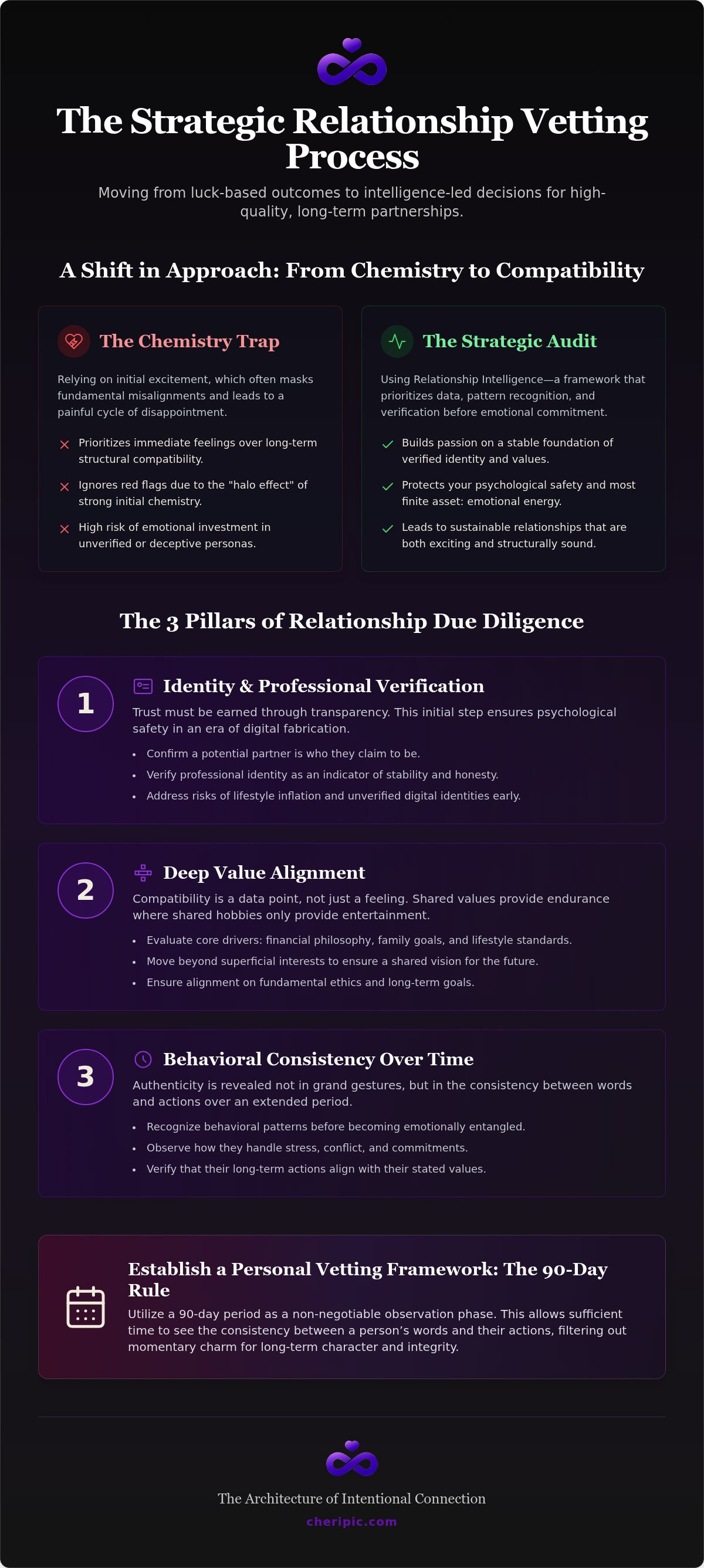
The "Chemistry Trap" remains one of the most common emotional pitfalls. Biological excitement often creates a halo effect, masking fundamental misalignments in lifestyle, ethics, or long-term goals. A disciplined vetting process doesn't eliminate passion. Instead, it ensures that passion is built upon a foundation of structural integrity. It's about verifying compatibility before the fog of chemistry takes hold. Today, advanced tools and AI coaching help identify these misalignments early. They look at communication styles and value consistency, providing a stabilizing force in an often chaotic search for connection. This methodical approach leads to relationships that aren't just exciting, but sustainable.
The 3 Pillars of Relationship Due Diligence
A successful relationship vetting process is not a single event; it's a structural audit of a potential partner's character and history. To build a lasting connection, you must move beyond the fog of early chemistry and apply a rigorous, three-part framework. This methodical approach is essential to avoid "confirmation bias," the psychological tendency to ignore red flags because we want the person to be "the one." By categorizing your assessment into three distinct pillars, you ensure that your emotional investment is backed by objective data.
CheriPic integrates these pillars into its core architecture, offering a stabilizing force for those who refuse to leave their future to chance. Through identity verification and compatibility assessments, the platform transforms the chaotic search for love into a disciplined journey of discovery.
Pillar 1: Identity and Professional Verification
Trust is a luxury that must be earned through transparency. In an era of digital fabrication, confirming that a partner is exactly who they claim to be is the first step in ensuring psychological safety. You should understand how to verify authenticity of online profiles before sharing your private life. Professional identity is more than just a job title; it serves as a key indicator of stability, honesty, and social integration. If a person’s professional claims are unverified or inconsistent, it often suggests a lack of integrity that will eventually manifest in the relationship.
Pillar 2: Deep Value Alignment and Shared Visions
Compatibility is a data point, not just a feeling. While shared hobbies provide entertainment, shared values provide endurance. You must look deeper than weekend interests to evaluate core drivers like financial philosophy, family goals, and lifestyle standards. Utilizing relationship compatibility assessments allows you to quantify these abstract concepts. Identifying "value-clash" red flags early, such as conflicting views on debt or career ambition, prevents the emotional exhaustion of trying to fix a fundamental misalignment during the honeymoon phase.
Pillar 3: Behavioral Pattern Recognition
Words are easily curated, but patterns are nearly impossible to hide over time. Past behavior remains the most accurate predictor of future actions. This pillar involves analyzing how a person handles conflict, treats strangers, and manages stress. Many people find themselves dating "the same person in different bodies" because they fail to recognize these recurring scripts. An AI relationship coach can provide the objective distance needed to highlight these patterns, acting as a mentor for better judgment. If you are ready to stop guessing and start knowing, consider a strategic investment in your emotional future through a verified community.
Manual Vetting vs. Intelligence-Led Verification
Relying on a manual relationship vetting process is a high-risk strategy that often yields incomplete or misleading results. Most individuals begin their due diligence by performing "DIY audits," such as cross-referencing social media profiles or conducting basic Google searches. While these actions feel productive, they are fundamentally limited. You are essentially attempting to audit a corporation using only its marketing brochures. Digital personas are curated facades designed to highlight strengths and obscure liabilities, making them poor indicators of true character.
Deceptive individuals in 2026 have become increasingly adept at bypassing these manual tests. The risks have evolved beyond simple "catfishing" into sophisticated "lifestyle inflation," where unverified digital spaces allow users to fabricate entire histories, professional achievements, and financial statuses without consequence. Traditional "friend-gossip" methods are equally flawed; they rely on anecdotal evidence and subjective bias rather than objective data. To achieve genuine psychological safety, you must shift from a casual inquiry to a "mentor-intelligence" approach that prioritizes structural integrity over curated narratives.
The Problem with Manual "Dating Audits"
Social media creates a curated reality that effectively bypasses standard vetting by presenting a polished, non-representative version of a person’s life. This creates immense psychological fatigue for the seeker. Having to act as your own private investigator is emotionally draining and often counterproductive, as your own desire for connection can cloud your judgment. There is also an ethical gray area to consider. Scouring the internet for "background checks" feels invasive and clandestine, whereas a platform-led verification process establishes a baseline of transparency from the very first interaction. Choosing a dating app with identity verification is the only way to close this trust gap and ensure you are engaging with a verified human being.
The CheriAI Advantage: Automated Pattern Recognition
CheriAI acts as a stabilizing force by processing behavioral data points without the interference of emotional bias. While humans often overlook inconsistencies during the excitement of a new connection, an AI mentor identifies them through sophisticated pattern recognition. This "Relationship Architect" approach improves decision-making speed and accuracy by flagging narrative inconsistencies that a manual search would likely miss. It’s about moving from a place of "hoping for the best" to a position of informed confidence. By delegating the analytical heavy lifting to intelligent systems, you free yourself to focus on the human elements of connection, knowing the structural foundation has already been verified.
Designing Your Personal Vetting Framework
Implementing a repeatable relationship vetting process requires a shift from passive observation to active, tiered assessment. You must move beyond the hope that things will work out and instead utilize a system that tests for structural integrity. A critical component of this framework is the "90-Day Rule." This period serves as a necessary buffer, allowing you to observe a partner’s consistency across various moods and situations before granting deep emotional commitment. During this phase, you should practice "Tiered Disclosure," matching the depth of your personal sharing to the level of verified authenticity the other person has demonstrated.
Step 1: Establishing Your Strategic Non-Negotiables
The foundation of any successful vetting framework is a clear definition of your non-negotiables. These are not superficial preferences like height or hair color; they are fundamental standards rooted in psychological safety and long-term vision. You must differentiate between "wants" and "requirements." While preferences might enhance a connection, requirements like integrity, financial maturity, and emotional intelligence are the pillars that sustain it. Standard setting is a fundamental expression of self-respect and psychological boundaries. Without these benchmarks, you are navigating without a compass, making you vulnerable to the first person who offers a convincing performance of chemistry.
Step 2: The Interview Phase—Asking High-Impact Questions
Effective vetting involves transitioning from polite small talk to intentional intelligence gathering. This doesn't mean making a date feel like an interrogation, but it does require a thorough inquiry into a person’s character. Think of this as a high-stakes job interview for the most important role in your life. You need to ask questions that reveal how a person operates under pressure and how they view their responsibilities. High-impact questions might include:
- "How do you handle professional failure?" This reveals their level of resilience and accountability.
- "What is your conflict resolution style?" This identifies whether they lean toward avoidance, aggression, or collaborative problem-solving.
- "What values did you inherit from your upbringing that you still hold today?" This uncovers the roots of their behavioral patterns.
Step 3: Verification and Reality Testing
Digital interactions are easily curated; real-world experiences are not. To truly vet a partner, you must move the connection from messaging to unscripted environments as quickly as possible. While dinner dates allow for polished conversation, activities like travel or wellness retreats reveal how a person handles logistical stress and social dynamics. These "reality tests" provide a clearer picture of their character than a dozen curated profile photos ever could. You should also utilize platform tools to verify claims made during the honeymoon phase, ensuring that their professional and personal narratives align with reality. If you are ready to apply this level of rigor to your search, secure your emotional future by joining a community that prioritizes verified intelligence.
CheriPic: The Architecture of Intentional Connection
CheriPic represents the logical conclusion for those who've recognized the structural flaws in traditional dating models. It's not a social platform; it's a relationship intelligence platform designed for the few who demand uncompromising quality. By integrating a professional relationship vetting process into its core architecture, CheriPic removes the burden of manual investigation from the individual. This shift allows you to move from a state of constant vigilance to one of informed engagement. It transforms the search for a partner from a game of chance into a disciplined strategy for long-term success.
Beyond Swiping: A Community of Verified Standards
The membership model serves as a strategic investment in your emotional future. Unlike free, unverified platforms that prioritize volume over value, this community attracts individuals who prioritize structural integrity and psychological safety. Every member undergoes rigorous Identity and Profile Verification. This ensures that the person you encounter is exactly who they claim to be, effectively eliminating the risks of catfishing or lifestyle inflation. Knowing that every peer has passed the same high standards provides a stabilizing force in your search for connection. These "Premium Experiences For The Few" aren't just about exclusivity; they're about creating an environment where transparency is the baseline, not the exception.
How to Get Started with Relationship Intelligence
Onboarding at CheriPic is a methodical journey of self-discovery. You don't just build a profile based on superficial aesthetics. You build one rooted in core drivers, financial philosophies, and long-term visions. Your first interaction involves engaging with CheriAI Relationship Coaching for your initial "Relationship Readiness Audit." This assessment uses behavioral psychology to help you recognize your own patterns and clarify your non-negotiables. It acts as a mentor for better judgment, preparing you to evaluate potential matches with objective precision.
Choosing to vet is not an act of cynicism or fear. It's an act of profound intentionality and self-respect. It's the recognition that your emotional energy is a finite asset that requires careful management. By adopting a disciplined approach to human connection, you aren't closing yourself off to passion. You're ensuring that when you finally invest your heart, you're building on a foundation that is verified, compatible, and secure. Join the CheriPic Early Access Membership today to reclaim your romantic clarity and start choosing with confidence.
Securing Your Emotional Future Through Relationship Intelligence
The landscape of modern connection requires more than hope; it requires a disciplined architecture for assessment. You now understand that a successful relationship vetting process is built on the pillars of identity verification, value alignment, and behavioral pattern recognition. By moving beyond the limitations of manual social media audits and embracing intelligence-led verification, you protect your most valuable assets: your time and your psychological safety. This isn't about cynicism. It's about the high-value intentionality required to build a connection that lasts.
You're invited to step into an exclusive community of intentional professionals who value transparency as much as you do. With our verified identity platform and AI-powered pattern recognition, you can finally navigate the romantic landscape with the clarity of a relationship architect. Join the CheriPic Early Access Membership to start your relationship intelligence journey.
Take control of your romantic narrative today. You've done the internal work; now it's time to choose a partner who meets the same uncompromising standards.
Frequently Asked Questions
What is a relationship vetting process and why is it necessary?
A relationship vetting process is a strategic audit of identity, values, and behavioral history to ensure long-term compatibility. It’s necessary because chemistry often masks fundamental misalignments that lead to emotional burnout. By treating partner selection as a serious commitment rather than a game of luck, you protect your emotional and temporal assets. This disciplined approach prevents the recurring cycle of investing in incompatible matches that ultimately fail to meet your high standards.
Is it ethical to "vet" a potential partner before a first date?
Vetting is an ethical practice rooted in self-respect and psychological safety. You have a right to verify the identity and integrity of anyone you intend to share your time with. Transparency should be the baseline for any mature connection. In an era of digital deception, performing due diligence isn’t an invasion of privacy; it’s a necessary step to ensure that both parties are engaging in a safe, honest environment from the start.
How do I identify red flags during the vetting process?
Red flags are identified by looking for inconsistencies between a person’s words and their behavioral patterns. You should observe how they handle professional setbacks, how they treat service staff, and whether their lifestyle claims match their reality. A sophisticated relationship vetting process prioritizes data over charm. If their narrative fluctuates or they avoid direct questions about their values, these are structural warnings that the person is not ready for a high-quality, intentional partnership.
Can AI really help me vet a relationship for compatibility?
AI provides an objective, data-driven perspective that bypasses the emotional bias often present in the early stages of dating. Tools like CheriAI analyze behavioral data points and communication styles to highlight potential misalignments in values or goals. This isn’t about replacing intuition; it’s about augmenting it with intelligence. AI acts as a stabilizing force, offering pattern recognition that helps you make faster, more accurate decisions about who is truly compatible with your vision.
How long should the vetting process take before a relationship becomes "official"?
You should allow for a minimum of 90 days of consistent observation before granting a deep emotional commitment. This timeframe allows the initial honeymoon hormones to subside, revealing a person’s true character across different moods and life stressors. It provides enough space to verify their identity and ensure their long-term goals align with yours. Moving slower than the modern swipe culture demands is a strategic advantage that protects your psychological well-being and long-term success.
What is the difference between vetting for safety and vetting for compatibility?
Safety vetting focuses on identity verification and the absence of harmful behavior, while compatibility vetting focuses on shared visions and lifestyle standards. Safety vetting ensures the person is who they claim to be and presents no immediate threat. Compatibility vetting is more analytical, determining if the connection can survive the complexities of a long-term partnership. While safety is a non-negotiable baseline, compatibility determines the relationship's structural integrity. Both are essential components of a thorough assessment.
How do I ask vetting questions without making it feel like an interview?
You can ask high-impact questions by sharing your own values first and using open-ended prompts that encourage storytelling. Instead of a rapid-fire interrogation, use curiosity to understand their history and motivations. For example, ask about a challenge they recently overcame to understand their resilience. This approach allows you to gather intelligence on their conflict resolution style and integrity while maintaining a warm, engaging atmosphere. It’s about being a curious observer rather than a cold investigator.
What should I do if my vetting process reveals a red flag?
You must prioritize your psychological safety and exit the connection with clarity if a red flag is revealed. Red flags are data points indicating that the structural foundation of the relationship is flawed. Don’t fall into the trap of trying to fix or ignore these warnings due to early chemistry. Acknowledge the dissonance, trust your assessment, and move on. Your emotional energy is too valuable to spend on someone who doesn’t meet your non-negotiable standards for integrity.


