
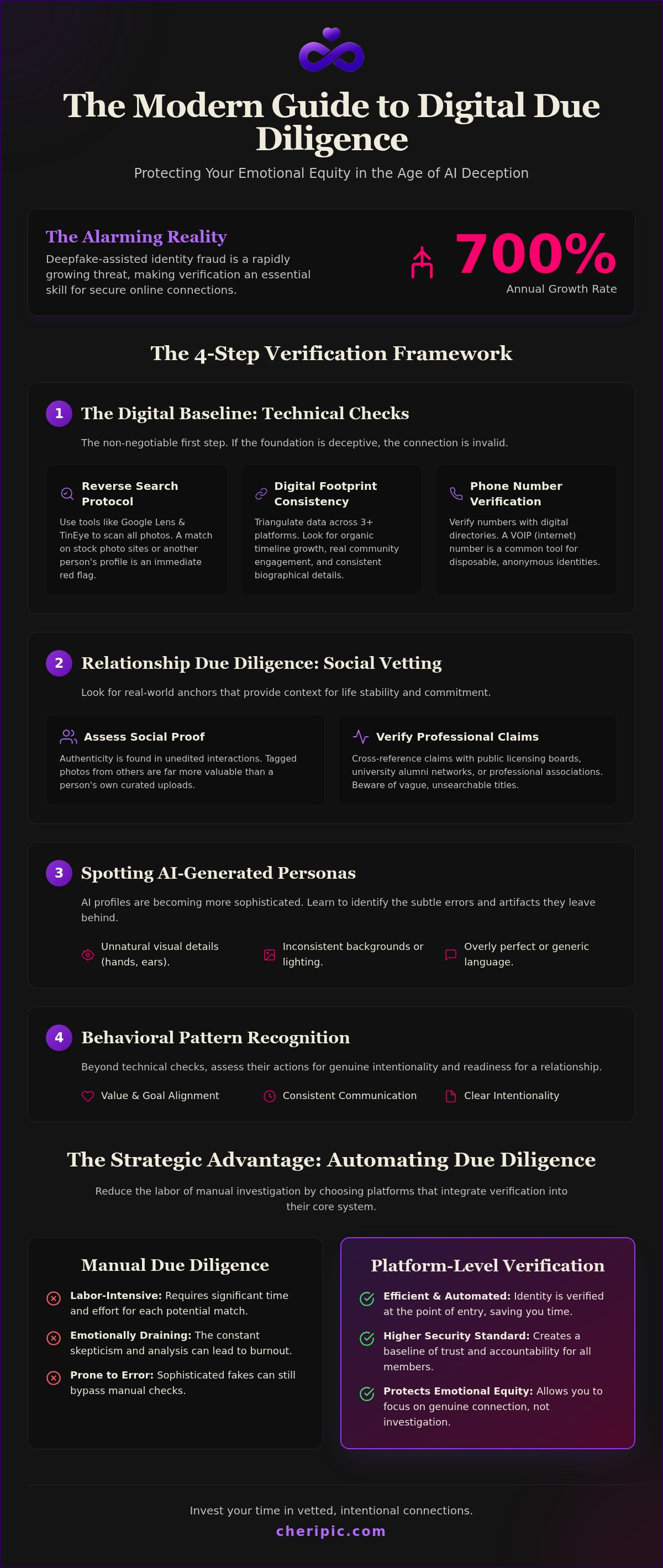
Deepfake-assisted identity fraud is currently expanding at a rate of 700% per year. This reality has transformed the simple act of meeting someone new into a complex exercise in risk management. You likely feel the weight of this uncertainty every time you open a digital platform. It is exhausting to wonder if you are speaking with a genuine partner or a sophisticated AI chatbot. Learning how to verify authenticity of online profiles is no longer a luxury; it is a fundamental requirement for anyone seeking a secure, intentional relationship.
Your emotional equity is a finite resource that deserves the highest level of protection. We agree that the current lack of accountability on mainstream platforms is unacceptable. This article provides a comprehensive framework for relationship due diligence, moving you from a state of anxiety to one of analytical clarity. We will explore the latest verification technologies and provide a structured checklist to ensure your digital connections are rooted in reality. By the end of this guide, you will have the tools to vet potential matches with professional precision. This ensures your time is invested only in those who meet your high standards.
Key Takeaways
- Establish a non-negotiable technical baseline by implementing a rigorous reverse-search protocol for images and digital handles.
- Learn how to verify authenticity of online profiles by identifying the subtle visual artifacts and errors common in AI-generated personas.
- Protect your emotional equity through professional identity verification, ensuring career claims reflect actual life stability.
- Don't rely solely on surface-level chemistry; use behavioral pattern recognition to assess true readiness and value alignment.
- Reduce the labor of manual due diligence by leveraging membership-based platforms that automate the identity verification process.
The Digital Baseline: A Technical Checklist for Profile Verification
Technical verification is the structural foundation of psychological safety. You cannot accurately assess a person's character if you aren't certain the person actually exists. It's a non-negotiable first step in the modern dating landscape. Think of this phase as a structural inspection of a building before you decide to move in. If the foundation is built on deception, the rest of the relationship will eventually collapse. Mastering the technical basics allows you to filter out noise and focus your energy on genuine connections.
The Reverse Search Protocol
Learning how to verify authenticity of online profiles begins with the visual evidence. You should use advanced tools like Google Lens or TinEye to scan profile photos. If a photo appears on a stock photography site or belongs to a different person's social media, the connection ends immediately. You should also search for username variations across professional networks. Most people are creatures of habit; they often use similar handles across multiple platforms. If the person behind the handle on one site doesn't match the person on another, you've identified a significant discrepancy. Finally, verify phone numbers via reputable digital directories. A VOIP (Voice over IP) number is frequently used to create temporary, disposable identities. A legitimate mobile connection suggests a higher level of social accountability.
Digital Footprint Consistency Checks
A comprehensive understanding digital identity requires you to look beyond a single profile. You should aim to match the digital footprint across at least three different platforms. This triangulation of data points creates a more complete picture of the person you're engaging with.
- Analyze the timeline: Does the account history show organic growth over years, or was it populated with several photos in a single day? Genuine lives leave a trail of gradual updates.
- Examine community engagement: High follower counts with zero comments or mutual connections often signal a fraudulent account. Look for real interactions with real people.
- Match biographical details: Compare job titles on LinkedIn with lifestyle claims on Instagram. If their career narrative on a professional network doesn't align with their social media presence, the story is fractured.
Consistency is the ultimate marker of truth. Low-effort profiles often lack this cross-platform depth because maintaining multiple fake identities is exhausting and time-consuming. When a digital presence feels thin, it's usually because it is. You should protect your emotional equity by demanding a cohesive story before you invest your time. If the technical baseline isn't met, there's no need to proceed to the deeper stages of due diligence.
Relationship Due Diligence: Verifying Professional and Social Identity
Once you've cleared the technical baseline, you must shift your focus to structural integrity. A person's professional and social identity provides the context for their life stability. In the Relationship Architect framework, we view career and community not as status symbols, but as evidence of sustained commitment and accountability. Mastering how to verify authenticity of online profiles means looking for these real-world anchors. If a profile lacks these anchors, the risk of deception increases. Your emotional equity is too valuable to spend on a ghost.
Verifying Career and Educational Claims
Professional claims are often the easiest to fabricate yet the most revealing when scrutinized. You should look for specific markers of legitimacy. Public licensing boards for medical, legal, or engineering professionals offer immediate confirmation of a person's standing. If they claim a high-level corporate role, cross-reference university alumni networks or professional associations. You should be wary of "title inflation" or vague descriptions like "entrepreneur" or "consultant" that lack a verifiable track record. Real life creates friction and a paper trail. If their career path is too smooth or entirely unsearchable, it warrants a pause. This isn't about judgment; it's about ensuring the person's self-narrative matches their actual history.
Assessing Social Proof and Community Standing
Authenticity isn't found in a curated gallery of solo shots. It's found in the unedited interactions with others. Tagged photos are far more valuable than profile uploads because they represent a third-party verification of presence. You should look for genuine engagement from long-term friends or family members. A person with a deep social well is often more reliable than someone whose digital life exists in a vacuum. High-value authenticity often carries a sense of exclusivity. They don't need to be visible to everyone, but they must be visible to their own community. When you know how to verify authenticity of online profiles, you prioritize these social connections over polished aesthetics.
Due diligence is an act of self-respect. It ensures that you aren't just falling for chemistry, but investing in a verified reality. Assessing these social and professional layers allows you to build a connection on a foundation of truth rather than projection. For those who prefer a more streamlined approach, using a verified relationship platform can remove the manual burden of vetting, allowing you to focus on the emotional connection itself. By outsourcing the verification, you reclaim your time and peace of mind.
The 2026 Challenge: Spotting AI-Generated Profiles and Deepfakes
The digital landscape has evolved beyond simple text-based bots. We now face the "AI Persona," a fully realized visual and auditory fabrication designed to mimic human intimacy. Research from McAfee in 2025 indicated that 1 in 4 people had already been approached by an AI chatbot posing as a real person. By 2026, deepfake-assisted identity fraud is growing at a staggering rate of 700% annually. Understanding how to verify authenticity of online profiles now requires a keen eye for technological artifacts that the human brain often overlooks during the initial "chemistry" phase.
AI remains a tool of imitation, not creation. It lacks the structural integrity of a lived human experience. While a machine can generate a beautiful face, it struggles to maintain the logic of the physical world. By slowing down your assessment, you can spot the fractures in these digital masks. Protecting your emotional equity means refusing to engage with an identity that cannot prove its physical existence.
Visual Red Flags in AI Photography
High-resolution AI images often contain subtle, illogical errors. You should analyze the background for "morphing" or architectural lines that don't follow the laws of physics. Check the ears, hands, and jewelry for inconsistencies. AI often fails to render complex symmetry, resulting in mismatched earrings or fingers that blend into objects. You must also be wary of the "perfect skin" trap. Human skin has pores, fine lines, and slight asymmetries. If a profile features a series of images with hyper-smooth textures and zero imperfections, you're likely looking at a synthetic creation rather than a person.
The Liveness Verification Framework
Static images are no longer sufficient for due diligence. You must implement a liveness test to ensure you're engaging with a physical being. Request a specific, real-time action that an AI cannot easily replicate on the fly. A photo holding a piece of paper with today's date and a specific three-finger gesture is a reliable hurdle for many current generators.
A video call remains the ultimate filter for authenticity. Even as deepfake technology advances, real-time video overlays often "glitch" or show "lag" when the subject moves their head quickly or passes a hand in front of their face. A 60-second live chat exposes these technical failures. If a match repeatedly makes excuses to avoid live video, they're likely hiding a synthetic identity. Your psychological safety depends on your willingness to demand this real-time proof before sharing your time or energy.
Behavioral Pattern Recognition: Verifying Intentionality and Readiness
Technical verification and social proof are merely the entry gates to a secure connection. Once those are cleared, you must shift your focus to the psychological architecture of the person. Many people fail at this stage because of the "Chemistry Trap." This is a physiological response that floods the brain with dopamine, effectively blinding your logical centers for the first 90 days of a connection. To successfully master how to verify authenticity of online profiles, you must learn to observe behavior with clinical detachment. You aren't just looking for a "real" person; you're looking for a "ready" person who possesses structural integrity.
Identifying Emotional Authenticity
You must learn to distinguish between "Love Bombing" and genuine intentional interest. Love bombing is characterized by unearned praise and an unnaturally accelerated timeline. In contrast, intentional interest respects the slow, methodical pace of discovery. You should also verify the consistency between their stated values and their actual lifestyle. If someone claims to value wellness but their daily patterns suggest chaos, the profile is inauthentic at a behavioral level. A sophisticated Relationship Intelligence framework helps identify these deceptive behavioral patterns early by prioritizing logic over fleeting chemistry.
The Value Alignment Audit
Emotional maturity is revealed through high-impact questions and the management of boundaries. When you understand how to verify authenticity of online profiles through behavioral cues, you move beyond surface-level traits to assess core character. Observe how a person handles a "no" or a request for more time during the vetting phase. A person with structural integrity will respect your pace; a manipulative actor will often push back or withdraw. Verifying relationship readiness also requires analyzing past patterns. If a match describes a history of "crazy" exes without taking personal accountability, they're likely repeating a destructive cycle. You're looking for a partner who has done the internal work, not just someone with a polished digital presence.
Slowing down the discovery process allows these behavioral inconsistencies to surface naturally. By refusing to rush, you protect your emotional equity from those who are only performing readiness. Applying for CheriPic Early Access Membership allows you to enter a community where this level of intentionality is the baseline, not the exception. This strategic approach ensures your time is only spent on connections that are both verified and viable.
The Strategic Standard: Why Platform-Level Verification Wins
The manual burden of due diligence often leads to a specific type of exhaustion known as vetting burnout. While learning how to verify authenticity of online profiles is a vital skill, performing these checks for every potential match is a significant drain on your emotional resources. You shouldn't have to act as a private investigator just to secure a first date. This defensive posture, while necessary on open platforms, prevents you from being fully present for the actual connection. When you spend all your energy on scrutiny, there's little left for vulnerability.
The CheriPic Verification Ecosystem
Structural safety shouldn't be a DIY project. By choosing a platform where identity verification for dating is a mandatory entry requirement, you outsource the technical and professional vetting to an automated system. This creates a closed, high-trust community where every member has already met a high standard of authenticity. Within this space, an AI relationship coach works continuously to maintain profile integrity and identify subtle behavioral red flags. This isn't just about security; it's about exclusivity. It ensures that your time is only shared with those who are as intentional and real as you are.
Transitioning to Intentional Connection
Once the burden of verification is lifted, you can reclaim your time for depth. Instead of spending weeks wondering if a person's career claims are true, you can use platform-driven insights to skip the superficial small talk. This allows you to move quickly from digital interaction to real-world experiences, such as curated wellness events or rooftop gatherings. The goal of knowing how to verify authenticity of online profiles is to reach a point where you no longer have to worry about it. It allows you to move from a state of constant suspicion to a state of informed confidence.
A profile is considered verified enough for a meeting when it meets these three criteria:
- It has passed a multi-factor identity check including biometric and document analysis.
- The person has demonstrated behavioral consistency over a period of intentional engagement.
- There is a clear, unglitched liveness confirmation through video or platform-level verification.
Choosing a verified standard is a strategic investment in your psychological safety. It signals that you value your time and emotional equity enough to demand a higher baseline of truth. When the vetting is automated, the connection becomes the priority. You are finally free to focus on the person, not the profile.
Reclaiming Your Relational Future Through Verified Clarity
Your emotional equity is a finite asset. It shouldn't be squandered on digital shadows or synthetic personas. By mastering how to verify authenticity of online profiles, you've moved from a state of reactive anxiety to one of proactive intelligence. You now understand that structural integrity is found in the intersection of technical consistency, professional anchors, and behavioral patterns. These layers of due diligence aren't acts of suspicion; they're essential investments in your psychological safety and long-term success.
The burden of constant vetting doesn't have to be yours alone. You can choose a path that prioritizes excellence over volume. Relationship Intelligence is the core of our platform, ensuring that every member is verified for both identity and intent. With personalized coaching provided by CheriAI, you gain the clarity needed to identify red flags before they compromise your peace of mind. It's time to stop defending your boundaries and start experiencing genuine connection.
Apply for CheriPic Early Access and experience the standard of verified connection.
You deserve a partner who is as real as the life you've built. Step into a community where authenticity is the baseline and intentionality is the only standard.
Frequently Asked Questions
What are the most common signs of a fake online profile in 2026?
High-resolution images with illogical backgrounds and a lack of specific social anchors are primary indicators of a fraudulent presence. You should look for "morphing" in architectural lines or jewelry inconsistencies in profile photos. A profile that lacks a 3+ platform digital footprint or shows patterns consistent with the 244% increase in document forgeries should be treated with caution. Genuine users leave a trail of gradual, organic interactions rather than sudden bursts of curated content.
How can I politely ask someone to verify their identity before we meet?
Frame the request as a shared commitment to psychological safety rather than a confrontational interrogation. You might say, "I value our connection and want to ensure we both feel secure before meeting; would you be open to a quick video chat?" This approach shifts the focus from suspicion to mutual protection. A person who is genuinely ready for a relationship will respect your standard for due diligence and understand the necessity of this step.
Is it possible for an AI profile to pass a standard video call?
While basic deepfakes struggle with real-time movement, sophisticated AI personas can occasionally mimic human presence in short bursts. You should look for "glitching" or "lag" when the person moves their hand across their face or turns their head quickly. These artifacts reveal the limits of current processing power. A 60-second live interaction remains the most effective manual filter for anyone learning how to verify authenticity of online profiles.
What should I do if I find a discrepancy in someone's professional background?
Address the inconsistency directly with a calm, analytical perspective to determine if it's a simple error or a deliberate fabrication. Ask for clarification without being accusatory. If the explanation lacks structural integrity or the person becomes defensive, it's a clear signal to pause the connection. Professional stability is a key indicator of life readiness. If the foundation of their self-narrative is fractured, the relationship will likely follow the same pattern.
Why is identity verification more important on dating apps than on social media?
Dating involves a higher level of emotional and physical risk than casual social networking, necessitating a higher baseline of trust. On a dating platform, you're sharing intimate details and planning real-world encounters with strangers. Understanding how to verify authenticity of online profiles is essential here because the "Chemistry Trap" can often cloud your judgment. Verification acts as a stabilizing force in an otherwise chaotic emotional landscape, protecting your time and equity.
Can someone be 'authentic' but still be a 'red flag' for compatibility?
Authenticity confirms the person is real, but it does not guarantee that their lifestyle or values align with yours. A person can be entirely genuine but possess behavioral patterns that are incompatible with your long-term success. For example, someone might be authentically unready for commitment or possess values that conflict with your own. Verification only confirms the identity; compatibility assessments are required to determine if the structural integrity of their life matches yours.
What is the difference between a bot and an emotional catfish?
A bot is a synthetic entity programmed to mimic human interaction, while an emotional catfish is a real human using a deceptive persona. Bots often focus on rapid escalation or financial scams. Emotional catfishing is more complex; it involves a real person seeking validation or intimacy through a fabricated identity. Both represent a failure of integrity. Identifying these requires a mix of technical checks and behavioral pattern recognition to protect your emotional energy.
How does CheriPic handle the verification of its members?
CheriPic utilizes a multi-layered verification ecosystem that combines biometric analysis with professional document verification. Identity and Profile Verification is a core pillar of our membership, ensuring every user is a real person with genuine intent. Our platform replaces swiping with intentional vetting. Additionally, CheriAI provides personalized insights to identify behavioral red flags, allowing you to focus on building deep connections within a high-trust, pre-verified community of high-value singles.


