

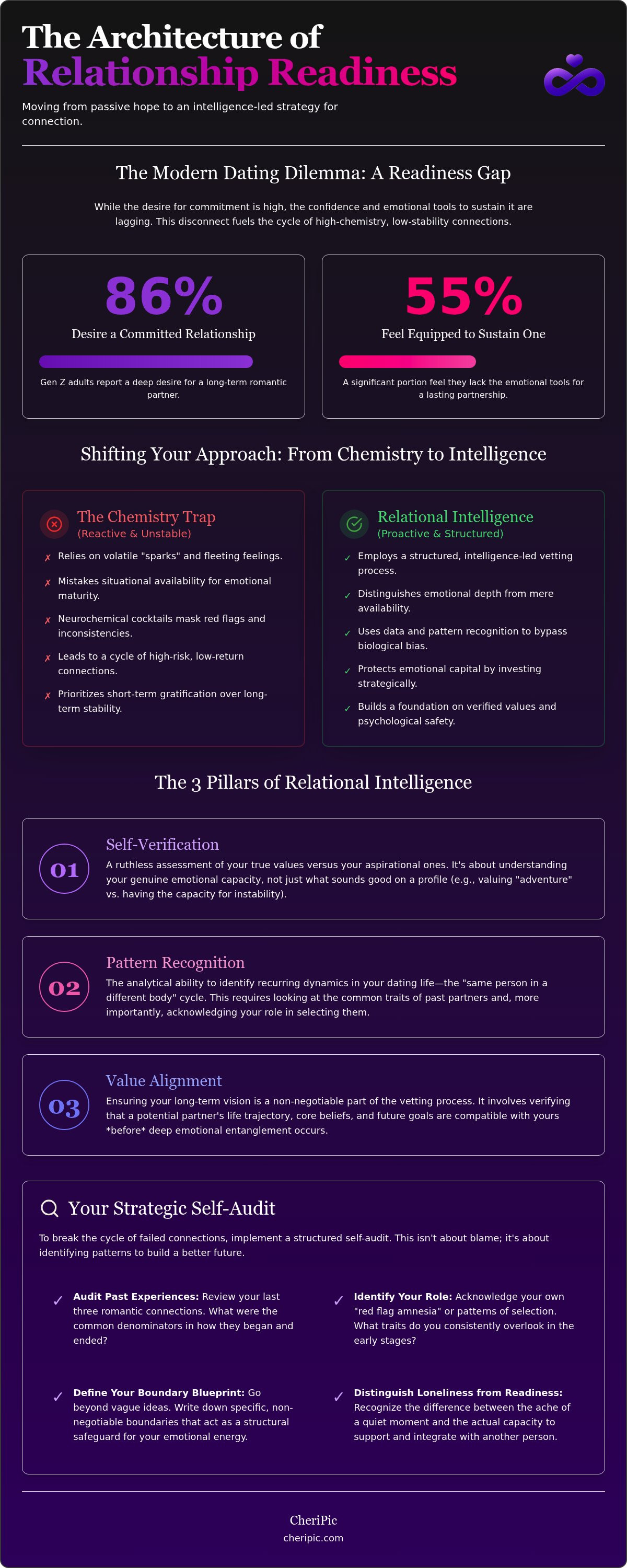
While 86 percent of Gen Z adults report a deep desire for a committed romantic relationship, only 55 percent feel they possess the emotional tools to sustain one. This significant gap suggests that while the heart is willing, the internal architecture is often incomplete. You likely recognize the exhaustion of the dating recession, where the desire for long-term partnership is high, yet the confidence to navigate those connections feels strikingly low. It's common to feel stuck in a cycle of chemistry traps that lead to predictable red flags; many people confuse the temporary ache of loneliness with genuine emotional readiness.
Learning how to improve relationship readiness requires you to move beyond emotional luck and toward a disciplined state of relationship intelligence. We promise to help you transition from passive hope to a structured approach by auditing your behavioral patterns and building a foundation for intentional connection. This guide provides a measurable framework to assess your situational availability versus your emotional depth. We will also outline a strategy to attract higher-quality partners who value due diligence as much as you do. By the end, you'll have the clarity to spot patterns before they become problems, ensuring your next investment of time is both strategic and secure.
Key Takeaways
- Distinguish between situational availability and genuine emotional maturity to avoid the cycle of high-chemistry, low-stability connections.
- Discover how to improve relationship readiness by conducting a rigorous self-audit of your behavioral patterns and the narratives you hold about past partners.
- Implement a boundary blueprint that acts as a structural safeguard for your emotional energy, ensuring long-term psychological safety.
- Shift from passive dating to an intelligence-led approach by applying "due diligence" to your own values and the vetting process of others.
- Leverage relationship intelligence tools and identity verification to eliminate blind spots and build a foundation of trust before investing emotional capital.
Beyond Chemistry: Defining Relationship Readiness in 2026
Relationship readiness isn't a vague emotional "vibe" or a state reached simply by being single for a set amount of time. In 2026, we define it as a measurable alignment between your current emotional capacity and your behavioral intent. Most people approach dating through the lens of chemistry, which is a reactive and often volatile metric. Intelligence-led intentionality, however, requires you to evaluate your internal structure before inviting another person into it. Traditional dating apps fail because they prioritize situational availability over emotional preparedness. They treat users as interchangeable parts in an engagement machine rather than individuals seeking alignment. To understand how to improve relationship readiness, you must adopt the mindset of a Relationship Architect. This involves designing the foundation of your life with such precision that a partner becomes an intentional addition rather than a structural necessity.
The Difference Between Loneliness and Readiness
Many individuals fall into the "void-filling" trap, where the search for a partner is actually a search for a distraction from personal stagnation. There is a sharp distinction between the desire for a partner and the capacity for a partnership. One is a wish; the other is a skill set rooted in psychological maturity. This maturity allows you to differentiate between the ache of a quiet Sunday and the actual ability to support another human being's emotional needs. Readiness is the demonstrated ability to maintain your core identity and boundaries while successfully integrating the complexities of another person's life.
Why 'Chemistry' is Often a False Signal
Chemistry is frequently a biological distraction. During the first 90 days of a connection, the brain’s reward system releases a neurochemical cocktail that can effectively mask red flags and behavioral inconsistencies. This "Chemistry Trap" explains why many find themselves repeating the same mistakes with different people. You need relationship intelligence to bypass these biological biases. Relying on data and pattern recognition allows you to see the person as they are, not as your dopamine levels want them to be. Learning how to improve relationship readiness means training yourself to value stability and verification over the fleeting high of a "spark" that has no structural integrity. By slowing down the vetting process, you protect your emotional capital from being spent on high-risk, low-return connections.
The Three Pillars of Relational Intelligence
Relational intelligence is the scaffolding of a stable partnership. It functions as a internal guidance system that prioritizes long-term compatibility over short-term gratification. Understanding how to improve relationship readiness begins with a shift from reactive dating to proactive architecture. This shift is supported by three core pillars: Self-Verification, Pattern Recognition, and Value Alignment. These elements are not just concepts; they are the practical tools required to build a healthy relationship that can withstand the pressures of modern life. Without these pillars, you're essentially building on sand, hoping that "chemistry" will provide the structural integrity that only shared values and self-awareness can offer.
- Self-Verification: This involves a ruthless assessment of your true values versus your aspirational ones. It's the difference between saying you value "adventure" and actually having the emotional capacity for the instability that comes with it.
- Pattern Recognition: This is the analytical ability to identify the "same person in different bodies" cycle. It requires looking at the common traits of past partners and acknowledging your role in selecting them.
- Value Alignment: This ensures your long-term vision is non-negotiable. It involves verifying that a partner’s trajectory matches your own before you become emotionally entangled.
Conducting a Personal Behavioral Audit
To break a cycle of failed connections, you must conduct a behavioral audit of your last three romantic experiences. Identify the common denominator in these relationships. Often, the commonality isn't the partner’s flaws, but your own "red flag amnesia" that occurs during the honeymoon phase. This amnesia is a biological bypass where dopamine overrides your logical vetting process. To counter this, establish a framework for recognizing destructive patterns before the first date. For those seeking structured guidance, CheriPic's Compatibility Assessments can help illuminate these blind spots by providing a data-driven perspective on your relational tendencies.
Defining Your Non-Negotiable Core Values
Mastering these pillars is the most effective way to understand how to improve relationship readiness. You must move beyond superficial preferences, such as height or career status, and focus on core values like integrity, growth, and dependability. These are the foundational relationship skills that determine whether a partnership will thrive or merely survive. When your long-term vision is aligned with a partner's, the need for constant, exhausting compromise is significantly reduced. Shared visions act as the structural integrity of a partnership; they ensure that both individuals are moving toward the same horizon, rather than pulling in opposite directions. This alignment creates a sense of psychological safety that allows for genuine vulnerability and growth.
Vetting Your Readiness: Emotional Maturity vs. Situational Availability
Readiness is not a binary state. It's a fluctuating spectrum influenced by professional stability, current stress levels, and your current stage of psychological healing. Understanding how to improve relationship readiness requires moving beyond the simple fact of being "unattached." It demands a "Due Diligence" phase where you audit your internal resources with the same scrutiny you'd apply to a major financial investment. This verification of your own emotional bandwidth is the essential first step in a professional relationship vetting process. Without this internal verification, you risk entering the dating market with a deficit, leading to connections that are reactive rather than intentional.
The Situational Availability Trap
Many confuse situational availability with genuine readiness. Being single and possessing a calendar with open evenings is merely a logistical status. It's not an indicator of your capacity for partnership. The "Situational Availability Trap" occurs when individuals use dating as a mechanism to distract from professional stagnation or personal boredom. If you're dating to fill a void rather than to share a full life, you're not connecting; you're consuming. Professional stability often serves as a prerequisite for readiness because it provides the cognitive ease necessary to focus on another person's needs. When your own foundation is shaky, you lack the structural space to house a partner’s complexities. True readiness means you've moved past dating to distract and are now dating to connect from a place of abundance.
Measuring Emotional Resilience and Regulation
Emotional maturity is defined by your ability to regulate your internal state. This resilience allows you to manage triggers without projecting past romantic failures onto a new, unverified partner. Self-regulation acts as a silent trust builder during the early stages of a connection. It demonstrates that you're a stabilizing force rather than a source of chaos. By maintaining your own psychological safety, you become better equipped for building a healthy relationship that survives the initial honeymoon phase. True readiness means you don't look to a partner to regulate your emotions. Instead, you bring a regulated self to the table. This self-generated safety is the ultimate green flag, signaling to high-quality partners that you're a secure investment for their time and energy.
Strategic Self-Audit: Actionable Steps to Improve Readiness
A strategic self-audit is the active phase of your relational preparation. It's the process where theory meets execution, allowing you to identify the specific structural weaknesses in your approach to dating. To understand how to improve relationship readiness, you must move beyond passive reflection and engage in a methodical assessment of your internal landscape. This audit isn't about self-criticism; it's about objective data collection and the removal of behavioral inefficiencies that have previously compromised your success.
- Step 1: The Narrative Audit. Evaluate the stories you tell about your past partners. Are you the victim of bad luck, or the architect of specific choices?
- Step 2: The Boundary Blueprint. Establish a definitive list of what is no longer permitted in your emotional space.
- Step 3: Intentional Isolation. Cultivate a state of peace in solitude to ensure a partner is a choice, not a necessity.
- Step 4: Seeking Professional Insights. Utilize objective tools to uncover psychological blind spots that internal reflection might miss.
- Step 5: Verification. Ensure you're presenting an authentic, vetted version of yourself to the world.
Rewriting Your Romantic Narrative
Your history isn't a series of accidents; it's a series of blueprints you've followed. To change your future, you must move from being a "victim of bad luck" to an "architect of choice." This shift requires identifying the limiting beliefs that drive poor partner selection, such as the idea that high-conflict passion equals deep love. Taking 100 percent responsibility for your relationship history is the only way to gain the power to change it. By acknowledging your role in past failures, you gain the intelligence needed to avoid them in the future.
Establishing High-Value Boundaries
Boundaries are often misunderstood as walls designed to keep people out. In reality, they're acts of self-love that define how you're to be treated. Establishing high-value boundaries is a critical component of how to improve relationship readiness because it filters for intentionality from the first interaction. Communicating these standards early doesn't make you "difficult"; it makes you clear. High-quality partners are attracted to this clarity because it signals a high level of self-respect and maturity. To begin this process with professional precision, you can explore CheriAI Relationship Coaching for personalized pattern recognition and strategic guidance. Strong boundaries ensure that your emotional energy is reserved for those who have passed your rigorous vetting process.
Leveraging Relationship Intelligence: Calibrating for Success
The final stage of becoming a Relationship Architect involves calibrating your internal work with external tools. While previous sections focused on internal audits, the modern dating landscape requires a layer of technical verification to ensure psychological safety. Technology now functions as a clarity coach, providing the analytical distance needed to evaluate potential partners objectively. This transition from "gut feelings" to data-informed decisions is a critical component of how to improve relationship readiness. It replaces the chaos of unverified digital interactions with a structured environment where trust is the baseline, not a gamble.
Identity and Profile Verification plays a pivotal role in restoring this digital trust. In an era of curated personas, having a verified foundation ensures that the person you're engaging with has passed a standard of "due diligence." This reduces the cognitive load of dating, allowing you to focus on compatibility rather than basic safety. CheriAI acts as the ultimate tool for this ongoing calibration, helping you maintain pattern recognition as connections evolve from initial interest to long-term investment. It allows you to track behavioral consistency over time, which is the only true measure of a partner's readiness.
Using AI to Identify Destructive Patterns
Using AI coaching is a strategic method for understanding how to improve relationship readiness. Human beings are notoriously poor at identifying their own blind spots, especially when neurochemicals are high. Data-driven insights can highlight subtle red flags that you typically ignore during the excitement of a new connection. By utilizing a neutral, analytical perspective, you can see the structural flaws in a potential partnership before they lead to emotional distress. AI coaching serves as the ultimate "due diligence" for modern romance, ensuring that your heart never moves faster than your intelligence. It provides a stabilizing force that keeps your long-term vision in focus when biological biases threaten to derail your progress.
The Shift to Intentional Connection
The goal of relationship intelligence is to move from the digital screen to real-world experiences as efficiently as possible. Verified platforms naturally attract a higher caliber of partner; these are individuals who value quality and intentionality over the dopamine hit of endless swiping. This shift eliminates the exhaustion of "endless messaging" and replaces it with curated, premium experiences designed for depth. True readiness means you no longer settle for the ambiguity of unverified connections. You deserve a partner who has also committed to the same level of self-audit and transparency. It's time to audit your readiness and join the future of relationship intelligence to ensure your next connection is built on a foundation of verified truth.
Designing Your Future of Intentional Connection
Relationship readiness is a structural achievement, not a passive state of being reached by simply waiting. By conducting a rigorous behavioral audit and establishing non-negotiable boundaries, you move from reactive dating to a position of analytical strength. You've learned that identifying destructive patterns and distinguishing situational availability from emotional maturity are the cornerstones of long-term success. This strategic approach ensures that your emotional capital is invested rather than spent. You now have the framework to evaluate your own capacity for partnership with the same precision you use in your professional life.
Mastering how to improve relationship readiness ensures that your next connection is built on a foundation of verified truth rather than fleeting chemistry. Now is the time to apply these insights through a platform designed for those who value due diligence. With personalized insights from CheriAI and secure identity verification, you can engage with a community of intentional, high-value singles who share your uncompromising standards. Start your journey toward relationship intelligence with CheriPic. You possess the tools to become the architect of your own romantic success; the path to a secure, intentional partnership begins with your first verified step.
Frequently Asked Questions
How can I tell if I am actually ready for a relationship or just lonely?
Readiness is the capacity to integrate another person's life into your own without losing your core identity, whereas loneliness is a reactive urge to fill an emotional void. If you're seeking a partner to manage your boredom or provide a sense of worth you don't possess solo, you're likely experiencing loneliness. True readiness involves having a stable internal foundation that remains intact regardless of your relationship status.
What are the most common signs of relationship unreadiness?
Unreadiness often manifests as a frantic search for validation or a tendency to ignore red flags in favor of immediate chemistry. Common indicators include a recurring pattern of high-conflict connections, an inability to maintain personal boundaries, and dating as a form of distraction from professional or personal stagnation. If you're projecting past traumas onto new connections, you lack the emotional bandwidth required for a healthy partnership.
How do I stop repeating the same relationship mistakes?
Breaking destructive cycles requires a rigorous behavioral audit and the application of analytical pattern recognition. You must identify the specific traits shared by past partners and acknowledge your role in selecting them. By shifting from a victim of bad luck to an intentional architect of choice, you gain the intelligence needed to vet for different, higher-quality attributes in future connections.
Is it possible to improve relationship readiness while dating?
You can refine your strategy on how to improve relationship readiness while actively dating by treating each interaction as a data point for self-audit. This involves practicing new boundaries and observing your emotional regulation in real-time. However, this live training requires significant self-awareness to ensure you don't fall back into old habits during the honeymoon phase. It's a process of constant calibration and behavioral adjustment.
What is the 'Chemistry Trap' and how do I avoid it?
The 'Chemistry Trap' is a biological bypass where dopamine and oxytocin mask red flags during the first 90 days of a connection. You avoid it by intentionally slowing down the vetting process and prioritizing value alignment over physical sparks. Applying relationship intelligence allows you to see the structural integrity of a potential partner rather than just their temporary neurochemical effect on your brain.
How does identity verification help in building a healthy relationship?
Identity verification establishes a baseline of trust and psychological safety in a digital environment. By removing the ambiguity of unverified personas, it allows you to focus your emotional energy on genuine, intentional individuals. This due diligence reduces the risk of deception, ensuring that your foundation is built on verified truth. It filters out low-value interactions before they can consume your valuable time.
What role does an AI relationship coach play in improving readiness?
An AI relationship coach, such as CheriAI, acts as a clarity coach by providing an objective, data-driven perspective on your behavioral patterns. It highlights blind spots and red flags that you might ignore due to biological bias. This technology serves as a stabilizing force, offering personalized insights that help you maintain your standards and strategic focus throughout the complex journey of modern dating.
Can a relationship compatibility assessment really predict success?
While no tool can guarantee a specific outcome, a relationship compatibility assessment provides a measurable framework for evaluating how to improve relationship readiness through alignment. It identifies potential friction points in values and communication styles before emotional entanglement occurs. This predictive intelligence allows you to make informed decisions about whether a partnership possesses the structural integrity required for long-term stability and success.


