

What if your recurring heartbreak isn't a streak of bad luck, but the predictable output of an unmapped behavioral algorithm? Most people treat romance as a series of accidents, yet many struggle with how to stop repeating relationship mistakes that lead to the same emotional dead ends. You likely recognize the burnout that comes from realizing a new connection is just a familiar structural failure in a different suit. It's natural to feel a growing distrust in your own judgment or a fear that you're simply wasting your most valuable years on incompatible matches.
This guide provides the strategic blueprint you need to break these cycles by replacing impulsive attraction with a rigorous, analytical vetting process. We'll move beyond the surface level of "chemistry" to prioritize psychological safety and long-term alignment. You'll learn how to identify your specific behavioral triggers, establish clear criteria for partner selection, and implement a framework for intentional dating in 2026. This journey will help you regain control over your romantic future, ensuring your emotional energy is treated as a high-value investment rather than an unvetted risk.
Key Takeaways
- Conduct a rigorous "Ex-Audit" to map your behavioral algorithms and identify the specific entry points where you previously rationalized destructive red flags.
- Discover how to stop repeating relationship mistakes by transitioning from impulsive attraction to a strategic vetting process that prioritizes functional compatibility.
- Implement a two-step due diligence framework involving identity verification and deep value alignment assessments before you become emotionally invested.
- Protect your time and emotional energy by learning to navigate the "90-day chemistry fog" that often blinds even high-intelligence individuals to systemic risks.
- Leverage relationship intelligence tools and AI-driven coaching to maintain objective clarity and ensure your connections are built on structural integrity.
The Anatomy of the Recurring Relationship Loop
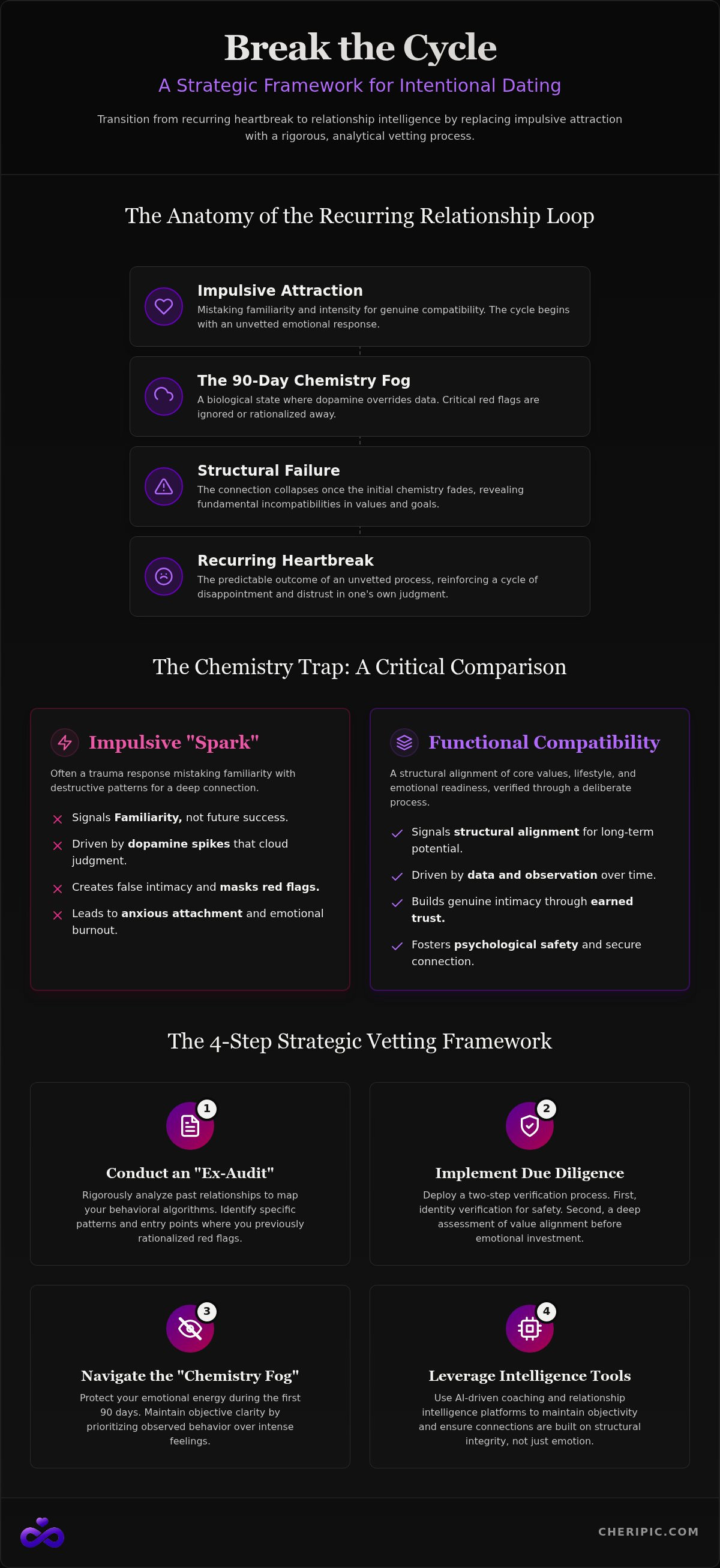
Relationship mistakes are rarely isolated incidents of bad luck. They are systemic failures in your vetting architecture. When you find yourself in a familiar cycle of disappointment, it's often because the initial selection process lacked the necessary due diligence. Most individuals, including those with high professional intelligence, fall victim to the "90-day chemistry fog." This biological state prioritizes dopamine over data, effectively blinding you to critical red flags until emotional investment is already established. You don't see the person; you see the projection. Learning how to stop repeating relationship mistakes starts with acknowledging that your current vetting system is compromised by this early-stage neurochemistry.
Relationship Intelligence is the disciplined ability to apply logic and verification to emotional connections before they become commitments. By shifting from a passive victim narrative to a Relationship Architect mindset, you reclaim agency over your romantic outcomes. You are no longer waiting for "the one" to appear by chance. Instead, you are actively auditing the structural integrity of every potential connection.
Why Experience Doesn't Always Lead to Wisdom
Many believe that suffering through bad relationships automatically builds wisdom. In reality, repeating these patterns can reinforce neural pathways that make unhealthy dynamics feel familiar and, by extension, safe. This is often linked to the psychological concept of repetition compulsion, where individuals unconsciously seek out partners who mirror past traumas in a futile attempt to fix the outcome. This loop is fueled by unmapped behavioral algorithms, which are internal scripts that dictate your partner choices without your conscious consent. Once you are invested, the sunk cost fallacy takes hold. You stay not because the connection is functional, but to justify the time and energy already spent. Understanding how to stop repeating relationship mistakes requires disrupting these algorithms with objective assessment.
The Cost of Romantic Inefficiency
The price of dating without a strategy is high. It exacts an emotional and temporal tax that drains your capacity for genuine connection. Traditional swiping culture rewards superficiality and rapid-fire engagement, which is the antithesis of functional compatibility. It prioritizes the "spark" over alignment in values, lifestyle, and emotional readiness. This inefficiency is why dating app fatigue has reached a peak in 2026. To move beyond this chaos, you must adopt a higher standard. Transitioning to a relationship intelligence platform allows you to replace luck with data-driven clarity. This strategic framework ensures that your emotional energy is shared only with those who have passed a rigorous verification process, effectively ending the cycle of romantic inefficiency.
The Chemistry Trap: Familiarity vs. Functional Compatibility
The biological drive for a "spark" is often a physiological siren song. It frequently signals familiarity rather than future success. For many, this intense attraction is actually the nervous system recognizing a familiar, yet destructive, pattern from the past. Understanding this distinction is vital for anyone learning how to stop repeating relationship mistakes. True functional compatibility is not a fleeting feeling; it's a structural alignment in values, lifestyle, and emotional readiness. It's the difference between a house built on aesthetic appeal and one built on a reinforced foundation.
Healthy excitement builds over time as trust is earned. In contrast, immediate intensity often masks anxious attachment. This masquerade creates a false sense of intimacy that bypasses necessary vetting. By utilizing personalized relationship insights, you can identify these biological traps before they compromise your judgment. Recognizing the difference between a genuine connection and a trauma response is the hallmark of a mature dater.
Deconstructing the 'Spark' Myth
Immediate intensity is rarely a sign of a soulmate-level connection. Often, it's a red flag indicating a lack of boundaries or an avoidant-anxious dance. A "slow-burn" approach allows for genuine due diligence rather than relying on dopamine spikes that cloud the intellect. During the first 30 days, cognitive biases like the halo effect or confirmation bias lead us to ignore glaring inconsistencies. We see what we want to see. Slowing down the process forces these red flags into the light, allowing your logic to catch up with your physiology. It's about choosing clarity over the chaos of an unvetted "spark."
The Value Alignment Audit
Long-term stability rests on non-negotiable pillars that must be evaluated early. These include:
- Financial Philosophy: How capital is managed, saved, and shared across the partnership.
- Conflict Style: The ability to navigate disagreement with emotional intelligence rather than volatility.
- Family Vision: Clear alignment on children, domestic roles, and long-term lifestyle goals.
These pillars must be verified before emotional intimacy is fully granted. Relationship Due Diligence is not a cold or clinical act. It is a professional necessity for your long-term psychological safety. Treating your partner selection with the same rigor as a high-stakes investment ensures that you build on solid ground. For those ready to apply this level of precision, exploring a strategic compatibility assessment can be the first step toward a more intentional romantic future. Knowing how to stop repeating relationship mistakes requires this fundamental shift from luck to logic.
Auditing Your History: Mapping Your Behavioral Algorithms
Introspection is a structural requirement for any Relationship Architect. To understand how to stop repeating relationship mistakes, you must first map your history with the precision of a forensic auditor. This process, which we define as an "Ex-Audit," moves beyond the superficial narrative of being "unlucky in love." It requires you to identify the recurring character traits and behavioral markers present in your past partners. By documenting these common denominators, you begin to see the unmapped algorithms that have governed your previous selections. You aren't just looking at who they were; you're looking at why you chose them.
A critical component of this audit is identifying the "Entry Point." This is the specific moment in a past relationship where a red flag was either ignored, rationalized, or minimized. Perhaps it was a subtle inconsistency in their story or a boundary that was tested early on. Recognizing these entry points allows you to see where your vetting process failed. It's also essential to track your own emotional state during the selection phase. Were you seeking validation, escaping loneliness, or acting out of a scarcity mindset? Patterns of emotional vulnerability often dictate the quality of partners we invite into our lives. For those seeking objective clarity, an AI relationship coach can provide data-driven feedback that identifies these destructive loops before they repeat.
Identifying Your 'Selection Algorithm'
To begin your audit, list the top three dominant traits of your last three partners. You will likely find a common denominator that reveals your unconscious selection criteria. This exercise is only effective if you are auditing real, verified data. Identity and Profile Verification ensures you are assessing the actual character of an individual rather than a curated persona. CheriAI identifies destructive patterns that the human brain overlooks by analyzing behavioral data points and highlighting inconsistencies that suggest a lack of long-term compatibility. This level of intelligence turns vague intuition into actionable insight.
From Pattern Recognition to Pattern Interruption
Pattern Interruption is the intentional act of choosing a partner who deviates from your usual "type" in favor of functional compatibility. This shift is often uncomfortable. To a brain addicted to the high-intensity chaos of unstable dynamics, a healthy, consistent partner might initially feel "boring." This isn't a lack of chemistry; it's the sensation of psychological safety. You must learn to distinguish between the "spark" of anxiety and the steady warmth of alignment. Clarity is a prerequisite for change. Once you have mapped your old algorithms, you can consciously choose to install a new, more intelligent framework for connection. Understanding how to stop repeating relationship mistakes is ultimately about prioritizing your long-term success over fleeting, familiar excitement.
The Strategic Vetting Framework: Implementing Relationship Due Diligence
Vagueness is the enemy of stability. To truly master how to stop repeating relationship mistakes, you need a structured, repeatable vetting framework that moves beyond intuition. This is the implementation of relationship due diligence. It's a methodology that ensures your emotional capital is only shared with those who meet a high standard of structural integrity. By following a deliberate sequence of evaluation, you remove the guesswork from partner selection.
The framework consists of five non-negotiable steps designed to protect your psychological safety:
- Step 1: Identity and Profile Verification. You must ensure the person is who they claim to be before a physical meeting occurs. This eliminates trust gaps from the outset.
- Step 2: Value Alignment Assessment. Engage in early-stage questioning regarding core life pillars like financial philosophy and family vision.
- Step 3: Behavioral Observation. Monitor the consistency between their words and actions over a 30-day period. Consistency is the only reliable metric for character.
- Step 4: Emotional Readiness Audit. Verify if the partner is truly "available" or merely "present." Presence is physical; availability is the capacity for deep, unencumbered connection.
- Step 5: The 'Clarity Pause.' Implement a mandatory reflection period before escalating commitment. This allows the "chemistry fog" to clear so you can evaluate the data objectively.
The Power of Verification
Trust is not a gift; it is a result of verified consistency. In the modern dating landscape, "trust but verify" is the only healthy stance for a Relationship Architect. Verification tools eliminate the anxiety of the unknown, creating a baseline of psychological safety before you share your time or energy. By utilizing Identity and Profile Verification, you automate the heavy lifting of due diligence. This allows you to focus on the nuance of connection rather than the stress of potential deception. Verification isn't about suspicion. It's about establishing a foundation where trust can actually grow.
Setting the 'Intelligence' Standard
Communicating your vetting process isn't an interrogation. It's a sign of high value. When you are upfront about your standards, you naturally attract other high-intelligence partners who value intentionality. Conversely, this approach repels low-effort actors who thrive on ambiguity. To verify character without sounding clinical, use these three due diligence questions:
- "How do you typically navigate a values-based disagreement?"
- "What does emotional availability look like in your current life stage?"
- "How have your past relationship patterns informed your current selection criteria?"
These inquiries reveal the depth of a partner's self-awareness and their capacity for the structural integrity required in a long-term connection. Understanding how to stop repeating relationship mistakes is as much about the questions you ask as it is about the answers you are willing to accept. It requires a commitment to logic over the fleeting comfort of the familiar.
The Future of Connection: Relationship Intelligence in 2026
The cultural zeitgeist of 2026 marks a definitive departure from "Swiping Culture" toward a more rigorous "Intelligence Culture." For years, digital dating focused on volume and superficial metrics, leading to the profound emotional burnout many feel today. We've now entered an era where the primary focus is on the structural integrity of a connection before it ever begins. This evolution is essential for those seeking how to stop repeating relationship mistakes, as it replaces the chaotic lottery of the swipe with a methodical, data-driven approach. You aren't just looking for a partner; you're engaging in a high-level architectural project that requires precise blueprints and verified materials.
AI-driven insights serve as a "Clarity Coach," providing a stabilizing force that prevents relapses into old, destructive patterns. While the human brain is often clouded by biological imperatives and the "chemistry fog," an intelligent system remains objective. It analyzes compatibility through a lens of long-term success rather than fleeting excitement. By viewing your romantic life as a project worthy of high-level architecture and strategic investment, you graduate from the uncertainty of "luck" to the certainty of "intentionality." CheriPic stands as the definitive platform for this transition, offering the tools necessary to manage your emotional energy with the same due diligence you'd apply to a professional career.
Leveraging Technology for Emotional Success
Technology shouldn't just facilitate more messaging; it should enhance the quality of human interaction. CheriAI acts as a stabilizing force in a chaotic emotional landscape, filtering out low-effort actors and ensuring that your time is only shared with verified, compatible individuals. This shift allows for a move away from endless digital noise and toward real-world experiences that foster genuine connection. Whether it's through curated wellness retreats or exclusive, intentional events, the focus remains on depth and psychological safety. To begin this journey toward data-driven romantic clarity, consider joining the CheriPic Early Access Membership. It's the first step in reclaiming control over your interpersonal future.
The Architecture of a Permanent Shift
Achieving a permanent shift in your romantic outcomes requires a fundamental change in your internal system. If you want to know how to stop repeating relationship mistakes, you must stop changing the partner and start changing the vetting algorithm. Quality over quantity is the hallmark of Relationship Intelligence. It's better to have zero connections than one that compromises your values or safety. Your emotional energy is your most valuable non-renewable asset. Treat it with the reverence it deserves by refusing to share it with anyone who hasn't passed a rigorous standard of verification. You are the architect of your future; build it with intention.
Mastering Your Romantic Architecture
Breaking the cycle of recurring heartbreak requires a fundamental shift from impulsive attraction to intentional vetting. By auditing your history and mapping your behavioral algorithms, you gain the clarity needed to identify systemic failures before they repeat. True success in 2026 relies on prioritizing functional compatibility and structural integrity over the fleeting "chemistry fog." Understanding how to stop repeating relationship mistakes is a commitment to your long-term psychological safety; it's about treating your emotional energy as a high-value asset that requires rigorous due diligence.
You don't have to navigate this transition alone. CheriPic provides the strategic framework you need, featuring AI-driven pattern recognition via CheriAI and mandatory identity and profile verification to eliminate trust gaps. You'll join an exclusive community of intentional, high-value singles who prioritize quality and verification over superficial engagement. Secure Your Romantic Future: Join the CheriPic Early Access Membership. Your romantic future is no longer a matter of luck; it's a project you are now equipped to lead with confidence and precision.
Frequently Asked Questions
Why do I keep dating the same 'type' even when they are bad for me?
You likely date the same "type" because your nervous system misinterprets familiarity for safety. This is a psychological drive where you unconsciously seek to resolve past dynamics by recreating them with new partners. Breaking this cycle requires you to map these behavioral algorithms and prioritize functional compatibility over the initial "spark." Without intentional intervention, your brain will continue to default to these familiar, yet destructive, patterns.
How can I tell if I'm repeating a relationship mistake in the first few dates?
You can identify recurring errors by monitoring the pace of the connection and the consistency of the partner's behavior. If you feel an immediate, overwhelming intensity, it's often a signal that boundaries are being bypassed. Learning how to stop repeating relationship mistakes involves implementing a "Clarity Pause" to evaluate data before emotional investment clouds your judgment. Watch for early rationalizations of inconsistent behavior.
Is it possible to change my 'selection algorithm' after years of bad choices?
Yes, you can recalibrate your selection criteria through deliberate pattern interruption and structured vetting. While your initial instincts may still point toward old "types," you can use logic to override these impulses. By treating partner selection as a strategic investment, you install a new system that prioritizes long-term psychological safety. This shift requires moving from a passive mindset to that of a Relationship Architect.
What is the difference between chemistry and toxic intensity?
Chemistry is an earned sense of resonance that builds over time, whereas toxic intensity is an immediate, destabilizing force. Toxic intensity often feels like a "high" because it triggers an anxious attachment response rather than genuine connection. True chemistry allows for a slow burn. It gives you the space to perform due diligence without the pressure of manufactured urgency or premature emotional intimacy.
How does an AI relationship coach help identify patterns I can't see?
An AI relationship coach provides an objective, analytical perspective that is unencumbered by your neurochemistry or cognitive biases. It identifies subtle behavioral markers and inconsistencies in data that the human brain often rationalizes away. This allows for precise pattern recognition. It helps you visualize the structural risks in a potential connection before you become emotionally entangled in a familiar, failing loop.
Can a relationship intelligence platform really improve my dating life?
A relationship intelligence platform improves your outcomes by replacing the randomness of swiping with a rigorous vetting architecture. It provides the tools for identity verification and value alignment assessments, ensuring you only engage with high-value, intentional individuals. This strategic approach is the most effective way to learn how to stop repeating relationship mistakes and secure a stable, long-term future built on verified trust.
What are the most common relationship red flags people ignore?
The most frequently ignored red flags include a lack of accountability for past actions and inconsistent communication patterns. People often rationalize these markers as "misunderstandings" or temporary stress during the early stages. However, these are often systemic indicators of low emotional readiness. Strategic vetting ensures you recognize these structural failures during the initial observation period before you escalate your level of commitment.


