

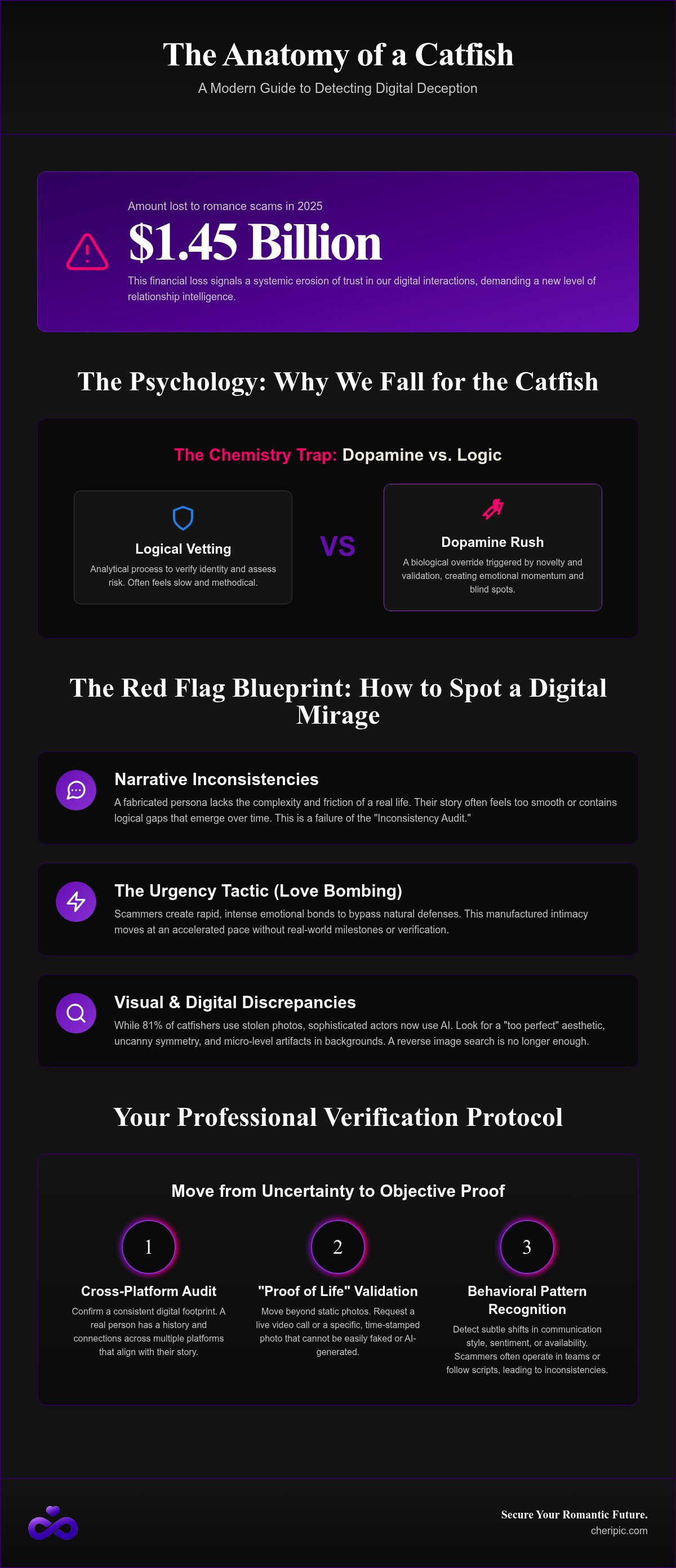
In 2025, romance scams extracted a staggering $1.45 billion from individuals searching for genuine connection. This figure represents more than just financial loss; it signals a systemic erosion of trust in our digital interactions. You've likely experienced the anxiety of wondering if a promising connection is actually a carefully constructed mirage. It's exhausting to invest weeks of emotional energy only to realize the person on the other side of the screen doesn't exist. Understanding how to know if you are being catfished is no longer an optional skill. It's a necessary component of modern relationship intelligence.
This guide moves past basic red flags to provide a sophisticated analytical framework for detecting digital deception. We'll replace uncertainty with objective proof and gut feelings with a repeatable vetting protocol. You'll learn to identify the subtle behavioral patterns used by sophisticated scammers and leverage professional-grade tools to verify identity. By the end of this exploration, you'll possess the clarity needed to protect your emotional assets and engage with digital platforms with uncompromising confidence.
Key Takeaways
- Understand the biological "chemistry trap" where dopamine overrides logic, and learn to maintain analytical clarity during early digital interactions.
- Identify specific narrative inconsistencies and visual anomalies that reveal how to know if you are being catfished, even when scammers use sophisticated AI tools.
- Implement a professional-grade verification protocol using cross-platform data and "proof of life" validation to confirm identity before any emotional investment occurs.
- Leverage behavioral pattern recognition and CheriAI coaching to detect subtle communication shifts and sentiment irregularities that signal potential deception.
- Establish a high-value verification standard for your romantic future, prioritizing psychological safety and intentionality over the unvetted chaos of traditional platforms.
The Psychology of Deception: Why We Fall for the Catfish
Digital deception is a calculated strategy, not a random occurrence. Within the framework of relationship intelligence, we must move beyond the basic definition of catfishing to understand it as a sophisticated failure of vetting. It's an intentional disruption of your emotional security. Learning how to know if you are being catfished is the first step in reclaiming your digital agency. To protect yourself, you must first acknowledge that your own biology might be working against you.
Dopamine is a powerful neurotransmitter. It rewards the brain for novelty and perceived connection. When a digital persona mirrors your values or offers immediate validation, your logical vetting process often shuts down. This is the 'Chemistry Trap.' It creates a psychological blind spot where red flags are minimized in favor of emotional momentum. You aren't being fooled because of a lack of intelligence. You're experiencing a biological override of your analytical faculties.
Sophisticated actors frequently target high-achieving professionals. These individuals often prioritize efficiency and seek high-value partners who appear to share their lifestyle and professional demands. Scammers exploit this by constructing personas that mimic the markers of professional success. They use shared social vocabulary to bypass initial skepticism. This marks a necessary shift in our approach. We must move from luck-based dating to a model of strategic connection architecture where verification is the foundation.
The Trust Gap in Modern Dating
By 2026, the proliferation of AI-generated personas has made traditional intuition insufficient. Deception has reached a professional grade. Finding objective answers on how to know if you are being catfished now requires more than a gut feeling. It demands a protocol of 'trust but verify.' This is the only sustainable strategy for maintaining psychological safety. Without a structured verification process, you're essentially gambling with your emotional health.
The Cost of Emotional Misinvestment
Your time is your most valuable non-renewable asset. Every hour spent engaging with a fabricated identity is an hour stolen from a genuine connection. This misinvestment does more than waste time; it erodes your relational intelligence. It creates a cycle of skepticism that can hinder future authentic interactions. If you find yourself repeatedly ignoring your intuition, it's time to analyze the underlying patterns. You can explore this further in our guide on Why I Ignore Red Flags: The Psychology of Romantic Blindness and How to Fix It. Protecting your emotional energy requires a commitment to due diligence.
The Red Flag Blueprint: How to Know if You Are Being Catfished
Detecting digital deception requires a shift from emotional reaction to analytical observation. Understanding how to know if you are being catfished starts with the "Inconsistency Audit." This is a methodical process of tracking a person's narrative over time to identify logical gaps. A fabricated persona lacks the friction and complexity of a real life. While 81% of those who catfish use stolen photos, modern actors are increasingly sophisticated, often utilizing AI to create entire lifestyles. You must look for the seams in their story. Genuine connection is built on a foundation of verifiable truth, not just shared interests.
Deception often relies on the "Urgency Tactic." Scammers use love bombing to create a rapid, intense emotional bond that bypasses your natural defenses. This manufactured intimacy is designed to make you feel special, yet it lacks the steady progression of genuine intentionality. If a connection feels like it's moving at an accelerated pace without real-world milestones, it's a signal to pause. You can find comprehensive resources on how to spot a catfish from the eSafety Commissioner to help calibrate your internal radar. High standards for communication are your best defense against these psychological maneuvers.
Visual and Digital Footprint Discrepancies
In the age of deepfakes, a reverse image search is no longer sufficient. AI-generated imagery often possesses a "too perfect" aesthetic, featuring uncanny symmetry or micro-level artifacts in the background. Beyond the visuals, look for a "Ghost Footprint." It is statistically improbable for a high-achieving professional to have zero external presence on LinkedIn, professional boards, or social archives. A lack of digital history is a significant behavioral anomaly. Utilizing basic Open Source Intelligence (OSINT) techniques to verify professional claims is a standard part of modern relationship due diligence.
Behavioral Anomalies and Avoidance
The "Video Call Veto" remains the most consistent indicator of deception. Scammers frequently offer technical excuses or tragic backstories to avoid real-time visual validation. If a person refuses to engage in a video call with specific "proof of life" actions, the connection is compromised. Observe how they react to your boundaries. A catfish will often meet a request for verification with defensiveness or guilt-tripping. For those who prioritize safety, leveraging identity and profile verification ensures that you are engaging with a verified individual from the very first interaction. Clarity is the antidote to deception.
Digital Due Diligence: A Professional Protocol for Verification
In the digital landscape of 2026, a simple selfie is no longer a valid metric for identity. Sophisticated deception requires an equally sophisticated response. Implementing a professional protocol is the most effective way to address the question of how to know if you are being catfished before deep emotional bonds form. This process isn't about cynicism; it's about exercising the same due diligence you'd apply to a high-stakes business investment. You're protecting your most valuable non-renewable asset: your time.
The first step involves cross-platform verification. A legitimate professional identity usually leaves a trail across LinkedIn, industry boards, or official registries. If a person claims a high-level role but possesses no digital history, the narrative is compromised. Move quickly to real-time validation. A video call is mandatory, but it must include specific "proof of life" actions. Ask them to move to a different room or hold up a specific, everyday object. These micro-interactions are difficult for deepfake software to replicate in real time and provide immediate clarity.
Pay close attention to the "Vibe Shift" when you request these steps. A transparent individual who values safety will understand the need for verification. A catfish, however, often responds with defensiveness, guilt, or a sudden "emergency" that prevents the call. This behavioral pivot is a data point in itself. To remove personal bias and the "Dopamine Cloud," utilize third-party verification tools. These systems provide an objective layer of security, allowing you to focus on compatibility rather than basic identity proofing.
Manual Vetting Techniques
For those performing manual due diligence, use advanced search operators to find unlinked profiles or mentions in local news. Verifying professional credentials through official state or industry registries is a standard practice for high-achieving individuals. This level of scrutiny ensures that the person's external claims align with reality. Establishing this foundation is essential for The Architecture of a Healthy Relationship, where honesty is a non-negotiable structural component.
The Strategic Advantage of Verified Platforms
Manual vetting is often a high-effort, low-yield activity that can lead to burnout. It forces you to act as a private investigator rather than a partner. Transitioning to a verified environment restores the "Trust Baseline" immediately. By choosing platforms that mandate identity verification, you ensure that every interaction starts from a place of confirmed truth. This shift allows for a more intentional approach to connection, as detailed in our guide on The Strategic Standard: Choosing a Dating App with Identity Verification in 2026. Quality begins with verification.
From Data to Behavior: Pattern Recognition with CheriAI
Catfishing is often viewed as a singular event, but it is actually a predictable pattern of behavior. While manual vetting checks for static facts, AI-driven analysis monitors dynamic interactions. This is the next evolution in understanding how to know if you are being catfished. By utilizing CheriAI, you move from reactive suspicion to proactive intelligence. It identifies the "Catfish Archetype" by cross-referencing communication frequency with known scripts of deception. This level of analysis provides a stabilizing force in an otherwise chaotic emotional landscape.
The "Dopamine Cloud" often prevents us from seeing subtle shifts in tone or sentiment. Objective clarity is required to maintain your standards. AI removes the emotional bias that naturally occurs during early-stage attraction. It provides a data-driven mirror, reflecting the reality of the interaction rather than the fantasy created by a sophisticated actor. You can begin this process by securing CheriPic Early Access Membership to experience a higher standard of verified connection. High-achieving individuals understand that strategic investment requires the best available data.
AI-Driven Pattern Recognition
Human intuition is often compromised by the desire for connection. AI, however, excels at detecting "Love Bombing" scripts through rigorous linguistic analysis. It identifies narrative inconsistencies that a human might overlook in the heat of a conversation. By analyzing sentiment and response latency, the AI Relationship Coach: Data-Driven Romantic Clarity and Pattern Recognition identifies destructive patterns before they result in emotional loss. It provides a structural assessment of the interaction, ensuring your investment is based on reality. Decisions become methodical rather than impulsive.
Quantifying Compatibility
Once identity is verified, the focus must shift from "Are they real?" to "Are we aligned?". High-value connections require more than just the absence of deception. They require deep value alignment and structural integrity. The CheriPic approach uses a Relationship Compatibility Assessment: The Strategic Guide to Romantic Due Diligence to quantify core values and long-term goals. This methodical vetting ensures that your emotional energy is directed toward individuals who meet your specific standard of quality. True relationship intelligence is about finding the right connection, not just any connection. It's about long-term success over fleeting excitement.
Securing Your Romantic Future: Implementing a Standard of Quality
Transitioning from digital vetting to real-world connection requires a deliberate shift in strategy. Once you've mastered the mechanics of how to know if you are being catfished, your focus must move toward creating curated experiences. Vetting isn't a hurdle; it's a foundation. High-achieving individuals understand that a connection's quality is directly proportional to the integrity of its starting point. By implementing a personal verification standard, you ensure that your emotional energy is invested only in individuals who meet your specific criteria for maturity and transparency.
Membership-based communities offer a significant return on investment compared to open, unvetted platforms. The presence of a verification requirement acts as a natural filter for intentionality. It discourages the low-effort, high-deception behavior prevalent on traditional apps. This method provides a definitive answer to how to know if you are being catfished by removing the possibility of unverified profiles entirely. In a verified environment, the baseline of trust is established before the first message is sent, protecting both your emotional well-being and your professional reputation.
Communicating Your Standards Gracefully
High-value individuals respect boundaries. When you frame verification as a mutual benefit for safety and quality, you're signaling your own standards. A simple request for a real-time video validation shouldn't be treated as an interrogation. It's a professional-grade assessment of compatibility. If a potential partner responds with defensiveness or guilt-tripping, they've provided you with a final, definitive red flag. A high-quality match will appreciate your commitment to due diligence because it protects them as much as it protects you. Transparency is a hallmark of a healthy connection.
Joining the Verified Elite
The future of relationship intelligence lies in intentionality over endless swiping. We're moving toward a model where identity verification and behavioral analysis are the standard, not the exception. CheriPic is designed for those who refuse to compromise on their psychological safety or their time. By prioritizing verified communities, you're choosing a path of clarity and long-term success. You can Secure Your Romantic Future with CheriPic Early Access and step into a curated environment where your connections are as real as your ambitions.
- Perform a narrative consistency audit over a minimum of 14 days to track logical gaps.
- Request a real-time video validation with a specific "proof of life" action.
- Verify professional claims via LinkedIn or official industry registries.
- Analyze their reaction to your request for verification as a behavioral data point.
- Confirm value alignment using a structured compatibility assessment before meeting.
Architecting a Future of Verified Connection
True relationship intelligence is the ability to distinguish between a manufactured fantasy and a genuine partner. By recognizing the biological "chemistry trap" and implementing a rigorous verification protocol, you protect your most valuable assets: your time and emotional energy. Mastering how to know if you are being catfished isn't just about security; it's about setting a high standard for your romantic life. You deserve a connection built on the structural integrity of confirmed truth rather than the uncertainty of digital mirages.
It's time to move beyond the unvetted chaos of traditional platforms. You can Secure Your Romantic Future with CheriPic Early Access. Our platform offers a 100% Identity Verified Community supported by CheriAI, which utilizes AI-driven pattern recognition to detect destructive behaviors. We prioritize intentionality through exclusive real-world experience booking, ensuring your journey leads to quality interactions. Step into a space where clarity is the standard and your safety is the foundation for lasting success.
Frequently Asked Questions
How can I tell if someone is using AI-generated photos?
Identifying AI-generated imagery requires looking for micro-level artifacts such as uncanny symmetry or distorted background elements. These photos often possess a "too perfect" aesthetic that lacks the natural friction of real-life environments. You should inspect for digital smoothing on skin textures or inconsistencies in earlobe and hair rendering. High-resolution displays can reveal these subtle digital markers that sophisticated software often misses during the generation process.
Is it rude to ask someone to verify their identity early on?
Requesting verification is a standard of quality, not an act of rudeness. High-value individuals prioritize psychological safety and respect the implementation of boundaries. Framing this request as a mutual benefit ensures that both parties feel secure in their investment. If a connection reacts with defensiveness or guilt, they've demonstrated a lack of emotional maturity or a potential for deception. Due diligence is a sign of self-respect.
What are the most common excuses catfish use to avoid video calls?
Catfish typically utilize tragic backstories or technical failures to avoid visual validation. Common scripts include broken smartphone cameras, sudden family emergencies, or high-security professional roles that supposedly prohibit video transmission. These excuses are designed to maintain the "Dopamine Cloud" while bypassing "proof of life" requirements. If a person consistently vetoes real-time communication, the connection is compromised and requires an immediate cessation of emotional energy.
Can a catfish have a LinkedIn profile or professional history?
Sophisticated scammers often fabricate professional histories by scraping data from legitimate LinkedIn profiles. They create "Ghost Footprints" that mimic the markers of success to bypass initial skepticism from high-achievers. A professional profile alone is not a guarantee of identity. You must cross-reference their claims with official registries or industry boards. Verify that their digital history has the depth and friction expected of a person in their stated position.
What should I do if I suspect I am currently being catfished?
If you suspect deception, cease all emotional and financial investment immediately. You must implement a protocol for how to know if you are being catfished by requesting a real-time video call with a specific "proof of life" action. If the individual refuses or becomes defensive, disconnect the connection. Reporting the profile is a necessary step to protect the broader community from professional-grade predators and maintain the integrity of the platform.
How does identity verification actually work on relationship platforms?
Identity verification on relationship intelligence platforms involves a multi-layered process of government ID validation and biometric facial recognition. This creates a "Trust Baseline" by ensuring the digital persona matches the physical individual. Unlike traditional apps, this standard is a core requirement for participation. It removes the high-effort burden of manual vetting, allowing members to focus on assessing values and compatibility rather than basic identity proofing.
What is the difference between a background check and relationship intelligence?
A background check is a static report of historical data; relationship intelligence is a dynamic analysis of behavioral patterns. Tools like CheriAI provide a data-driven mirror of your interactions, highlighting sentiment shifts and communication red flags. This helps you understand how to know if you are being catfished by identifying linguistic scripts used in deception. It focuses on future emotional safety rather than just past records.
Why do catfish target professionals and high-achievers?
Scammers target high-achievers because these individuals often possess significant assets and prioritize efficiency in their personal lives. Catfish exploit the professional's desire for a partner who mirrors their lifestyle and values. By constructing a persona that mimics professional success, they bypass the due diligence process that a high-achiever might otherwise apply. They rely on the "Chemistry Trap" to override the analytical faculties of even the most intelligent victims.


